
The Ultimate Guide to Sales Automation for Manufacturers: Accelerating the Inquiry-to-Order Pipeline

Sales automation for manufacturers streamlines complex B2B sales cycles by using AI and software to automate lead qualification, RFQ routing, and multi-round quote follow-ups. Manufacturers and exporters should adopt it when manual processing of technical inquiries leads to slow response times and lost global revenue.
Traditional manufacturing sales operations are notoriously slow. In an era where overseas buyers demand rapid, transparent communication, relying on manual calculations and outdated communication methods can cost you massive global contracts. Modernizing your pipeline with sales automation for manufacturers is no longer a luxury—it is an essential growth driver.
The Cost of Manual Bottlenecks in B2B Manufacturing Sales
B2B industrial buyers frequently face frustrating wait times when requesting custom quotes. In complex industries—such as electrical distribution, heavy machinery, and precision mold manufacturing—the standard sales process is plagued by manual friction.
Sales representatives spend up to 70% of their day sorting through unrefined inquiries rather than closing deals. Without proper lead qualification for manufacturers, low-value or incomplete inquiries crowd out high-potential contracts. For instance, solar equipment exporters and precision component suppliers often waste critical days qualifying leads that do not fit their production parameters.
Furthermore, when a technical specification is incomplete, back-and-forth communication delays pricing by several business days. In global manufacturing markets, speed is a major competitive advantage; the exporter that quotes first is often the one that wins the contract.
What Is Sales Automation for Manufacturers and How Does It Work?
At its core, sales automation for manufacturers is the integration of intelligent software engines into the end-to-end commercial workflow. Instead of treating the customer journey as a series of disconnected emails, automation acts as a continuous bridge between incoming demand and your internal manufacturing capabilities.
By leveraging B2B sales process automation, manufacturers can build structured intake channels. When a global distributor submits a pricing request on your website, the system automatically parses the attachment, extracts technical dimensions or bill-of-materials (BOM), and cross-references them with real-time material inventory and capacity.

Rather than forcing human sales reps to manually input data into a static CRM, the automation platform automatically classifies the deal size, assesses production fit, and drafts a preliminary quote. This minimizes raw data entry, ensuring that your team spends time optimizing technical specs and building trust rather than copying text from PDFs.
Traditional CRM Workflows vs. AI-Powered Sales Automation
Traditional Customer Relationship Management (CRM) tools function primarily as static databases. They require manual upkeep, constant data logging, and rely on human memory for multi-round follow-ups. In contrast, modern sales automation for manufacturers uses proactive AI agents that operate as autonomous digital teammates.
Process Step | Traditional CRM Workflow | AI-Powered Sales Automation |
|---|---|---|
:--- | :--- | :--- |
Inquiry Receipt | Rep manually opens email, reads PDF specs, and copies details into CRM. | AI parses incoming email and files; auto-extracts BOM and specifications. |
Lead Qualification | Rep guesses buyer potential based on email signature or company website. | Automatic lead qualification for manufacturers via firmographic & intent analysis. |
RFQ Routing | Emails are forwarded manually, leading to internal communication delays. | High-value, complex RFQs are instantly routed to matching technical engineers. |
Quote Follow-up | Rep relies on calendar reminders, often missing follow-up dates. | Active AI agents execute multi-round, highly personalized quote follow-ups. |
By employing dedicated AI sales agents for manufacturing, companies can scale their technical sales outreach across multiple time zones. These digital agents maintain context-aware communication 24/7, keeping overseas buyers warm while managing complex technical queries based on product knowledge databases.
Setting Human-in-the-Loop Boundaries for Complex RFQs and Quotes
One of the most common concerns regarding automation in industrial sales is accuracy. In manufacturing, quoting the wrong material or underestimating production costs can lead to devastating margin erosion. This is why high-performing organizations rely on a hybrid "Human-in-the-Loop" model.
Implementing manufacturing RFQ automation does not mean removing your expert sales engineers. Instead, the AI functions as an intelligent copilot. For standard, highly recurring items, the system can fully automate quotes. For custom, multi-component assemblies, the system executes the heavy lifting: extracting technical requirements, checking raw material prices, and drafting the pricing structure.
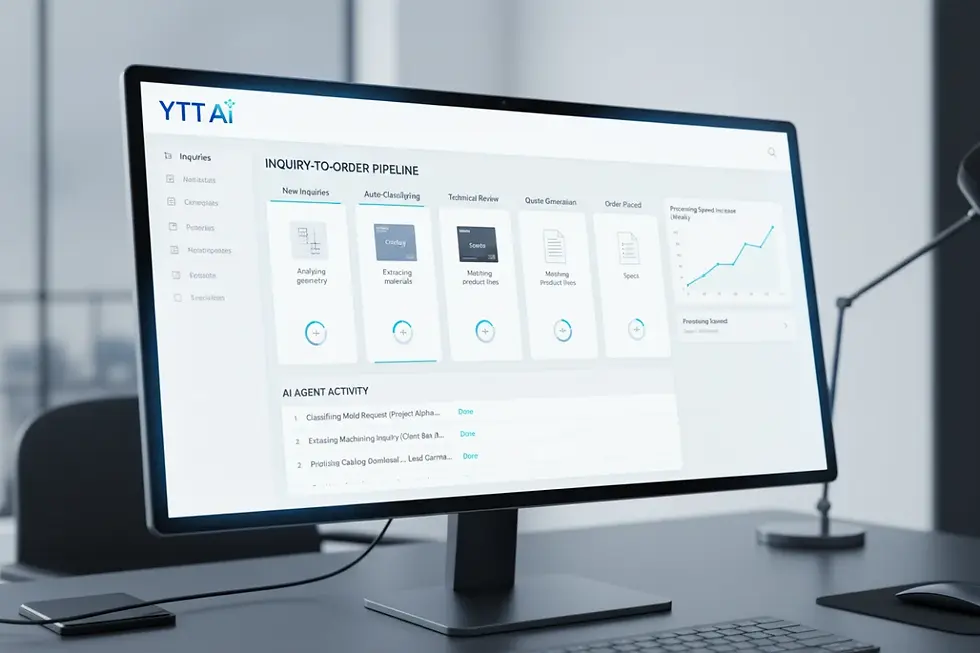
Once the draft quote is compiled, a senior engineer reviews, adjusts, and approves it before it is dispatched to the client. This dual approach guarantees that your quotes are delivered in record time while preserving absolute technical precision and margin security.
Step-by-Step Implementation Roadmap for Global B2B Exporters
Transitioning to automated sales operations is highly effective when executed in structured phases over a 90-day horizon:
Phase 1: Standardize the Intake Channel (Days 1-30) Define the standard input formats for custom specifications, drawings, and BOMs. Integrate your web-based RFQ forms and incoming mailbox with an extraction engine to eliminate manual data entry.
Phase 2: Deploy Lead Scoring and Rules-Engine (Days 31-60) Activate automated qualification models that score deals based on production volume, technical complexity, buyer region, and budget compatibility. High-priority inquiries should bypass standard queues directly to specialized sales reps.
Phase 3: Integrate Multi-Round Follow-Ups and AI Agents (Days 61-90) Launch AI-driven follow-up workflows. When quotes are delivered to international clients, configure the system to trigger context-aware email nudges across various intervals, ensuring no global pipeline leaks due to time-zone latency.
Key Performance Indicators (KPIs) for Manufacturing Sales Automation
To ensure your implementation of sales automation for manufacturers translates to concrete business growth, track these primary performance metrics:
Inquiry-to-Quote Turnaround Time: Measure the duration from when an RFQ is received to when the final quote is delivered. Automation routinely reduces this metric from days to mere minutes.
Pipeline Velocity: Monitor how rapidly a qualified lead advances from initial qualification to a closed-won purchase order.
Sales Rep Productivity: Calculate the ratio of active selling time versus administrative tasks. A reduction in copy-paste manual CRM logging is a primary sign of success.
Inquiry Conversion Rate: Track the percentage of incoming website or email inquiries that successfully convert into paid manufacturing orders.

By continuously measuring these metrics, operational leaders can systematically isolate remaining bottlenecks and refine their AI rules to maximize high-margin pipeline throughput.
Driving Global Growth with YTTAI
For global B2B manufacturers and exporters, capturing overseas market share requires rapid, intelligent, and standardized sales execution. YTTAI provides world-class AI sales and overseas growth solutions specifically tailored for industrial organizations, machinery builders, and precision manufacturers. Our flagship Sales Master suite works alongside your sales team to handle multi-lingual lead qualification, technical RFQ extraction, and proactive multi-round follow-ups, transforming complex inquiry pipelines into highly predictable revenue engines.
Stop losing high-value global orders to slow response cycles and operational bottlenecks. Ready to modernize your pipeline? Request an inquiry-to-order workflow audit to see how YTTAI can scale your manufacturing sales operations today.
FAQ
What is the difference between traditional CRM and sales automation for manufacturers?
Traditional CRMs serve primarily as static record databases that require manual input and constant updating by sales representatives. Sales automation for manufacturers uses proactive AI agents and intelligent software workflows to automate data extraction, perform automated lead qualification, and manage multi-round quote follow-ups without manual intervention.
How does manufacturing RFQ automation handle highly customized or complex designs?
It uses a hybrid 'Human-in-the-Loop' model. The automation engine parses the complex specifications, drafts the initial bill of materials (BOM), and estimates material costs. The technical sales engineer then reviews, adjusts, and approves the pre-calculated quote, combining AI speed with engineering precision.
Why is automated lead qualification critical for B2B exporters?
B2B exporters receive inquiries from multiple time zones and regions. Automated lead qualification instantly filters out low-potential queries, evaluates production feasibility against current capacity, and prioritizes high-value contracts, allowing the sales team to focus their immediate energy on the most profitable opportunities.


Comments