
Sales Memory Software for B2B Manufacturing: The Architectural Guide for Long-Cycle Teams

Executive Summary: Long sales cycles in industrial manufacturing frequently collapse during handoffs and multi-channel communications across email, WhatsApp, CAD revisions, and technical meetings. Modern commercial operations are transitioning from passive CRM logging to structured contextual persistence. This case study and architectural evaluation examines how institutional context retention reduces deal slippage, clarifies technical scope, and supports enterprise revenue consistency across multi-stakeholder procurement.
Company Snapshot: High-Stakes Capital Equipment in Discrete Manufacturing
To understand the operational demand for contextual data integrity, consider a mid-market industrial machinery manufacturer specializing in customized packaging automation and material handling systems. Operating across North America, Western Europe, and East Asia, the enterprise serves tier-1 automotive suppliers, contract pharmaceutical packaging firms, and multinational food processing operations.
The commercial model relies on high-order-value capital equipment, where single production lines range from $350,000 to upwards of $3 million. Sales cycles typically extend between six and eighteen months. Every potential transaction involves an expansive buying committee: plant operations directors, electrical controls engineers, procurement leads, maintenance supervisors, and corporate financial executives.
Commercial interactions in this environment do not unfold within a tidy, centralized inbox. Rather, they are dispersed across formal executive email exchanges, informal mobile messaging during on-site plant inspections, CAD drafting redlines, technical specification sheets, and external vendor procurement portals. The organization faced a structural challenge familiar to enterprise industrial companies: institutional memory was fragmented across regional sales reps' personal computers, disconnected email threads, and field notes, creating widespread deal slippage and preventable quoting errors.
What the Company Sells: Engineering Specifications and Multi-Tier Stakeholder Procurement
Industrial packaging lines are engineered-to-order capital goods rather than standard catalog components. Prospective enterprise buyers rarely issue a standard purchase order immediately after reading a brochure. Instead, they submit extensive Request for Quotation (RFQ) packages containing detailed facility constraints, line layout schematics, strict throughput tolerances, electrical standards, and formal Factory Acceptance Test (FAT) criteria.
The typical customer acquisition and engineering lifecycle progresses through several tightly coupled phases:
Technical Discovery and Site Assessment: Regional sales representatives and application engineers conduct plant walkthroughs, photograph mechanical bottlenecks, evaluate utility connections, and document physical line boundaries.
Iterative RFQ Scoping and Engineering Validation: Application engineers collaborate with the prospect's technical staff to define machine speeds, servo motor manufacturers, human-machine interface (HMI) configurations, and programmable logic controller (PLC) standards (such as Siemens or Rockwell Automation).
Commercial Structuring and Risk Allocation: Formal proposals are drafted, negotiated, and redlined. Commercial terms regarding delivery penalties, installation milestones, spare parts provisioning, and multi-year maintenance service level agreements (SLAs) are established.
Operational Kickoff and Factory Acceptance: Following commercial contract execution, the engineering and assembly departments take ownership of the project to build, program, test, and commission the machinery according to agreed specifications.
Because this process spans multiple quarters, critical commercial context frequently erodes. An objection raised by a third-shift plant manager over WhatsApp during an on-site visit regarding changeover speed might never reach the proposal engineer calculating the bill of materials (BOM). When institutional context fails to transfer between touchpoints, manufacturers encounter severe margin erosion, protracted sales cycles, and expensive post-installation disputes.
The Business Problem: Multi-Channel Information Decay and Knowledge Silos
Prior to modernizing its contextual architecture, the manufacturer experienced severe operational friction driven by three systemic vulnerabilities:
The Multi-Channel Context Black Hole: Technical data, commercial clarifications, and customer preferences were distributed across isolated communication silos. Informal agreements recorded in WhatsApp chats, technical exceptions documented in PDF email attachments, and verbal commitments made during plant floor walkthroughs were rarely transferred into the centralized system of record.
Vulnerability to Account Executive Turnover and Territory Reassignment: When senior sales representatives left the company or transitioned to new territories, years of accumulated nuance vanished. Historical pricing negotiations, past engineering compromises, unstated stakeholder preferences, and political dynamics within the buying account were permanently lost.
High Quoting Friction and Proposal Discrepancies: Quoting engineers were forced to assemble custom proposals using incomplete context. Lacking visibility into late-stage modifications requested during informal discussions, engineering departments repeatedly generated estimates based on obsolete specifications, forcing multiple time-consuming proposal revisions.
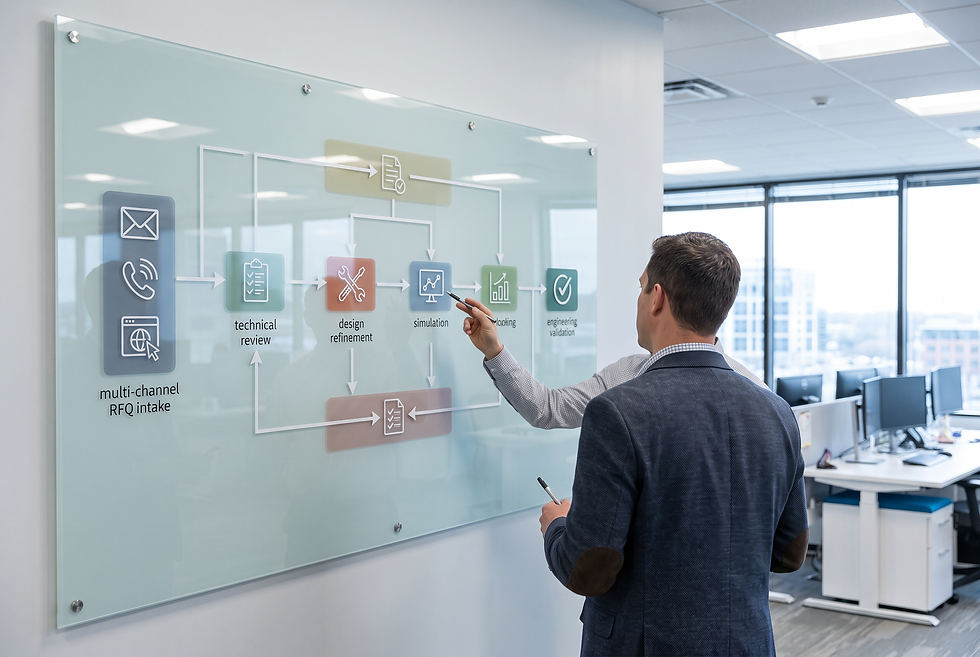
Traditional Customer Relationship Management (CRM) databases failed to resolve this breakdown. Legacy CRMs function as structured relational databases designed for sales management oversight rather than dynamic contextual retrieval engines. Field sales engineers viewed manual data entry as an unproductive administrative burden, frequently logging vague summaries like "Held technical review meeting with client engineering team" instead of detailing the exact motor specifications, voltage constraints, or factory acceptance criteria debated on the call.
What Changed: Deploying Sales Memory Software for B2B Manufacturing
To eliminate the operational risks of context fragmentation, the commercial leadership deployed specialized contextual retention infrastructure. Rather than demanding that engineers and commercial reps spend hours manually updating structured CRM forms, the organization integrated an intelligent data ingestion and memory layer.
The strategic shift focused on sales memory software for b2b manufacturing, which autonomously ingests, indexes, and correlates unstructured communications across email systems, mobile messaging platforms, meeting transcripts, and engineering documents. This technology establishes a continuously updating institutional memory layer that links every technical parameter, stakeholder objection, and pricing discussion directly to the corresponding deal record.
Instead of treating customer communication as ephemeral messages, the architecture converts every conversation into searchable, auditable institutional knowledge accessible across sales, estimating, engineering, and executive leadership teams.
How the Workflow Actually Works: The End-to-End Context Retention Pipeline
The modernized commercial process operates across six systematic steps that govern data ingestion, contextual synthesis, human verification, and operational execution:
Step 1: Multi-Channel Inbound and Outbound Ingestion: All customer-facing touchpoints—including inbound RFQ attachments, technical email threads, authorized enterprise WhatsApp communications, virtual conference recordings, and CAD layout notes—are continuously ingested into an encrypted, centralized data repository.
Step 2: Semantic Entity Mapping and Scope Extraction: The underlying processing engine parses unstructured conversations to identify and extract key business entities, technical parameters (such as required cycles per minute, packaging dimensions, and cleanroom ratings), commercial timelines, and stakeholder influence matrices.
Step 3: Real-Time Objection and Risk Identification: As discussions progress across multiple channels, the contextual memory layer continuously evaluates the deal state. It automatically detects and flags unresolved objections, scope ambiguities, conflicting engineering requests, or legal terms that deviate from corporate standards.
Step 4: Human-in-the-Loop Validation: The assigned technical sales lead and application engineering director review synthesized summaries generated by the platform. They validate extracted engineering tolerances against physical manufacturing constraints before approving commercial outputs.
Step 5: Context-Aware Document and Proposal Synthesis: When generating updated quotes, scope-of-work agreements, or formal proposal revisions, the estimating team queries the sales memory repository. The system generates accurate, context-grounded drafts that reflect every historical technical modification and commercial commitment.
Step 6: Continuous Contextual Preservation and Post-Sale Transfer: Once a contract is executed, the entire auditable memory timeline—including every drawing iteration, customer preference, and resolved dispute—is packaged and transferred directly to the project management and commissioning teams for execution.
Process Transformation: Legacy Systems vs. Unified Context Retention
The transition from manual CRM logging to automated sales memory software fundamentally altered commercial operations across every phase of the deal lifecycle.
Operating Metric / Dimension | Legacy CRM Approach | Modern Unified Sales Memory Workflow |
Data Capture Mechanism | Manual, inconsistent text entry by sales reps post-meeting | Automated, passive multi-channel ingestion (Email, WhatsApp, Transcripts, PDFs) |
Technical Context Fidelity | High data loss; critical engineering nuances omitted from CRM | Granular technical parameters and constraints indexed automatically |
Account Representative Handoffs | 3 to 5 weeks lost to discovery catch-up; high risk of lost account history | Immediate contextual query capability with complete chronological provenance |
Objection Resolution Tracking | Objections trapped in individual sales reps' personal memory | Unresolved concerns automatically identified, categorized, and tracked to resolution |
Proposal Turnaround Efficiency | Repetitive back-and-forth between estimating and field sales | Instant access to verified historical parameters for rapid proposal synthesis |
Sales-to-Engineering Handover | Disjointed kickoff meetings with missing customer expectations | Unified digital paper trail linking all customer promises to engineering work orders |
Evidence and Measurable Operational Results
According to an industry benchmark report by the Manufacturing Enterprise Solutions Association (MESA) (2024), industrial manufacturers implementing automated, cross-functional contextual data infrastructure achieved an average 32% acceleration in proposal turnaround speed and a 27% reduction in post-sale scope discrepancies.

Within the machinery manufacturer's own commercial operations, audited performance reviews documented significant measurable improvements within nine months of deployment:
Proposal Velocity: The average turnaround time required to generate complex, engineered-to-order proposals dropped from 16 business days to just 4 business days, as estimating teams no longer had to track down lost specifications across disparate email chains.
Reduction in Post-Signature Scope Modifications: Unplanned engineering change orders during factory assembly decreased by 41%, directly attributable to the complete audit trail of customer-confirmed specifications.
Commercial Onboarding Acceleration: Newly hired technical sales managers reached full quota productivity in 3.5 months compared to the historical baseline of 7.2 months, using the searchable sales memory repository to study historical deal negotiations and account context.
Follow-up Consistency: Unanswered technical inquiries and stalled stakeholder questions dropped by 53%, as automated context tracking alerted commercial managers to stagnant objections before deals suffered momentum loss.
What Other Companies Can Learn: Four Methodological Takeaways
Industrial organizations operating in complex, long-cycle B2B environments can extract four fundamental architectural principles from this implementation:
Treat Context as Enterprise Capital: In complex B2B manufacturing, institutional memory is a vital commercial asset. Organizations must not permit valuable account knowledge, technical specifications, and relationship nuances to remain locked within the personal mobile devices or private inboxes of individual employees.
Eliminate Friction at the Capture Point: Demanding that technical salespeople act as administrative clerks invariably leads to low data quality and missed information. High-performing organizations capture unstructured communications passively at the point of origin.
Unify Cross-Functional Workstreams: In capital goods and custom manufacturing, commercial success depends on seamless alignment between field sales, proposal estimators, applications engineers, and production leads. Context must flow freely across these functional domains.
Maintain Strict Traceability and Provenance: In high-value procurement, every engineering promise and commercial compromise carries legal and financial ramifications. Establishing an auditable, timestamped record of how decisions evolved prevents costly post-sale liabilities.
What This Looks Like for Industrial Machinery and Component Suppliers
For enterprise manufacturers producing hydraulic systems, CNC machining centers, precision fluid-handling skids, or automated assembly cells, this operating logic resolves everyday commercial vulnerabilities.
Consider an industrial pump manufacturer serving overseas chemical processing facilities. Throughout a nine-month sales cycle, conversations take place across English and regional languages, involving local distributors, engineering procurement contractors (EPCs), and plant safety managers. The lead engineer might specify Hastelloy impeller requirements during an on-site technical session, while the procurement director negotiates milestone payment schedules over email.
By deploying unified sales memory architecture, every technical constraint and commercial preference is continuously correlated. When an estimating engineer in the home office prepares the final commercial tender, the system highlights the exact metallurgy constraints agreed upon months earlier, ensuring that the final proposal is technically accurate, commercially viable, and fully compliant with plant requirements.
YTT AI Worker Mapping: Deploying the AI Export Sales Rep
To translate these contextual workflows into an autonomous operational reality, manufacturers do not need a complex overhaul of their enterprise software stack. Instead, they can deploy a dedicated digital worker designed specifically for global technical commerce: the AI Export Sales Rep.
Worker Job Title: AI Export Sales Rep
Main Daily Tasks: Continuously ingests and indexes multi-channel technical inquiries across global time zones; maps multi-stakeholder relationships across complex buyer accounts; parses technical RFQ attachments and cross-references customer requirements against manufacturing capabilities; monitors deal pipelines for unaddressed engineering objections; drafts context-grounded proposal revisions for engineering review.
Primary Work Channels: Corporate Email Systems, Enterprise WhatsApp / WeChat Commercial Channels, Customer Procurement Portals, and Central CRM Context Repositories.
Authority Boundary: Operates autonomously in contextual data ingestion, entity extraction, and draft proposal synthesis; all external pricing commitments, custom engineering approvals, and formal contract distributions require explicit human sign-off from the Sales Director or Lead Application Engineer.
First Value Event: Successful end-to-end ingestion and semantic indexing of an ongoing, active multi-month RFQ thread, resulting in the immediate identification of an unaddressed customer engineering objection and the automated generation of an accurate technical follow-up brief within 48 hours of deployment.
Daily Report Result: A consolidated operational brief delivered to the VP of Sales and Engineering Leads every morning, detailing newly indexed account interactions, highlighted engineering discrepancies across active proposals, flagged deal risks, and prioritized follow-up recommendations across all active international accounts.
FAQ
What is sales memory software for B2B manufacturing?
Sales memory software for B2B manufacturing is an enterprise data architecture that automatically ingests, indexes, and retains multi-channel commercial context—including emails, chat messages, technical RFQ documents, and call transcripts—across extended, complex sales cycles.
How does sales memory software differ from a traditional CRM?
Traditional CRMs rely on manual data entry and focus on structured pipeline stages and contact records. Sales memory software operates passively in the background, extracting unstructured technical requirements, stakeholder objections, and commercial history without requiring sales reps to perform manual logging.
Why is unified context retention critical for industrial equipment manufacturers?
Industrial machinery sales involve high contract values, multi-stakeholder procurement teams, and deep technical engineering requirements. Unified context retention prevents data loss during account executive turnover, reduces proposal turnaround times, and ensures engineering deliverables match commercial promises.
How does sales memory software handle sensitive engineering specifications?
The software indexes and correlates technical parameters within a secure, access-controlled institutional repository, ensuring that engineering standards, proprietary CAD references, and commercial terms remain protected while remaining accessible to authorized team members.
Request a Sales Memory Assessment
Discover how structured sales memory unifies multi-channel communications, eliminates deal context loss, and accelerates your complex industrial sales cycles. Request a Sales Memory Assessment today at https://www.ytt-ai.com/.


Comments