

What Should a B2B AI Sales System Include? Essential Core Components

A robust B2B AI sales system must include five core components: autonomous AI SDRs for lead qualification, AI CRM integration with deep product context, automated multilingual multi-channel follow-up, configure-price-quote (CPQ) assistance, and robust human-in-the-loop (HITL) guardrails to ensure complex technical accuracy and transaction security.
What Is the Core Architecture of a Modern B2B AI Sales System?
To understand what should a B2B AI sales system include, we must first look at how it differs from traditional Customer Relationship Management (CRM) databases. Legacy systems act as passive repositories of customer data. In contrast, an AI-powered sales system operates as an active digital worker that analyzes intent, writes tailored technical responses, and drives pipeline velocity.
Feature | Legacy B2B CRM | Modern B2B AI Sales System |
|---|---|---|
:--- | :--- | :--- |
Core Function | Static database entry & tracking | Autonomous action, reasoning, & outreach |
Lead Processing | Manual data entry and basic filtering | Dynamic, real-time AI lead qualification for B2B |
Communication | Template-based manual emails | Multilingual, multi-channel hyper-personalized follow-up |
Product Context | Missing; sales reps must explain details | Deep technical understanding of catalogs & RFQs |
Human Involvement | Reps do 90% of manual repetitive tasks | AI executes 80% of workflows; humans approve final terms |
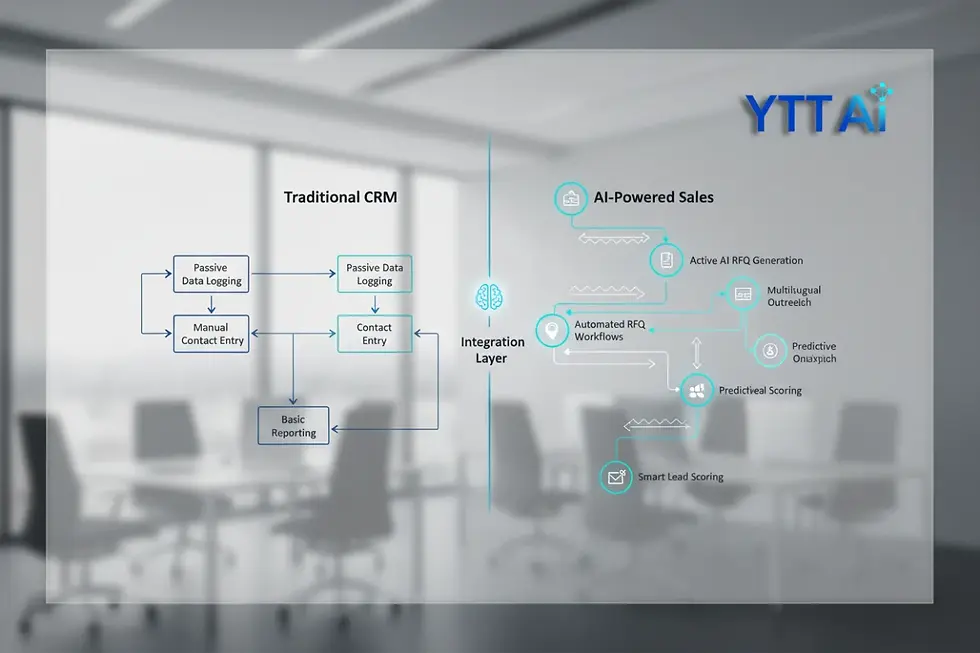
What are the 5 Essential Components Your AI Sales System Must Include?
To successfully automate complex B2B sales pipelines—especially for exporters and industrial companies—your system must contain these five foundational layers:
1. Autonomous AI SDRs for Lead Qualification
An effective system needs an AI sales agent for manufacturers that acts as a Sales Development Representative (SDR). This agent handles incoming inquiries across websites, email, and channels like WhatsApp 24/7. It assesses the prospective buyer's fit, budget, and project urgency, filtering out low-quality spam so your human reps focus on high-value deals.
2. An AI CRM with Deep Product Context
Traditional systems fall short when dealing with complex industrial components, custom molds, or heavy machinery. An AI CRM for exporters must be trained on your specific product catalogs, technical sheets, and compliance standards. This ensures the system can converse intelligently about technical specifications, lead times, and shipping logistics.
3. Multi-Channel B2B Sales Automation
B2B buyers operate across multiple channels depending on their region. Your system must coordinate outreach across email, LinkedIn, and instant messaging. It maps the follow-up cadence based on buyer responses, reviving cold leads and managing cross-border time-zone differences automatically.
4. Technical RFQ & CPQ Support
Processing Request for Quotes (RFQs) manually is a major bottleneck. The AI system should extract technical variables directly from buyer files, cross-reference them with inventory or historical quote databases, and prepare draft price quotes for the sales manager's review.
5. Human-in-the-Loop (HITL) Safety Controls
For high-value, high-risk industries like power equipment or precision manufacturing, fully autonomous AI can be risky. The system must include approval gates, letting human sales managers review, tweak, and sign off on technical quotes, pricing structures, and custom contracts before they are sent to the client.
How Does an AI Sales Agent for Manufacturers Solve the Technical Quote Bottleneck?
Manufacturers often lose deals because technical sales teams take days—or even weeks—to reply to complex RFQs. When an engineer or procurement specialist asks for specific details on custom molds, power distributions, or machinery tolerances, a generic AI tool cannot help.
An AI sales agent for manufacturers bridges this gap by directly linking your core technical database with buyer-facing communication interfaces. When an inquiry arrives, the agent reads the schematics, matches them to past production cases, and draft-constructs a technical response. This reduces response time from 3 days to under 15 minutes, boosting top-of-funnel conversion rates dramatically.

Why is Human-in-the-Loop (HITL) Critical for Complex B2B AI Sales?
While B2B sales automation handles repetitive workflows, human oversight ensures relationship-driven trust. High-ticket B2B transactions are rarely closed completely hands-off.
By establishing a strict Human-in-the-Loop guardrail, the AI acts as an accelerator, not an uncontrolled driver. For instance, the system can draft a follow-up email explaining a custom pricing model for a solar power developer. However, the email remains in a "pending" status inside the dashboard until a human representative clicks "approve" or makes adjustments. This hybrid approach eliminates hallucination risks and protects business margins.
How Do You Implement B2B AI Sales Automation in 4 Actionable Steps?
Transitioning to an AI-driven sales model does not require replacing your entire software ecosystem overnight. Exporters and manufacturers can implement automated workflows incrementally:
Define the Knowledge Base: Centralize your technical documentation, catalogs, past RFQ responses, and shipping policies into a secure AI memory layer.
Set up AI Lead Qualification Rules: Program the qualification parameters (e.g., target industry, minimum order quantity, geographic fit) to score and prioritize prospects.
Integrate Communication Channels: Connect the AI engine to your inbound channels (website forms, email accounts, WhatsApp Business) so the agent can respond instantly.
Build the Approval Workflow: Establish clear thresholds where the AI must hand off the conversation to a human seller, such as custom pricing negotiations or complex contract reviews.

By following this blueprint, businesses can scale their global footprint without exponentially expanding headcount.
Ready to transform your global sales pipeline and accelerate technical quote responses? Book a Sales Master demonstration to see how YTTAI can revolutionize your B2B growth.
FAQ
How does an AI CRM for exporters handle complex product catalogs?
An AI CRM for exporters utilizes a specialized vector knowledge base trained directly on your product manuals, CAD designs, compliance certifications, and pricing formulas. This allows the AI to accurately answer technical questions and reference exact product capabilities instead of relying on generic public data.
What is the difference between legacy B2B sales automation and generative AI sales agents?
Legacy automation is strictly rule-based (e.g., if a user downloads a PDF, wait 3 days and send email templates). Generative AI sales agents can read context, understand the intent of unstructured customer inquiries, generate personalized technical answers in multiple languages, and make logical decisions on how to move a lead forward.
Can AI lead qualification for B2B systems sync with our existing Salesforce or HubSpot setup?
Yes. Modern B2B AI sales platforms are designed to run alongside and integrate natively with industry-standard CRMs like Salesforce, HubSpot, and Microsoft Dynamics, augmenting them with autonomous agent actions while keeping your central database synchronized.


Comments