
When to Choose a Local Sales Rep vs Distributor for Industrial Manufacturing

Executive Summary: Expanding industrial equipment and machinery brands into new international markets requires a fundamental go-to-market decision. Choosing a local sales rep vs distributor impacts gross margin retention, direct customer account ownership, technical specification velocity, and long-term aftermarket revenue. This study presents an operational evaluation framework across seven commercial dimensions, detailing the exact transition mechanics and workflows required to de-risk direct market expansion.
Company Snapshot: The Global Industrial Equipment Manufacturer
Mid-sized and enterprise industrial manufacturers in sectors such as packaging machinery, industrial robotics, precision CNC systems, fluid handling, and automated material handling encounter an identical commercial inflection point during global expansion. These enterprises typically generate between $25 million and $300 million in annual gross revenue, manufacture highly configurable standard or engineer-to-order (ETO) equipment, and sell directly to tier-one production facilities, plant operations managers, and corporate engineering teams across North America, Europe, and Asia-Pacific.
Historically, these engineering-led organizations have relied heavily on independent regional distributors, commercial trading houses, and local stocking agents to establish an initial international footprint. While third-party distributor networks minimize initial upfront financial overhead and provide immediate geographical reach, they introduce significant friction as sales volume, application complexity, and installed-base density mature.
Understanding when and how to restructure international commercial representation requires examining how industrial capital goods are bought, configured, and maintained across their operating lifecycles.
What Industrial Manufacturers Actually Sell and Deliver
Industrial equipment is fundamentally distinct from transactional commercial merchandise. Capital equipment purchases are high-stakes, capital-intensive investments with operating lifespans ranging from 10 to 30 years. The commercial journey involves complex, multi-departmental evaluations rather than unilateral procurement decisions.
A typical industrial transaction spans three distinct phases:
Technical Application Discovery and Engineering Feasibility: Scoping exact plant requirements, CAD model validation, cycle-time calculations, factory integration audits, and programmable logic controller (PLC) compatibility checks.
Capital Expenditure (CapEx) Procurement and Contracting: Navigating multi-tiered corporate procurement matrices involving plant general managers, production supervisors, environmental health and safety (EHS) officers, and corporate financial directors.
Lifecycle Commissioning, Maintenance, and Aftermarket Upgrades: On-site mechanical and electrical commissioning, operator safety certification, warranty management, recurring consumable supply, and preventive maintenance agreements.
Because every stage requires deep, factory-level technical domain expertise, the commercial intermediary representing the brand directly dictates conversion efficiency, pricing power, and customer retention.
The Business Problem: Structural Friction in Third-Party Distribution
According to industrial distribution benchmarks across heavy machinery and automation sectors, manufacturing enterprises encounter three systemic operational bottlenecks when scaling through traditional distributor channels:
First, there is a structural barrier to customer data transparency and account ownership. Independent distributors treat end-customer relationships as proprietary assets. They routinely mask plant contact details, operating usage patterns, and project expansion timelines to prevent direct engagement. As a result, the manufacturer remains completely insulated from the Voice of the Customer (VoC), complicating product engineering, demand planning, and service positioning.
Second, deal velocity and specification control deteriorate as technical complexity rises. Distributor sales teams manage expansive line cards featuring dozens of complementary or competing manufacturers. When complex engineering questions arise during custom RFQ evaluation, generalist distributor representatives frequently default to promoting simpler catalog items rather than investing the engineering effort required to position advanced machinery.
Third, gross margin capture erodes significantly. Distributor agreements typically require margin concessions ranging between 20% and 40%. On multi-million-dollar capital project lines, these discount allocations represent substantial capital outlays that could directly support dedicated regional application engineering and direct commercial staff.
Evaluating a Local Sales Rep vs Distributor: 7 Core Drivers
To make an objective commercial determination between a local sales rep vs distributor, manufacturing leadership must systematically evaluate seven core operational dimensions.
1. Account Ownership and Direct Lifecycle Data
When aftermarket parts, field service contracts, retrofits, and software updates account for a substantial percentage of total customer lifetime value (LTV), direct account ownership is vital. Third-party intermediaries often capture high-margin spare parts revenue while leaving the manufacturer with low-margin warranty obligations. Direct sales models preserve direct customer connectivity and telemetry data access.
2. Technical Deal Complexity and Application Engineering
If closing a sale requires extensive application engineering, custom layout drawings, PLC software integration, or cycle-time guarantees, distributor sales reps rarely possess the technical fluency required to close enterprise accounts. If factory-based internal sales engineers are already performing 85% of the pre-sales engineering work, compensating a distributor with a 30% margin cut becomes commercially inefficient.
3. Market Account Density and Geographic Concentration
In markets where target industrial plants are concentrated in dense manufacturing clusters—such as automotive or semiconductor manufacturing corridors—a dedicated local sales rep can manage targeted enterprise account lists with high efficiency. Conversely, in highly fragmented, geographically dispersed markets with thousands of small, low-value purchasers, stocking distributors offer critical inventory warehousing and logistical reach.
4. Field Service, Installation, and Commissioning Demands
Machinery that requires certified commissioning, strict regulatory safety compliance, and rapid field service response times demands tight organizational control. When distributors fail to maintain fully trained field service engineers, customer dissatisfaction and warranty disputes inevitably fall back on the original equipment manufacturer.
5. Margin Concession vs. Fixed Payroll Expenditure
The economic inflection point is determined by comparing total annual distributor margin concessions against the fully burdened cost of a dedicated local sales representative, including base salary, performance commissions, travel expenses, and regional office infrastructure. Once annual distributor discount concessions in a territory exceed $250,000 to $400,000, direct hiring produces positive financial returns.
6. Brand Positioning and Value Proposition Integrity
In premium machinery categories, brand equity depends on consultative application guidance and white-glove engineering support. Distributors often commoditize equipment by competing purely on purchase price or bundling premium machinery with lower-grade accessories, diluting the manufacturer's market reputation.
7. Commercial Pipeline Transparency and Forecasting Accuracy
Direct sales representations provide direct access to real-time pipeline telemetry, CRM stage movement, and upcoming plant CapEx cycle tracking. Distributor reporting is frequently retrospective, providing visibility only after purchase orders are placed and obscuring lost bid diagnostics.
Operational Dimension | Distributor Model Fit | Direct Local Sales Rep Model Fit |
Technical Product Complexity | Standard, off-the-shelf, catalog machinery | Highly configurable or engineer-to-order (ETO) systems |
Customer Relationship & Data | Intermediary owns end-user relationship | Direct, permanent factory-to-plant relationship |
Margin Economics | High discount concession (20%–40% per unit) | Fixed payroll overhead + variable success incentive |
Market Density | Broad, geographically dispersed, low-ticket buyers | Concentrated industrial corridors with high-value accounts |
Pipeline Visibility | Low; retrospective point-of-sale (POS) data | Real-time CRM tracking and multi-stage deal forecasting |
Aftermarket & Lifecycle Control | Intermediary captures spare parts & service margin | Manufacturer retains 100% of recurring lifecycle contracts |
How the Transition Workflow Actually Operates
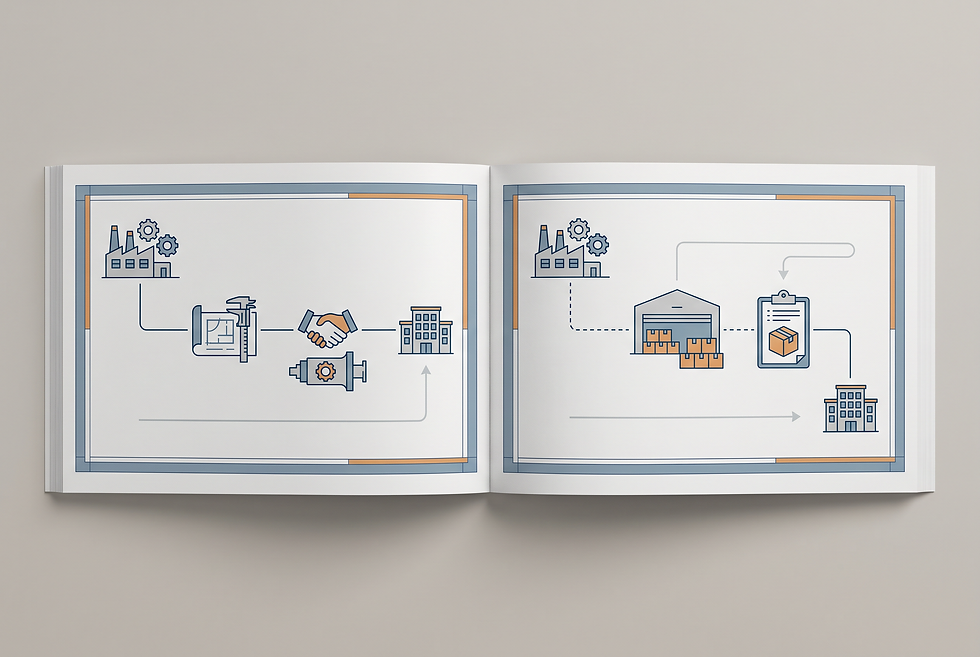
Transitioning from an indirect channel model to a dedicated direct commercial presence must follow a disciplined operational sequence rather than an abrupt contractual termination. Leading industrial enterprises utilize a structured six-stage workflow:
Step 1: Point-of-Sale Audit and Customer Identification. The commercial operations team audits historical point-of-sale data, warranty registrations, and spare parts delivery addresses to map all active end-user manufacturing plants within the target territory.
Step 2: Strategic Account Carve-Outs and Contract Renegotiation. Ahead of distributor agreement renewals, leadership renegotiates contractual boundaries, establishing named strategic account exclusions and non-exclusive rights for major multi-national enterprise accounts.
Step 3: Territory Sales Representative Onboarding. The manufacturer places dedicated technical sales professionals in the region, supported by standardized qualification rubrics, rapid engineering sizing tools, and unified CRM infrastructure.

Step 4: Implementation of a Hybrid Co-Selling Structure. For complex custom integration projects, direct technical sales reps lead customer discovery, specification modeling, and commercial proposals, while regional stocking partners manage physical inventory logistics, local warehousing, and currency settlements.
Step 5: Direct Plant Procurement and SLA Integration. Direct vendor-management profiles, enterprise electronic data interchange (EDI) links, and direct service-level agreements (SLAs) are established with end-user procurement teams.
Step 6: Closed-Loop Engineering Feedback. Field application insights, competitive mechanical benchmarking, and operator feedback flow directly from local sales reps into R&D engineering, driving iterative product improvements.
Evidence and Results: Documented Commercial Impacts
Commercial transition data from industrial machinery and automation suppliers highlights substantial improvements in gross margin realization and sales velocity:
According to published research from the Industrial Distribution Association (IDA) and benchmark studies across mid-market European and North American industrial machinery exporters, manufacturers that transitioned high-complexity equipment lines from third-party distributors to dedicated technical sales representations documented an average 18% to 26% improvement in realized gross margins across key accounts over a 24-month timeframe.
Furthermore, direct technical engagement compressed the average Request for Quotation (RFQ) processing cycle from 38 days—frequently stalled by multi-tier distributor communications—to under 11 business days through direct engineering-to-buyer alignment. While direct operating expenditure increased during the initial hiring and deployment phase, aftermarket customer retention rates for annual service contracts grew by more than 30% due to direct lifecycle engagement.
What Other Industrial Companies Can Learn
For commercial executives evaluating channel architecture, four foundational principles emerge from this decision framework:
Align Channel Selection with Application Engineering Requirements: Never depend on non-exclusive distributor reps to communicate complex technical differentiators for engineered capital equipment.
Treat Customer Contact Data as a Core Balance-Sheet Asset: Channel agreements that obscure plant operator identities prevent long-term value compounding. Always mandate transparent account reporting.
Model Total Channel Cost Accurately: When calculating channel economics, include lost aftermarket service contracts, warranty handling overhead, and brand erosion alongside standard discount percentages.
Leverage Hybrid Operational Models: Utilize direct sales reps for technical qualification and key account relationship management, while retaining specialized distribution partners for local spare parts fulfillment and freight logistics.
What This Could Look Like for Industrial Automation & Robotics
Consider an industrial automation and robotics manufacturer expanding into an overseas automotive manufacturing corridor. Under a conventional distributor model, a local distributor passively includes robotic palletizers alongside dozens of unrelated conveyor components, rarely initiating proactive technical outreach.
In contrast, adopting a direct territory model allows the robotics manufacturer to map every Tier-1 automotive plant in the region, conduct direct technical feasibility reviews, deliver automated cycle-time calculations, and engage corporate manufacturing engineering teams directly with customized robotic automation proposals.
YTT AI Worker Mapping: AI Global Sales Rep
For industrial machinery and equipment manufacturers seeking to transition toward direct territory engagement without immediately absorbing substantial overseas payroll overhead, deploying an AI Global Sales Rep provides an agile commercial bridge.
Worker Job Title: AI Global Sales Rep
Main Daily Tasks: Ingesting international buyer RFQs, parsing technical machinery specifications, validating plant integration feasibility, generating engineered draft proposals, and scheduling technical discovery meetings with factory application engineers.
Primary Work Channel: Inbound territory email channels, international web quote portals, and enterprise CRM systems.
Authority Boundary: Autonomously handles technical qualification, standard equipment specification matching, and preliminary budgetary guidance; requires human Sales Director sign-off for custom engineering commitments, final contractual pricing, and performance guarantees.
First Value Event: Delivering a verified, engineering-qualified RFQ package with verified plant stakeholder contact details and preliminary sizing specifications within 2 hours of customer inquiry.
Daily Report Result: A daily territory commercial briefing detailing newly qualified engineering RFQs, buyer engagement velocity, competitor displacement opportunities, and scheduled meetings for regional field engineers.
FAQ
What is the primary risk when transitioning from a distributor to a local sales rep?
The primary risk is short-term revenue disruption if the incumbent distributor retaliates by promoting a competitor's product line to existing accounts before your direct sales representative has fully established customer relationships.
Can a manufacturer combine direct sales reps and distributors in the same territory?
Yes, many industrial manufacturers utilize a hybrid model where direct sales reps handle technical specification, enterprise key accounts, and engineered projects, while distributors provide local stock, fulfillment, and credit services for smaller transactions.
How do you calculate the financial breakeven for hiring a local sales rep?
Compare the annual discount dollars conceded to distributors in that territory against the fully burdened cost of a direct sales rep, including salary, travel, and support infrastructure. When distributor discounts exceed dedicated rep expenses, direct hiring becomes financially accretive.
How does technical product complexity influence channel selection?
Higher technical complexity strongly favors direct technical sales representation because generalist distributor reps rarely possess the specialized engineering expertise required to configure, quote, and close custom machinery solutions.
Use the Market Entry Decision Framework
Evaluate your commercial channel strategy with structured frameworks and autonomous sales workflows designed for international industrial manufacturers at https://www.ytt-ai.com/.


Comments