

Who Needs Generative Engine Optimization? A Complete B2B Guide

Generative Engine Optimization (GEO) is essential for B2B manufacturers, global exporters, and enterprises with complex products or long sales cycles. If your prospective buyers use AI search tools like ChatGPT, Claude, Gemini, or Google's AI Overviews to research technical specifications, compare vendors, or evaluate operational workflows, your business must optimize for AI search engines to secure direct citations and maintain high visibility in AI-driven search results.
What is Generative Engine Optimization (GEO) and how does it work?
Generative Engine Optimization (GEO) is the process of structuring, optimizing, and feeding your digital footprint so that AI engines accurately retrieve, recommend, and cite your brand in response to user queries. Unlike traditional search engines that serve a list of blue links, generative AI models analyze vast multi-modal datasets to provide single, synthesized answers.
To index and recommend your brand, AI engines rely on Retrieval-Augmented Generation (RAG). They fetch information from trusted technical documentation, authoritative industry forums, and clear web structures. If your content is not designed for easy machine consumption, your business remains completely invisible to buyers using AI tools.
Who needs generative engine optimization in the B2B sector?
If your business falls under any of the following categories, you are the prime answer to the question of who needs generative engine optimization:
Industrial Manufacturers & Precision Machining Exporters: Buyers of heavy machinery, molds, precision tools, and power distribution systems perform rigorous research before asking for an RFQ. AI search engines are their primary tools for vetting technical standards.
Companies with Complex or Long B2B Sales Cycles: If your products require customer education, integration explanations, or multi-department approvals, AI search engines will synthesize these comparison stages for procurement teams.
Businesses Experiencing a Shift in Search Behavior: High-value buyers increasingly ask complex, conversational questions like "which precision molding exporter can meet tight tolerances for automotive connectors?" instead of simple, short-tail keywords.
By leveraging generative engine optimization B2B frameworks, companies in highly specialized sectors can guarantee that their technical expertise is easily accessible to these digital researchers.
What is the difference between GEO and traditional SEO?
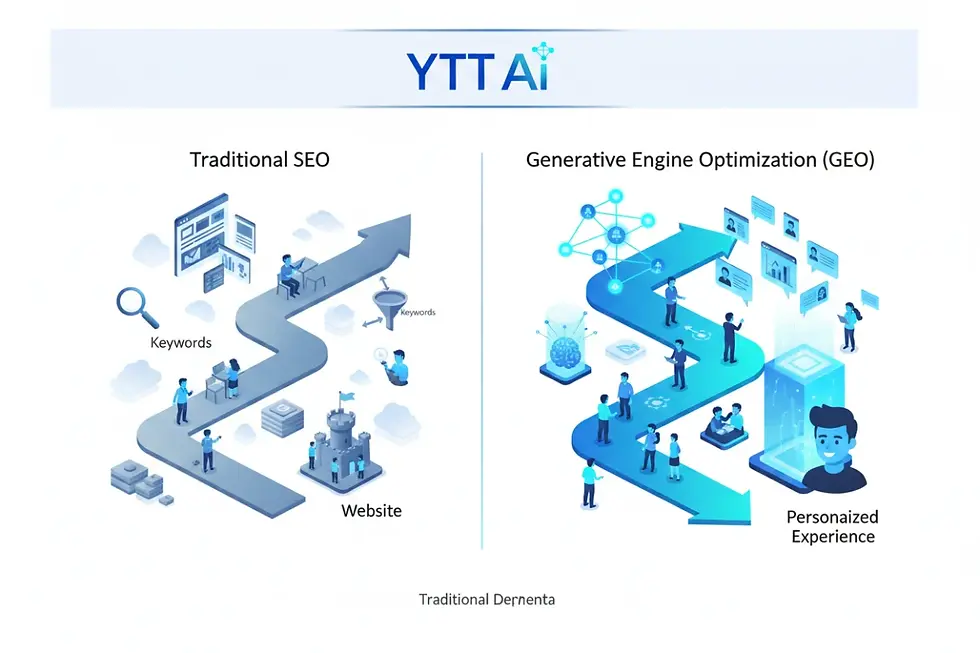
While both strategies aim to capture organic traffic, their technical mechanisms, output goals, and indexing processes differ significantly. Understanding this GEO vs SEO comparison helps B2B leaders allocate marketing budgets effectively.
Feature | Traditional SEO | Generative Engine Optimization (GEO) |
|---|---|---|
:--- | :--- | :--- |
Primary Target | Human users browsing search engine results pages (SERPs) | Large Language Models (LLMs) and RAG crawlers |
Search Intent | Keyword-matching, transactional, and short-tail queries | Conversational, highly specific, and multi-variable questions |
Core Goal | High rankings (Position 1-3) on Google Search | Inclusion in AI syntheses with trusted citations and links |
Content Format | Blog articles, landing pages, meta titles | Structured data, API endpoints, comprehensive whitepapers, and FAQs |
Success Metric | Click-Through Rate (CTR) and organic traffic volume | Share of Voice (SoV) in AI responses and citation quality |
How can B2B manufacturers optimize for AI search engines?
To build lasting AI search visibility for manufacturers, your content must prioritize high technical accuracy and authoritative citations. AI engines look for structured data that solves real-world buyer pain points, such as technical data completeness, pricing transparency, and delivery terms.
To optimize for AI search engines effectively, implement the following steps:
Publish Comprehensive Technical Specifications: Ensure all PDFs, catalogs, and technical specification sheets are indexable, schema-marked, and readable by AI web-scrapers. This directly solves buyer frustrations regarding incomplete RFQs.
Resolve Complex Buyer Pain Points in Public Content: Target issues highlighted by global buyers on forums like Reddit. Address topics like production lead times, pricing models for custom equipment, and step-by-step risk management in global supply chains.
Implement Structured QA and Schema Markup: Use FAQ schemas and clear question-and-answer pairs across your digital assets. This structure allows RAG-driven AI search engines to pull exact answers directly into their generated summaries.
Manage Third-Party Reviews and Brand Mentions: AI models build confidence by cross-referencing multiple sources. Cultivate brand mentions across industry databases, reputable trade publications, and directories.

What are the risks and limits of generative engine optimization B2B strategies?
While GEO is highly effective, it has limitations. Unlike SEO, where code changes can quickly affect SERP rankings, LLM models operate on training schedules and real-time retrieval parameters. This introduces potential risks:
Model Hallucination and Accuracy Issues: LLMs can occasionally misrepresent detailed specifications or pricing structures if your website lacks structured, machine-readable data.
Loss of Direct Click Traffic: When an AI engine answers a query directly, a portion of the search audience might get their answers without visiting your website. This makes securing high-quality citations in the generated answer critical.
The Need for Human Oversight: In complex B2B sales (e.g., custom transformers, heavy machinery, and SaaS platforms), AI can qualify leads and explain capabilities, but human validation is required for final pricing, delivery schedules, and technical sign-offs.
How do you measure and track your GEO success?
Tracking the ROI of your GEO efforts requires moving beyond traditional metrics like keyword rankings. Instead, focus on tracking your overall share of voice in the AI ecosystem.
AI Share of Voice (SoV): The percentage of times your brand is recommended when testers query popular LLMs about your industry niche.
Citation Referral Traffic: Traffic arriving from links embedded within answers generated by ChatGPT, Perplexity, or Google AI Overviews.
Lead Quality Scores: Monitoring if inbound RFQs mention solutions that were highlighted primarily in your AI-optimized assets.

Traditional search is shifting rapidly, and the companies that build clear technical foundations today will dominate tomorrow's digital marketplaces. By structuring your expertise to meet the needs of modern algorithms, you ensure that your brand remains the primary answer when global buyers consult AI.
Are you ready to secure your brand's digital presence in the age of AI search? Request a B2B SEO and GEO visibility assessment today and find out how we can help your brand stay visible, trusted, and highly cited.
FAQ
How long does it take to see results from GEO compared to traditional SEO?
GEO results can happen quickly when targeting real-time search engines like Perplexity or Google's AI Overviews, as they crawl and cite live web structures hourly. However, for core LLM training models like GPT-4 or Gemini updates, visibility gains depend on the next training cycle or RAG database refresh, which typically takes a few weeks to several months.
Will optimizing for AI search engines hurt my traditional Google rankings?
No. In fact, GEO and traditional SEO support each other. AI search engines value structured data, clear tables, verified external citations, and deep, technical content—the very same quality signals that Google uses to rank pages in standard organic search.
How do AI engines source details for highly specialized B2B industries like custom molding or power distribution?
AI engines search for authoritative technical data. They crawl manufacturer-provided spec sheets, industry standards documentation, patent filings, trusted third-party trade journals, and community discussions. High-quality, clear, machine-readable specifications are highly likely to be indexed and cited.


Comments