%20%E6%8B%B7%E8%B4%9D.png)
AI in B2B Sales: Practical Use Cases for Manufacturers and Exporters

Deploying ai in b2b sales allows industrial manufacturers and complex exporters to automate technical account research, triage request-for-quote (RFQ) inquiries, structure domain knowledge, and maintain proactive follow-up across global time zones. Rather than replacing human relationship builders, modern sales intelligence platforms eliminate manual administrative drag so revenue teams can focus on high-value negotiation, custom engineering alignment, and closing strategic contracts.
Industrial sales cycles typically involve multi-stakeholder buying committees, extensive technical specifications, and cross-border commercial terms. According to Gartner (2023), B2B buyers spend only 17% of their total purchase journey meeting with potential suppliers, meaning commercial teams must maximize every interaction with contextual precision. When applied systematically across the commercial lifecycle, artificial intelligence transforms fragmented sales workflows into high-velocity revenue engines.
High-Impact Use Cases Across the Industrial Revenue Cycle
Manufacturing and export organizations face unique operational bottlenecks that standard transactional CRM tools cannot resolve. Implementing purpose-built workflows bridges the gap between commercial inquiries and operational execution.
1. Automated Customer Research and Account Enrichment
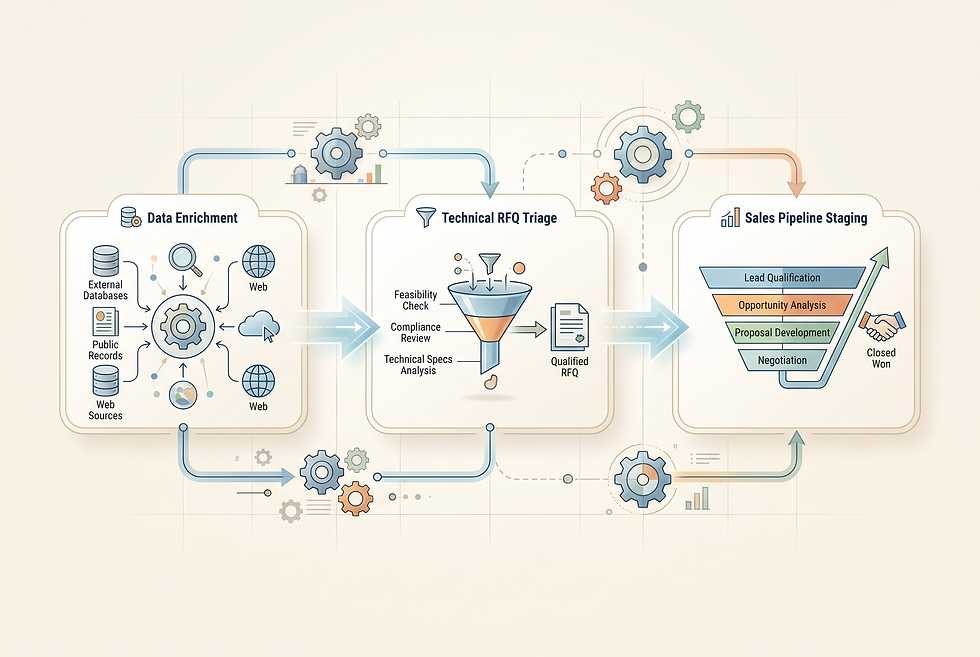
Before reaching out or responding to an inbound lead, commercial teams traditionally spend hours gathering background data on factory locations, compliance mandates, import histories, and corporate hierarchies. Sales intelligence systems automate this process by aggregating global trade registries, corporate filings, technical catalogs, and digital footprints into structured account dossiers.
This enrichment allows account executives to identify hidden buying triggers, understand localized production capacity needs, and anticipate specific product configurations before initial discovery calls.
2. RFQ Triage and Intelligent Lead Qualification
Exporters often receive hundreds of raw inquiries per month across digital portals, email inboxes, and global trade platforms. Sifting through unstructured technical queries, vague specifications, and non-serious buyers drains valuable engineering and sales hours.
Natural language processing models parse unstructured RFQs, extract core operating parameters—such as material grades, dimensional tolerances, volume requirements, and certification standards—and score the opportunity against production capabilities. Inquiries that meet strict commercial thresholds are routed immediately to the right product specialist, while unqualified requests are politely handled or guided toward standard catalog offerings.
3. Centralized Technical Knowledge Management
Industrial sales teams manage thousands of stock-keeping units (SKUs), regional compliance standards (such as CE, RoHS, or ASME), lead times, and fluctuating freight logistics. Product catalogs and compliance documentation are frequently trapped in static PDFs or isolated departmental drives.
Generative knowledge systems index engineering documentation, testing certifications, and historical quotation databases. Sales representatives can query internal repositories in real time to answer complex technical inquiries accurately during live client negotiations, preventing costly back-and-forth delays with busy plant engineers.
4. Autonomous Follow-Up and Multilingual Nurturing
Cross-border industrial transactions often stall during technical evaluation and compliance validation. Managing ongoing outreach across diverse time zones, languages, and seasonal trade schedules manually leads to dropped opportunities.
Automated communication workflows monitor buyer engagement, sending contextual follow-ups that address specific technical considerations or regulatory updates. Global exporters can communicate seamlessly in the buyer's native language while ensuring technical terminology remains strictly accurate.
Evaluating Traditional Workflows Against Modern AI Implementations
Transitioning from manual commercial processes to data-driven orchestration fundamentally changes how industrial exporters manage capacity, pipeline health, and customer acquisition costs.
Capability Area | Traditional B2B Sales Workflow | AI-Enabled Manufacturing Sales | Strategic Business Impact |
Account Research | 60–90 minutes per account using search engines and public databases | Instant dossier synthesis combining trade data, plant scale, and hierarchy | 70% reduction in pre-call prep time; deeper technical context |
RFQ Qualification | Manual inbox review by sales engineers; high response latency | Automated parsing of technical parameters, certifications, and volume | Response times cut from days to minutes; higher bid conversion |
Technical Inquiries | Days waiting for internal engineering feedback on tolerances and compliance | Direct querying of indexed technical repositories and past quotes | Accelerated sales cycle and reduced engineering interruptions |
Global Follow-Up | Inconsistent manual outreach; language barriers and time zone delays | Multilingual, trigger-based communication tailored to buyer stage | Maximized pipeline recovery and shorter conversion cycles |
Pipeline Visibility | Subjective rep forecasting based on manual CRM logging | Objective health scoring derived from buyer interaction velocity | Accurate capacity planning and reliable export revenue forecasts |
Establishing Human-in-the-Loop Governance and Risk Boundaries
While automation delivers operational speed, complex manufacturing and international trade carry substantial contractual, technical, and financial liability. Enterprise organizations must establish clear operational boundaries regarding what tasks systems may automate versus what requires mandatory human validation.
Core Human Approval Checkpoints
Pricing Commitments and Discount Structures: Algorithms can benchmark competitor indices and calculate margin floors, but commercial directors must approve final pricing tiers and payment terms.
Engineering Tolerances and Custom Capabilities: AI can verify catalog alignment, but custom tool modifications, non-standard material substitution, or production schedule overrides require sign-off from plant engineering.
Legal Terms and International Warranties: Incoterms, liability caps, and jurisdiction clauses must remain under strict human legal oversight.
Final Contract Execution: Strategic client relationships require authentic human empathy, negotiation nuance, and executive alignment.
McKinsey & Company (2023) highlights that organizations combining automated intelligence with human relationship management generate up to 20% higher commercial efficiency compared to those attempting pure automation or relying solely on legacy practices.

Strategic Pipeline Visibility and Sales Coaching
Managing global sales teams across distributed export branches often leaves commercial leaders with poor visibility into true deal health. Traditional CRMs rely on subjective updates from sales representatives, leading to inaccurate forecasting and late discovery of stalled negotiations.
Modern sales operations platforms analyze conversational signals, email responsiveness, and engagement velocity to assign objective pipeline risk scores. If an overseas buyer stops engaging after receiving a preliminary specification sheet, the system flags the bottleneck proactively.
Furthermore, by analyzing successful negotiation patterns across top-performing account managers, sales leaders can deliver targeted coaching to junior representatives. Teams can explore how dedicated solutions like YTTAI Sales Master unify technical knowledge, automated lead enrichment, and commercial execution to scale export operations securely.
A 4-Step Implementation Roadmap for Industrial Exporters
Successfully modernizing industrial sales operations requires structured execution and change management rather than abrupt disruption.
Audit Unstructured Data Assets: Aggregate product catalogs, spec sheets, compliance certificates, and historical RFQ logs into a clean, searchable digital format.
Deploy Intelligent Triage on Inbound Channels: Implement automated parsing on top-of-funnel inquiry channels to instantly filter high-fit buyers from low-margin tire-kickers.
Connect Account Intelligence to Rep Workflows: Provide commercial teams with direct access to enriched company profiles and rapid knowledge retrieval tools.
Define Risk Guardrails and Review Metrics: Set strict approval gates for commercial terms while tracking key performance indicators, including average lead response time, engineering hours saved, and RFQ win rates.
For enterprise organizations seeking a structured assessment of their digital readiness and commercial workflows, scheduling a Guided Growth Demo provides a clear blueprint for deployment.
Conclusion
Implementing artificial intelligence in manufacturing and export sales is not about replacing commercial expertise; it is about eliminating administrative overhead, accelerating technical response times, and delivering contextually rich buyer experiences. By establishing robust technical workflows and clear human governance, industrial leaders can capture higher-margin global contracts, optimize engineering resources, and build scalable revenue engines.
FAQ
How does AI improve lead qualification for custom manufacturing?
AI parses incoming technical specifications, drawings, volume demands, and compliance requirements from unstructured RFQs, matching them directly against plant manufacturing capabilities to score lead fit instantly.
Can AI in B2B sales handle multi-language export communications?
Yes. Modern platforms translate and localize technical sales communications across dozens of languages, ensuring accurate terminology, regulatory references, and regional commercial etiquette.
What sales tasks should never be fully automated in industrial trade?
Final commercial pricing, contract terms, engineering liability sign-offs, and custom warranty commitments must always require human review and approval to mitigate operational and financial risk.
How long does it take for a manufacturer to deploy AI sales workflows?
Most manufacturers can deploy initial lead enrichment and knowledge triage workflows within 2 to 4 weeks, provided existing technical documentation and product catalogs are digitally accessible.
Modernize Your Global B2B Sales Operations
Equip your commercial and technical sales teams with intelligent qualification, automated research, and structured pipeline execution tailored for global trade.


Comments