%20%E6%8B%B7%E8%B4%9D.png)
How to Qualify Prototype Leads for Production Potential in Additive Manufacturing

Executive Summary
Industrial additive manufacturing service providers frequently spend up to 40% of their senior engineering bandwidth quoting one-off R&D prototypes that never convert to recurring revenue. By deploying an eight-dimension technical screening model combined with automated commercial qualification, contract manufacturers can effectively isolate high-margin serial production programs early. This operational study examines how industrial 3D printing bureaus systematically separate transient hobbyist or early R&D submissions from high-value production opportunities, reducing engineering quotation overhead while increasing production win rates.
Company Snapshot: The Contract Additive Manufacturing Business Model
Contract additive manufacturing (AM) suppliers and precision 3D printing service bureaus operate at the intersection of advanced manufacturing engineering and rapid on-demand fulfillment. These organizations invest millions of dollars in industrial selective laser sintering (SLS), direct metal laser sintering (DMLS/LPBF), stereolithography (SLA), and multi-jet fusion (MJF) platforms.
Their primary target customers include tier-one automotive suppliers, aerospace component designers, medical device original equipment manufacturers (OEMs), robotics developers, and industrial machinery builders. The revenue model typically rests on two distinct transaction types:
Low-volume, one-off rapid prototyping with tight turnarounds and low lifetime contract value.
Serial additive production, bridge-to-tooling manufacturing, and recurring spare-parts programs characterized by sustained annual volume, long-term supply agreements, and high margins.
While rapid prototyping provides immediate cash flow, enterprise valuation and operating profitability depend heavily on winning multi-year production programs. However, incoming digital requests for quotation (RFQs) arrive through identical web portals, mixed indiscriminately between university students, early-stage tinkerers, and enterprise procurement directors.
What Contract Additive Manufacturers Actually Sell
Commercial additive suppliers do not merely sell machine time; they sell specialized application engineering, design for additive manufacturing (DfAM) optimization, certified material properties, quality control documentation, and post-processing repeatability.
In standard B2B procurement, buyers submit 3D CAD files (.STEP, .STL, .IGES) alongside basic material requests. A sales engineer must inspect geometry for printability, calculate build volume packing, identify thermal stress risks, select support structures, specify post-machining tolerances, and calculate finishing costs.
When a buyer requests a single 3D-printed bracket, the pre-sale engineering effort is virtually identical whether that part is an exploratory student project or the functional prototype of an aerospace subsystem destined for 10,000 units per year. Because sales engineers cannot spend two hours manually interrogating every inquiry, high-potential production clients frequently receive generic transactional quotes, while low-value one-off requests consume critical commercial capacity.
The Business Problem: Quoting Overhead and Hidden Production Potential
Contract AM suppliers face a structural qualification bottleneck driven by three commercial realities:
Severe Engineering Strain: Application engineers spend hours running orientation analysis, slicing previews, and tolerance verification on prototype RFQs that have zero recurring intent.
Slow Turnaround for Tier-One Buyers: High-value enterprise buyers testing potential suppliers with a prototype order experience slow response times because engineering queues are clogged with low-priority submissions.
Lack of Systematic Production Discovery: Commercial teams lack structured intake mechanisms to evaluate whether a prototype’s geometry, material specification, and regulatory footprint indicate an upcoming production ramp.
Without an operational method to qualify prototype leads for production potential, sales teams treat every digital lead as a low-margin commodity transaction, abandoning proactive qualification after emailing the initial quote.
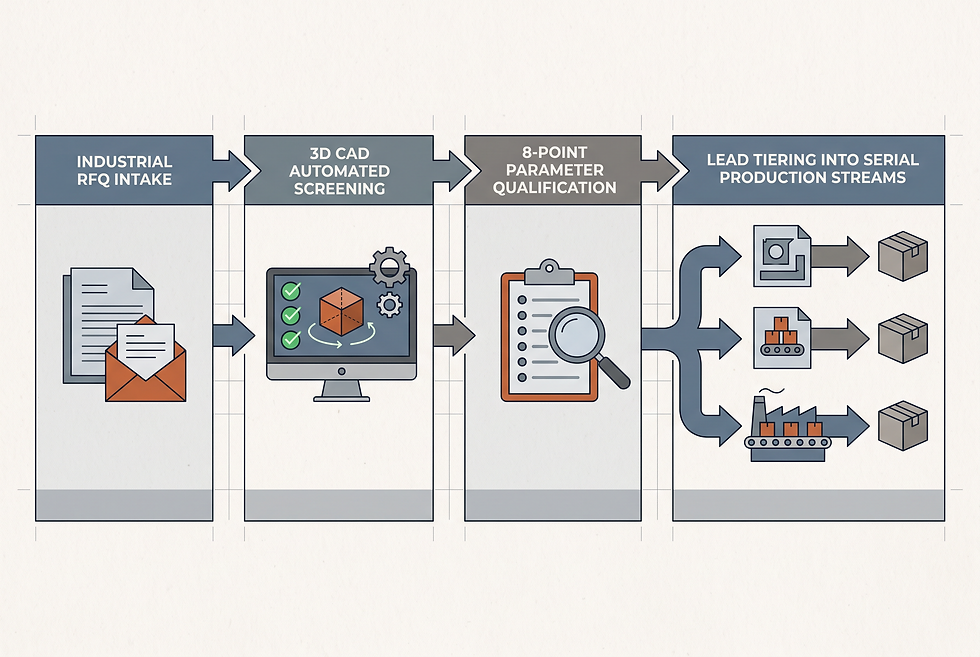
What Changed: The 8-Dimension Production Triage Framework
Leading contract manufacturers replace open-ended quoting forms with a structured technical qualification matrix. Instead of asking generic sales questions like "What is your budget?", the technical intake captures operational parameters that reveal downstream production feasibility.
To effectively qualify prototype leads for production potential, suppliers evaluate submissions across eight specific engineering and commercial criteria:
Part Geometry (DfAM Fit): Does the geometry leverage additive manufacturing advantages (internal cooling channels, topology optimization, consolidated assemblies), or is it a simple prismatic shape better suited for CNC milling or injection molding once scaled?
Material Specifications: Is the requested material an engineering polymer (PEEK, ULTEM) or production metal (Inconel 718, Ti-6Al-4V, 316L) tied to rigorous application demands, or a generic resin/PLA?
Volume & Estimated Annual Usage (EAU): What is the delta between the initial test lot (e.g., 2 units) and the projected annual production run (e.g., 2,500 units/year)?
Tolerance Requirements: Are critical dimensions achievable in the as-printed state, or does the part require secondary CNC post-machining, wire EDM, or precision grinding that indicates a high-value assembly?
Regulatory & Quality Certifications: Does the application require AS9100, ISO 13485, PPAP level documentation, or material test reports (MTRs)? Regulated parts almost universally transition into protected recurring revenue streams.
Repeat Order Cadence: Is the purchase tied to ongoing maintenance, repair, and operations (MRO), scheduled device manufacturing, or a one-time college thesis?
Assembly Function & Criticality: Is the component a cosmetic visual model, or a functional load-bearing part embedded in a larger industrial machine or vehicle?
Production Ramp Plan: Is there a defined timeline moving from functional prototype (T0) to pilot validation (T1) and serial manufacturing (SOP)?
How the Qualification Workflow Operates Step-by-Step
The modernized qualification mechanism operates across five distinct workflow stages:
Step 1: Automated File & Metadata Intake
The customer uploads CAD models (.STEP/.STP preferred) into an intake portal. The system automatically calculates bounding box dimensions, volume, surface area, thin-wall violations, and mass properties.
Step 2: Technical Parameter Screening
The submitter answers four mandatory technical dropdowns: target application environment (e.g., aerospace, medical, general tooling), required certifications, target commercial stage (concept, functional bench testing, serial bridge), and projected annual volume.
Step 3: Algorithmic Lead Scoring & Tier Assignment
Based on geometric complexity, material value, certification requirements, and target annual volume, the system scores the inquiry:
Tier A (High-Potential Production): Complex functional geometry, certified materials, EAU > 200 units, defined ramp within 6 months. Routed immediately to a senior Sales Engineer for custom application review and direct phone outreach.
Tier B (Standard Business Prototype): Standard engineering materials, moderate volume potential, corporate email domain. Handled via automated instant quote with scheduled follow-up workflows.
Tier C (One-Off / Transactional): Generic materials, single unit, educational or personal domain, no production timeline. Managed entirely via instant self-serve checkout without consuming manual engineering hours.
Step 4: Proactive Post-Prototype Commercial Milestones
When a Tier A or Tier B prototype order ships, the automated commercial workflow does not simply send an invoice. It triggers milestone-based follow-ups aligned with the customer's engineering validation schedule: Day 3 (Delivery & Visual Check), Day 14 (Fit & Functional Test Results), and Day 30 (Engineering Review for Pilot Batch Pricing).
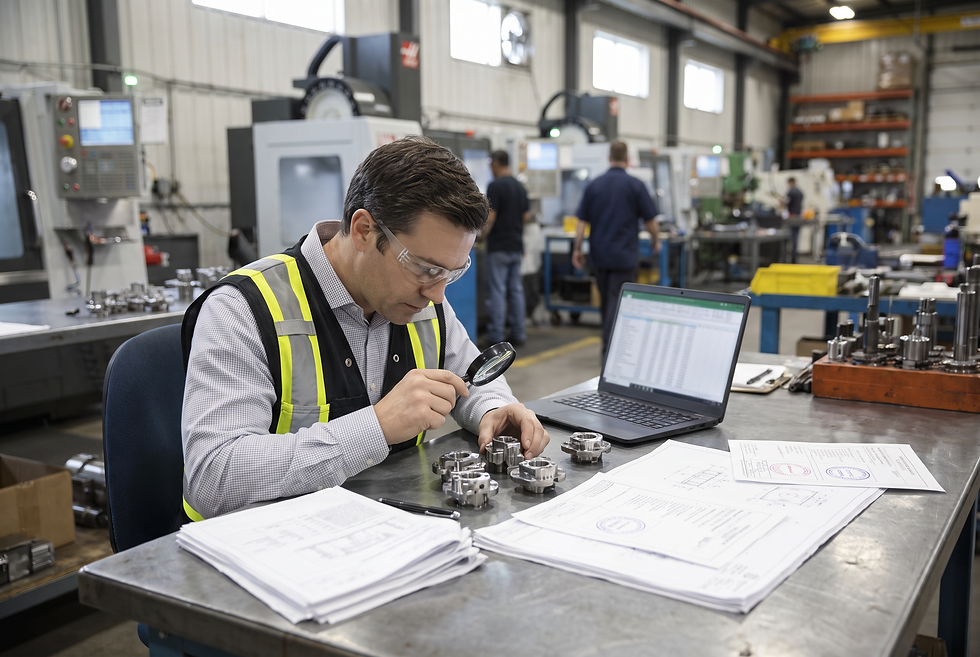
Step 5: Feedback and Continuous DfAM Optimization
Technical feedback gathered during the prototype phase (such as tolerance adjustments or surface finish feedback) is logged directly into the CRM opportunity record, providing sales engineers with immediate leverage to present serial supply proposals.
Comparative Analysis: Traditional vs. Qualification-Driven Intake
Evaluation Metric | Traditional Unfiltered Quoting | 8-Dimension Structured Qualification |
Engineering Time per Quote | 45–90 minutes of manual review on all incoming files | 0 minutes for Tier C; 15 minutes focused review for Tier A/B |
Quote Turnaround Time | 24–48 hours across all incoming leads | < 10 minutes for automated quotes; < 2 hours for high-value RFQs |
Production Lead Identification | Reactive (relies on customer stating future intent) | Proactive (detected via CAD, material, EAU, and certification data) |
Sales Follow-up Cadence | Single transactional invoice follow-up | Structured 3-stage validation workflow tied to testing cycles |
Conversion to Serial Contract | Low (< 5% transition from prototype to series) | High (18–28% conversion on identified Tier A opportunities) |
Operational Evidence and Measurable Industry Impact
According to an industrial 3D printing industry benchmark published in the Additive Manufacturing State of the Market Report (2024), specialized contract manufacturers that implemented automated technical intake and systematic qualification achieved a 65% reduction in non-productive engineering estimation hours.
Furthermore, supplier case data documented by digital manufacturing platforms shows that over 70% of high-volume serial production contracts began as single-part prototype orders. However, suppliers who failed to follow up within 14 days of prototype delivery lost 82% of those follow-on production contracts to competing machine shops and service bureaus. Implementing a structured technical triage process ensures that high-volume production indicators are flagged before parts leave the facility.
What Other Contract Manufacturers Can Learn
Suppliers seeking to protect engineering margins and build predictable contract manufacturing pipelines should adopt four core principles:
Stop Quoting Raw Files Without Application Context: A CAD model alone does not provide commercial intent. Always capture material criticality, certification needs, and ramp timelines during intake.
Segment Sales Engineering by Commercial Potential: Senior application engineers should exclusively touch files with verified serial production potential or high-margin technical complexity.
Align Follow-Up with the Client's Physical Testing Schedule: Engineering buyers test prototypes over 1–4 weeks. Commercial follow-ups must align with bench testing, environmental stress screening, and assembly fit-checks.
Automate the Transactional Long Tail: Enable self-service quoting for low-risk, one-off prototypes so commercial staff can focus on multi-part industrial assemblies.
Operational Application for Industrial Equipment and Precision Manufacturing
For precision CNC suppliers, industrial automation integrators, and additive manufacturing bureaus, transitioning from passive quoting to active technical qualification changes the entire commercial dynamic.
When an industrial equipment builder receives a prototype request for a 316L stainless steel manifold with complex internal channels, evaluating assembly function and ramp plans reveals whether that manifold is destined for a one-off laboratory rig or an upcoming line of serial packaging machines. Armed with this operational intelligence, the commercial team positions value around repeatability, batch quality assurance, and long-term blanket purchase agreements rather than competing on single-unit piece prices.
Deploying Dedicated Digital Support: The AI Technical Sales Rep
Implementing structured qualification across hundreds of incoming inquiries requires dedicated commercial execution. Within the YTT AI operational framework, this role is executed by the AI Technical Sales Rep.
Worker Job Title: AI Technical Sales Rep
Main Daily Tasks: Ingest incoming 3D CAD submissions and RFQ metadata, extract geometric and material specifications, conduct automated 8-point production potential scoring, draft preliminary DfAM feedback, and trigger milestone-based validation inquiries post-delivery.
Primary Work Channels: Inbound Web RFQ Portal, Corporate Email, Technical Sales CRM, WhatsApp Business.
Authority Boundary: Automatically issues standard pricing for qualified Tier B/C geometries; flags and schedules engineering review calls for Tier A production programs; never modifies approved pricing thresholds without sales director review.
First Value Event: Identifying an unflagged serial production opportunity within the first 14 days by analyzing incoming CAD tolerances and certification parameters.
Daily Report Result: Delivers a daily executive summary detailing total inbound inquiries triaged, number of high-EAU production opportunities isolated, engineering hours saved, and upcoming prototype validation milestones due for follow-up.
FAQ
What is the most reliable indicator that a 3D printing prototype lead has serial production potential?
The strongest indicator is the intersection of high material specification maturity (such as certified aerospace or medical alloys), defined regulatory compliance requirements (AS9100, ISO 13485, PPAP), and a documented Estimated Annual Usage (EAU) with a scheduled validation timeline.
How do you qualify prototype leads for production potential without driving away buyers with long forms?
Keep initial mandatory fields focused on engineering metadata: application environment, required certifications, primary material, and target annual batch size. Position these questions as necessary for accurate DfAM analysis and machine selection rather than commercial interrogation.
Why do so many additive manufacturing prototype orders fail to convert into production contracts?
Most conversions fail because suppliers treat prototype deliveries as closed one-off e-commerce transactions. Without structured post-delivery follow-ups aligned with the customer's functional testing and pilot validation milestones, buyers take serial production orders to other vendors or alternative processes.
Can automated qualification replace sales engineers in custom manufacturing?
No. Automated qualification filters out low-value transactional noise and automates routine parameter scoring so that human sales engineers can dedicate their specialized technical expertise exclusively to high-value, complex production opportunities.
Scale Your Technical Sales Pipeline
Discover how deploying an AI Technical Sales Rep helps additive and precision manufacturers qualify complex RFQs, protect engineering bandwidth, and win recurring production contracts.



Comments