%20%E6%8B%B7%E8%B4%9D.png)
Caterpillar B2B Ecommerce Customer Journey Case Study: Segmentation Strategy

Industrial equipment buyers do not follow uniform purchasing paths. A field maintenance mechanic requiring emergency replacement parts operates with entirely different operational constraints, technical parameters, and approval hierarchies than an enterprise procurement director negotiating multi-unit machinery fleets. Standard digital storefronts frequently underperform in heavy industry because they attempt to force transactional component reorders and complex capital investments through an identical customer interface.
Industrial leaders succeed by dividing commercial touchpoints into specialized digital workflows tailored to operational urgency, order complexity, and organizational governance.
Caterpillar B2B Ecommerce Customer Journey Case Study and Core Architecture
Examining an enterprise Caterpillar B2B ecommerce customer journey case study reveals how multi-channel machinery leaders systematically resolve channel conflict, technical validation errors, and slow procurement cycles. Heavy machinery manufacturers cannot treat digital commerce as a standalone direct-to-consumer store. Instead, digital commerce serves as an operational execution layer linking global manufacturing data, decentralized authorized dealer inventories, and heterogeneous customer personas.
According to Gartner research from 2024, 75% of B2B buyers prefer a digital-first buying experience, yet 61% report that complex industrial capital purchases still require consultative interactions with technical experts before contract execution. Navigating these complementary requirements requires segmenting digital journeys based on technical risk, order frequency, and financial authority.
In heavy equipment manufacturing, digital interfaces bifurcate into two distinct engines. High-velocity consumable parts and routine maintenance kits run through automated self-service portals with automated inventory validation. In contrast, engineered machinery configurations, long-term fleet leases, and warranty-heavy equipment purchases flow into guided request-for-quote (RFQ) pipelines that connect directly with regional engineering teams.
Industrial Buyer Segmentation Across Digital Commercial Touchpoints
Designing effective digital buying journeys requires mapping specific account tiers to their appropriate technical and commercial requirements. Applying an undifferentiated purchasing flow introduces friction across both ends of the transaction spectrum.
The framework below outlines how modern industrial commercial architectures segment distinct buyer profiles across digital channels:
Buyer Persona | Primary Operational Goal | Key Buying Loop Requirement | Digital Channel Capability | Human Approval & Governance Boundary |
Field Service Technician | Emergency asset repair, minimizing active downtime | Serial-number schematic lookup, local dealer shelf availability | 24/7 mobile self-service catalog, 1-click verified parts reorder | Autonomous up to pre-approved department spending limit |
Fleet Operations Director | Lifecycle cost management, preventive maintenance scheduling | Consolidated billing, custom contracted pricing, multi-site delivery | Enterprise customer portal with ERP and telematics API integration | Medium: Department budget sign-off and scheduled order review |
Authorized Dealer Principal | Wholesale inventory replenishment, territorial customer fulfillment | Bulk volume discounts, real-time parts availability, warranty claims | Dedicated dealer extranet, dynamic credit lines, priority logistics | High: Territory contract validation and seasonal credit approval |
Enterprise Capital Procurement | Strategic fleet expansion, custom equipment configuration | Technical specification builder, delivery lead-time commitment, financing | Guided digital RFQ interface with automated account routing | Mandatory: Senior commercial director, legal, and engineering sign-off |
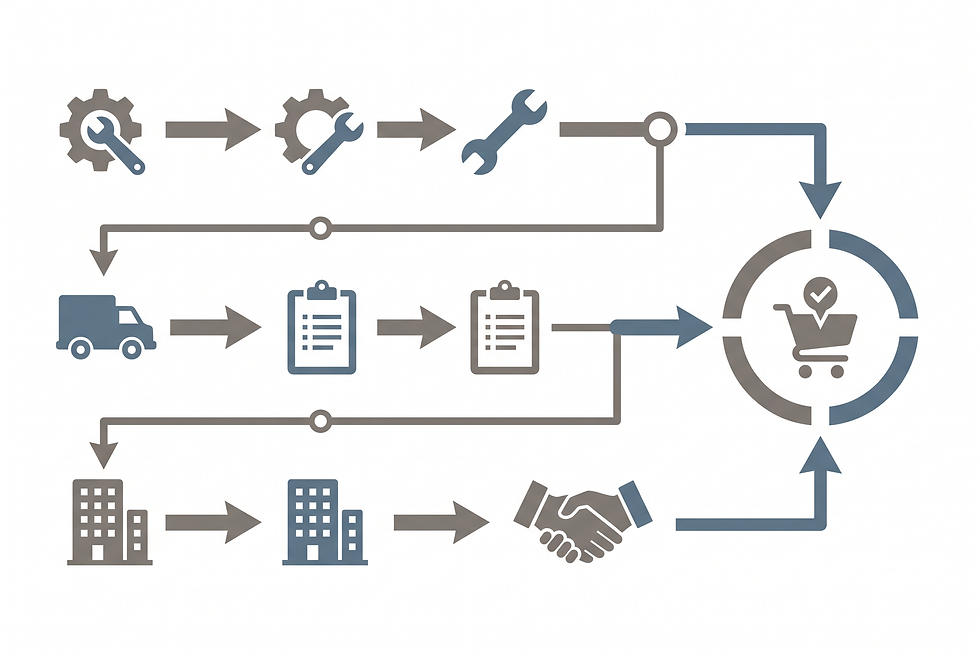
Three Structural Pillars of Enterprise Industrial Ecommerce
To translate buyer segmentation into measurable commercial outcomes, industrial enterprises build their digital infrastructure around three foundational capabilities.
1. Telematics and Serial-Number Asset Mapping
Heavy machinery components cannot be reliably procured through conventional keyword search bars. An industrial excavator or generator contains thousands of interchangeable and non-interchangeable components depending on production year, engine modification, and field operating conditions.
Enterprise platforms resolve this technical challenge by tying customer digital profiles directly to their registered machinery assets. When a field technician accesses the platform, the interface filters catalog results against specific machine serial numbers and telematics diagnostic fault codes. This eliminates incorrect component orders, lowers return rates, and preserves asset uptime.
2. Integrated Dealer Network Orchestration
Industrial commerce rarely operates as a pure direct-to-buyer transaction. Authorized regional dealers provide crucial localized services including equipment staging, mechanical assembly, emergency field repair, and customized commercial credit terms that central manufacturers cannot operate at scale.
Effective digital architecture routes online buyer orders through the appropriate local dealer based on physical geography, stocked inventory, and existing contractual relationships. Rather than disintermediating the dealer channel, the digital platform serves as a unified digital storefront that accelerates dealer order throughput, maintains territorial alignment, and provides real-time visibility across distributed channel inventory.
3. Tiered Human-in-the-Loop Governance Workflows
Full commercial automation is appropriate for standard consumables and pre-negotiated component reorders, but complex transactions require strict operational safeguards. High-performing industrial architectures incorporate explicit human approval gates based on transactional risk.
Standard preventive maintenance supplies, hydraulic fluids, and pre-approved replacement parts process autonomously up to predetermined account spending limits. However, custom engineering modifications, requests for non-standard payment terms, volume price discounting, and machinery procurement above established capital thresholds automatically pause for commercial review. Sales directors and technical specialists review the contextual digital data before issuing binding commercial approvals.
Implementation Roadmap: Designing Resilient B2B Buying Workflows
Commercial and export directors modernizing their digital sales operations should adopt a phased deployment strategy to avoid operational disruption:

Conduct Account Complexity Audits: Categorize existing customer accounts by order volume, technical configuration complexity, and required stakeholder touchpoints.
Deploy Asset-Linked Self-Service: Construct a parts and consumables catalog connected to equipment schematics and serial numbers to automate routine replenishment.
Integrate Channel Partner Data: Connect ERP and warehouse inventory feeds from authorized regional dealers to deliver transparent lead times and local fulfillment.
Establish Strict Approval Rules: Define explicit criteria where digital workflows must escalate to human commercial leadership—such as customized warranty requests, custom fabrication requirements, and multi-unit bids.
Monitor Multi-Stakeholder Intent: Capture digital buyer signals across the entire purchasing committee to identify high-value enterprise requirements early.
Organizations seeking to align digital buyer engagement with enterprise sales execution can evaluate our methodologies for B2B Sales Account Strategy and Industrial Pipeline Optimization to refine their go-to-market workflows.
Connecting Self-Service Portals with Enterprise Revenue Architecture
Managing the intersection of autonomous digital purchasing and consultative enterprise sales remains a primary challenge for industrial equipment manufacturers. While self-service portals handle predictable, high-frequency transactions efficiently, multi-stakeholder equipment acquisitions require coordinated human engagement.
YTTAI supports industrial manufacturing and commercial operations by orchestrating digital buyer signals and routing complex enterprise intent into structured sales workflows. Instead of treating high-value industrial buyers as generic web traffic or relying on unassisted contact forms, YTTAI evaluates commercial intent signals, organizes complex account data, and routes qualified enterprise opportunities directly to responsible commercial and technical teams.
By integrating account-level signal tracking with structured governance boundaries, commercial directors gain complete visibility across dealer, distributor, and enterprise interactions, ensuring strategic accounts receive prompt, highly context-rich human consultation.
Conclusion
The fundamental insight from global industrial leaders is that digital buying journeys must reflect account complexity rather than forcing all buyers into a singular channel. Forcing enterprise capital equipment negotiations into a standard web checkout leads to lost deals, while forcing routine parts buyers through complex manual RFQ cycles creates costly operational delays.
By segmenting digital touchpoints, integrating regional dealer fulfillment, and establishing strict human approval checkpoints for high-risk commercial decisions, industrial enterprises establish durable digital commerce engines that drive sustainable revenue growth.
FAQ
Why is a uniform digital customer journey ineffective for industrial B2B commerce?
Industrial manufacturing serves fundamentally diverse buyer roles, ranging from field technicians needing immediate replacement parts to procurement executives negotiating multi-million-dollar machinery acquisitions. A uniform customer journey creates operational friction by failing to provide the speed required for emergency repairs while lacking the technical validation, governance, and custom contract workflows required for strategic equipment investments.
How do industrial equipment manufacturers avoid channel conflict with authorized dealers?
Leading equipment manufacturers integrate regional authorized dealers directly into their digital commerce architecture. The central digital platform acts as a unified customer front-end, while transactions are dynamically routed to local dealers for regional inventory fulfillment, field service, warranty support, and credit management, thereby preserving dealer margins and expanding territorial coverage.
What commercial decisions require human approval in automated industrial ecommerce?
Human approval boundaries are essential for non-standard pricing negotiations, custom engineering modifications, extended warranty agreements, credit limit overrides, and multi-unit capital equipment contracts. Routine consumable reorders within pre-approved spending limits can execute fully autonomously, while high-risk commercial commitments require review by designated commercial or engineering directors.
Align Your Industrial Accounts with Intelligent Routing
Discover how commercial leaders orchestrate complex buyer signals, protect dealer relationships, and accelerate enterprise manufacturing pipelines with structured intelligence.



Comments