%20%E6%8B%B7%E8%B4%9D.png)
AI Project Sales Rep for Water Treatment Equipment: Scaling Engineering Pipeline

Executive Summary: Capital equipment manufacturers in the water and wastewater treatment sector face lengthy sales cycles, complex engineering specifications, and fragmented stakeholder networks. Deploying an AI project sales rep for water treatment equipment bridges the gap between public project notices and active engineering bids. By systematically monitoring regulatory filings, matching technical specifications, and managing disciplined outreach to EPC contractors and plant engineers, manufacturers transform unstructured capital signals into verified pipeline opportunities without expanding engineering overhead.
Company Snapshot: Capital Sales in Industrial Water Systems
Water treatment and environmental equipment manufacturers engineer specialized systems, including membrane bioreactors (MBR), reverse osmosis skids, dissolved air flotation (DAF) units, industrial clarifiers, and advanced oxidation systems. These solutions serve heavy industry, municipal utilities, power generation, chemical processing, and food and beverage production.
Commercial transactions in this sector rarely follow standard B2B e-commerce or linear SaaS funnels. Contracts range from hundreds of thousands to tens of millions of dollars. Sales cycles routinely extend from 9 to 24 months, involving multiple organizational tiers, engineering consultations, and regulatory approvals. Profitability depends heavily on securing early design-in status during front-end engineering design (FEED) stages before tenders go out for broad public procurement.
How Water and Environmental Equipment Is Bought and Sold
The procurement chain for industrial water treatment equipment is indirect and heavily mediated. Original Equipment Manufacturers (OEMs) rarely sell directly to an end-user corporate executive in isolation. Instead, procurement flows through a complex matrix of stakeholders:
EPC Contractors & Design Engineering Firms: Entities such as Jacobs, AECOM, Black & Veatch, or regional civil engineering practices draft baseline design specifications and select approved vendor lists (AVL).
Plant Asset Owners & Environmental Directors: Industrial operators who require effluent compliance, zero liquid discharge (ZLD), or water recycling to satisfy regional environmental mandates.
Municipal Utilities & Operations Contractors: Public and semi-private utilities managing municipal wastewater treatment works under rigorous public procurement laws.
Equipment Distributors & Regional Systems Integrators: Local partners handling physical skid assembly, electrical integration, commissioning, and localized maintenance.
Winning a major bid requires technical equipment manufacturers to identify capital expenditure (CapEx) initiatives at the permitting or feasibility stage. If an OEM discovers a project only when the formal request for quotation (RFQ) is publicly issued, competitor equipment is often already pre-specified into the engineering drawings, drastically reducing win rates.
The Business Problem: Structural Friction in Technical Capital Sales
Manufacturers of water treatment machinery face distinct operational bottlenecks that prevent predictable pipeline growth across domestic and global territories:
High Research Overhead: Uncovering planned expansions, plant modernizations, and municipal infrastructure projects requires combing through planning board agendas, environmental impact reports, discharge permit applications, and regional procurement portals. Highly paid application engineers spend disproportionate time doing manual data collection rather than sizing equipment.
Complex Multi-Stakeholder Mapping: An individual project requires building relationships with the lead process engineer at an EPC, the environmental compliance manager at the client facility, and the regional project director. Identifying these specific technical personas manually across hundreds of active projects is slow and incomplete.
Long Follow-Up Latency: Between initial project announcement, design feasibility, EPC contractor selection, and equipment procurement, months or years can elapse. Human sales teams routinely lose touch during quiet phases, allowing competing vendors to capture the project when design milestones advance.
Inefficient Technical Qualification: Initial inquiries often lack critical operational parameters, such as chemical oxygen demand (COD), total suspended solids (TSS), daily flow rates ($m^3/day$), and footprint constraints. Sales teams waste extensive engineering hours chasing projects that fail basic feasibility or budget thresholds.
The Shift: From Ad-Hoc Prospecting to Automated Project Intelligence
Leading environmental equipment manufacturers are moving away from manual directory prospecting and static database lists. Instead, they implement automated operating workflows that treat capital sales as an intelligence pipeline.
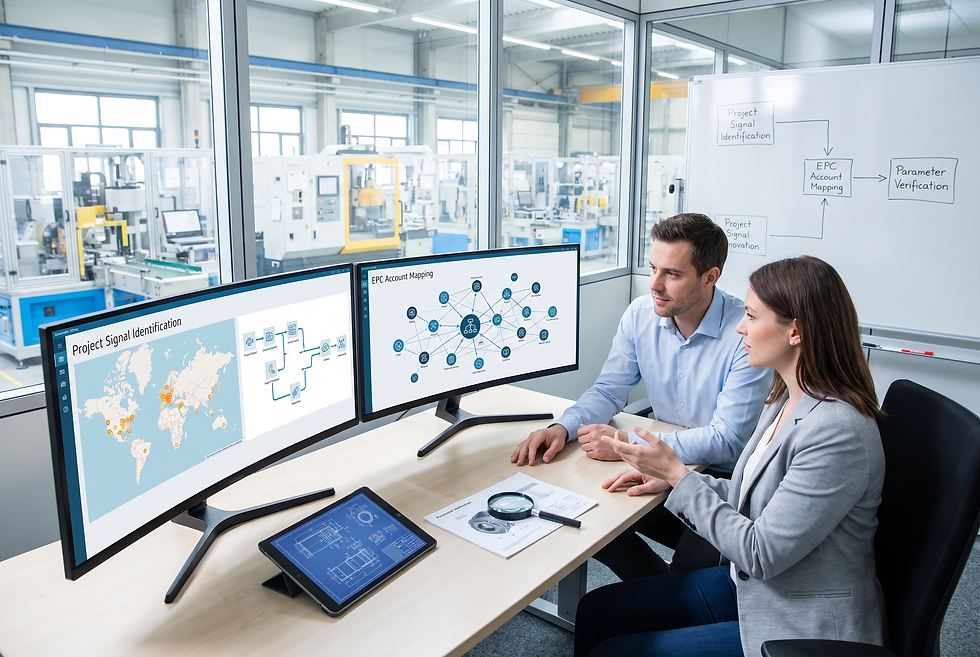
This operating model combines automated scanning of industrial project registries, permit filings, and tender notices with systematic account enrichment. Rather than deploying generic email cadences, the workflow contextualizes every interaction around verifiable project milestones: an approved environmental impact study, a planned refinery expansion, or a municipal wastewater upgrade grant.
By systematizing project discovery, stakeholder verification, and technical parameter gathering, technical sales engineers focus exclusively on sizing equipment, refining process flow diagrams (PFDs), and presenting commercial proposals.
How the Engineering Sales Workflow Operates
A modern capital equipment sales workflow translates raw market signals into qualified commercial bids through structured, verifiable stages:
Signal Ingestion & Project Identification: The system continuously monitors municipal planning registries, state environmental agency filings, EPC press releases, and global procurement feeds to detect new capital expenditure announcements in target verticals.
Engineering Parameter Extraction: Unstructured documents (e.g., environmental permits, facility blueprints, project descriptions) are parsed to identify core technical attributes such as treatment capacity, target contaminants, influent water characteristics, and required discharge standards.
Account & Stakeholder Graph Construction: The workflow identifies the assigned EPC engineering firm, the plant asset owner, and key technical roles (Process Engineer, Project Director, Environmental Health & Safety Manager).
Contextualized Technical Outreach: The system drafts tailored, technical communications to engineering counterparts, referencing the specific project milestone, relevant case studies in the same effluent category, and preliminary design criteria.
Parameter Collection & Pre-Qualification: When stakeholders respond, the system gathers essential operational inputs (influent chemistry, flow rates, discharge limits, site constraints) using structured technical questionnaires.
Human Application Engineer Review: Once all mandatory engineering parameters and timeline checkpoints are established, the opportunity is handed off to a senior application engineer or regional sales director to execute formal process sizing, CAD/BIM modeling, and commercial proposal drafting.
Closed-Loop Pipeline Governance: The interaction logs, stakeholder notes, and technical files are synchronized with the enterprise CRM, scheduling automated milestone check-ins aligned with the projected FEED and procurement schedule.
Workflow Stage | Operational Trigger | Automation & AI Responsibility | Human Engineer Responsibility | Commercial Outcome |
1. Signal Detection | State discharge permit application filed | Ingest filing, identify facility, extract wastewater volume ($m^3/d$) | None (automated background process) | Early visibility before public tender |
2. Account Mapping | EPC awarded design contract | Identify designated engineering firm and lead process team | Approve target account list | Accurate stakeholder matrix across EPC and Owner |
3. Technical Outreach | Project enters FEED stage | Dispatch personalized technical brief with relevant pilot test data | Review tailored messaging for key enterprise accounts | High-response engagement with project engineers |
4. Scoping & Triaging | Prospect responds with project scope | Collect influent/effluent specs, flow profile, and delivery timelines | Verify technical feasibility against standard equipment line | Fully qualified engineering inquiry ready for design |
5. Proposal Handoff | Technical specs verified | Package project file, update CRM, create sizing task | Execute process design, mass balance, and formal quotation | Clean handoff to regional sales leadership |
Evidence and Measurable Operational Results
Data from enterprise industrial sales studies and capital equipment market analyses demonstrate the tangible impact of operationalized project discovery:
Accelerated Lead-to-Quote Times: According to industry research published by the Association of Equipment Manufacturers (AEM), capital equipment firms that operationalize early-stage project tracking experience up to a 40% reduction in customer acquisition lead time compared to firms relying solely on public bid portals.
Higher Specification Capture Rates: A benchmark study by McKinsey & Company on industrial machinery sales indicates that vendors engaging engineering teams during early conceptual and FEED phases win final procurement contracts at more than 2.5 times the rate of vendors entering at the formal RFQ stage.
Optimized Engineering Utilization: Engineering consultancy reports indicate that senior application engineers spend up to 35% of their working hours fielding unqualified inquiries or gathering missing basic parameters. Standardizing the discovery workflow recovers these technical hours for billable proposal generation.
Core Operating Principles for Industrial Manufacturers
Equipment manufacturers seeking to modernize their business development operations should apply several architectural principles:
Prioritize Project Signals Over Generic Company Profiles: In capital goods, selling to a corporate entity is ineffective if they have no active CapEx initiatives. Base outreach triggers on real-world events: plant expansions, compliance deadlines, permit approvals, or EPC awards.
Treat Engineering Data as the Core Qualification Currency: Never advance a prospect to senior sales staff without baseline operating parameters. Establish clear gates for flow rate, influent characteristics, site footprint, and budget authorization.
Engage Both the Specifier and the Owner: Equipment sales succeed when both the EPC process engineer (who specifies the technology) and the plant asset owner (who pays for operating efficiency and reliability) agree on the solution.
Maintain Multi-Year Cadences Aligned to Project Schedules: Capital infrastructure evolves over quarters, not weeks. Maintain disciplined, non-intrusive technical check-ins tied to known construction milestones.
Application Across Environmental and Process Industries
This structured approach to technical sales applies across diverse process equipment verticals:
For Industrial Filtration and Separation Suppliers: Systematically monitor industrial manufacturing facility upgrades to identify opportunities for microfiltration, ultrafiltration, and sludge dewatering retrofits.
For Biogas & Anaerobic Digestion Specialists: Track agricultural waste permits, municipal solid waste mandates, and renewable natural gas (RNG) incentives to engage agricultural cooperatives and utility operators.
For Desalination & High-Purity Water Providers: Follow coastal development permits, semiconductor plant construction announcements, and power plant cooling tower specifications to supply high-recovery reverse osmosis systems.
For Municipal Wastewater System Integrators: Scan regional infrastructure bank disbursements and public works committee meetings to pre-qualify headworks, aeration, and disinfection equipment.
Implementing the AI Project Sales Rep for Water Treatment Equipment
For industrial water and environmental machinery manufacturers, deploying an AI Project Sales Rep for Water Treatment Equipment establishes an autonomous, systematic sales development function. Rather than treating AI as a conversational gimmick, this worker acts as a dedicated technical development representative integrated into your commercial operations.
Job Role and Core Responsibilities
Job Title: AI Project Sales Rep for Water Treatment Equipment
Core Tasks: Continual discovery of environmental and water infrastructure projects; identifying EPC project managers, process engineers, and facility environmental directors; executing personalized technical outreach; and collecting preliminary engineering requirements (BOD/COD levels, TSS, flow rates, pH ranges, footprint constraints).
Primary Work Channels: Corporate Email (direct technical outreach), LinkedIn (professional engineering network research and connection), Project Portals/Registries, and bidirectional CRM integration (HubSpot, Salesforce, Microsoft Dynamics).
Authority Boundary: Autonomously discovers projects, maps accounts, and conducts initial technical scoping; hands over the deal file to human Application Engineers the moment proprietary process sizing, custom engineering design, price discounting, or formal proposal creation is required.
First Value Event: The identification of an unannounced or early-stage capital project, successful verification of the lead EPC engineer or plant manager, and receipt of an initial technical specification sheet (e.g., flow rate and target effluent parameters) ready for engineering review.
Daily Report Delivery: Each morning, sales directors receive a structured digest detailing: newly mapped capital projects, verified EPC contacts added to active cadences, technical responses received with summarized water chemistry parameters, and scheduled technical handover calls for human engineers.
FAQ
How does an AI project sales rep for water treatment equipment handle complex technical specifications?
The AI sales rep uses structured parameter frameworks tailored to industrial water processes. It asks targeted scoping questions regarding influent chemistry (COD, BOD, TSS, heavy metals), flow rates (m3/day or GPM), temperature ranges, and regulatory discharge limits, compiling these into a complete project dossier before handing the opportunity to human application engineers.
What is the primary difference between a generic sales bot and a technical AI project sales rep?
A generic sales bot operates on simple FAQ scripts and conversational prompts. A technical AI project sales rep monitors project intelligence feeds, maps complex relationships across EPCs, consultants, and facility owners, tracks multi-month CapEx development milestones, and operates within strict engineering authority boundaries.
How are customer data, proprietary designs, and confidential bids protected?
Enterprise-grade AI workers operate within secure, tenant-isolated data environments. They strictly adhere to defined organizational authority boundaries, never disclosing proprietary sizing formulas, pricing models, or confidential partner data without explicit authorization from human sales directors.
Scale Your Technical Equipment Pipeline
Equip your environmental engineering business with an AI Project Sales Rep to track early-stage capital projects, map EPC stakeholders, and deliver pre-qualified equipment opportunities directly to your application engineers.


Comments