%20%E6%8B%B7%E8%B4%9D.png)
AI Sales Agent vs Chatbot: Which is Best for Global B2B Sales?

For years, B2B manufacturers, exporters, and industrial firms have added live chat widgets to their websites, hoping to capture overseas buyers. However, many have noticed a frustrating trend: standard chatbots frustrate high-value buyers with repetitive, scripted menus, while failing to answer technical questions about complex machinery, custom mold requirements, or regional safety compliance standards.
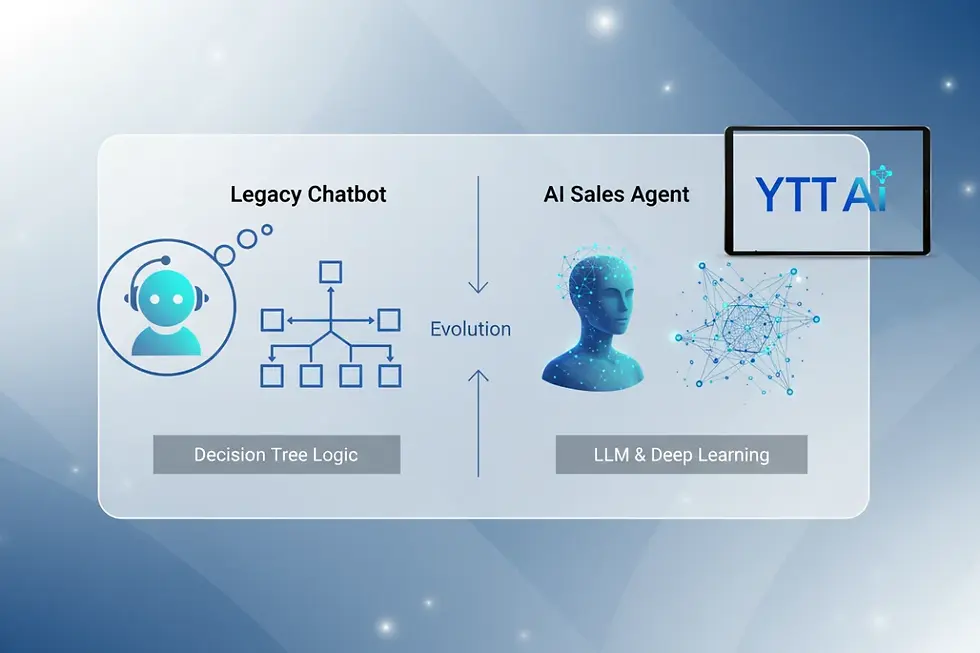
While traditional chatbots rely on pre-programmed decision trees to answer basic FAQs, AI sales agents use large language models (LLMs) to execute complex, multi-step B2B workflows. They autonomously research prospects, handle technical manufacturing inquiries with precise product context, qualify global leads, and manage multi-channel follow-ups.
When evaluating an AI sales agent vs chatbot, understanding this shift from scripted dialog to goal-oriented execution is vital for any global B2B enterprise aiming to scale overseas revenue.
What Is the Core Difference Between an AI Sales Agent and a Chatbot?
To understand the AI sales agent vs chatbot distinction, we must examine their underlying architectures. A legacy chatbot is reactive. It operates like a digital phone tree, asking rigid multi-choice questions to route a user to a human or provide a static link. If a foreign contractor asks, "Do your 25kV power distribution cabinets meet IEEE standards for high-altitude installation?" a standard chatbot will fail, outputting a generic "I don't understand" message.
Conversely, an autonomous agent represents the transition from conversational AI vs generative AI sales. Built on advanced LLMs with deep contextual memory, an agent understands business intent, interprets technical CAD schematics, and queries integrated product databases. It acts as an autonomous sales manager—retrieving accurate parameters, researching the buyer’s company website to assess fit, and compiling structured briefing notes for human review.
Furthermore, when comparing an AI sales assistant vs chatbot, assistants usually require constant human prompts to draft single emails. An AI agent, however, works proactively. It monitors incoming emails, coordinates RFQs (Requests for Quotes), drafts technical follow-ups, and schedules its own pipeline tasks.
AI Sales Agent vs Chatbot: Comprehensive Comparison Matrix
Capability / Feature | Traditional Chatbot | B2B AI Sales Agent (e.g., YTTAI Sales Master) |
|---|---|---|
:--- | :--- | :--- |
Core Technology | Scripted rules, regex matching, basic NLP | LLMs, Agentic workflows, vector search, RAG |
Contextual Memory | Session-only; forgets details once chat ends | Long-term memory; cross-channel tracking (Email, WhatsApp, CRM) |
Technical RFQ Handling | Impossible; directs user to a generic contact form | Reads technical parameters, queries ERP inventories, drafts quote estimates |
Autonomous Research | None | Scrapes prospect website, identifies key decision-makers |
Integrations | Basic CRM lead capture | Bidirectional CRM syncing, ERP connection, inventory lookups |
Operational Logic | Reactive (only responds when spoken to) | Proactive (initiates follow-ups, alerts human sales reps) |
Why Traditional Chatbots Fail in Complex B2B and Manufacturing Sales
In B2B sectors like precision machining, electrical equipment, solar energy, and custom industrial molds, transactions are complex, technical, and high-value. Reddit discussions among procurement professionals and technical buyers highlight deep frustrations with current vendor response systems.
For instance, contractors in subreddits like r/electricians and r/solar frequently complain about slow response times for custom pricing, shipping errors, and suppliers' lack of product knowledge. In high-stakes environments, waiting three days for a sales representative to verify if a specific valve or circuit breaker is in stock can cost a contractor thousands of dollars.
This is where the traditional chatbot fails. It cannot:
Verify Technical Feasibility: A chatbot cannot cross-reference a buyer's custom technical specifications against a manufacturer's engineering capabilities.
Manage Multi-Language Nuances: Global trade involves cross-border communication. Traditional translation APIs often miss specialized industry jargon, leading to misunderstandings.
Handle Dynamic Pricing: In industries where raw material costs fluctuate (e.g., steel, copper, precision machining resins), static chatbot scripts cannot calculate complex tier-pricing rules.
Using a B2B AI sales agent solves these critical bottlenecks by acting as an on-demand technical expert. It instantly parses incoming RFQs, checks raw material availability, and drafts technical proposals in the buyer's native language.
How AI Sales Agents Drive the B2B Pipeline (With Human-in-the-Loop Controls)
Instead of completely replacing humans, the most effective sales organizations use AI agents to automate tedious administrative and research tasks, freeing up human sales representatives to close high-intent deals.
An AI sales agent drives the pipeline through several key autonomous stages:
1. Multi-Channel Lead Capture & Instant Qualification
When a foreign buyer submits an inquiry via email, WhatsApp, or a website portal, the agent immediately analyzes the buyer's intent, country, and company profile. It cross-references this information with your Ideal Customer Profile (ICP) to score the lead based on fit and budget.
2. Autonomous Product Context Matching
Using Retrieval-Augmented Generation (RAG), the agent searches the company’s internal sales knowledge base, past quotation records, product manuals, and compliance certificates to assemble an accurate technical reply.
3. Human-in-the-Loop Approval for Pricing
To prevent unauthorized discount or pricing errors, sophisticated agents compile the draft proposal—complete with calculated shipping rates and bulk pricing—and push it to the human sales manager for final approval. With one click, the representative can modify, approve, and send the professional response.

Integrating AI Sales Agents with CRM and ERP Systems
A critical difference between an AI sales agent vs chatbot is integration depth. While a basic chatbot simply forwards email notifications, an AI agent operates deep within your enterprise tech stack.
Modern sales automation software must synchronize with CRM platforms (like HubSpot or Salesforce) and ERP databases to maintain a single source of truth.
CRM Synchronization: The agent logs every email interaction, WhatsApp message, and document exchange directly to the prospect's CRM contact card. No more lost leads or missed follow-ups.
ERP and Inventory Lookups: In manufacturing, order lead times are critical. By connecting to your ERP, the agent can inform buyers of current production lead times, material backlogs, and real-time shipping schedules.
Automated Lead Routing: Once a lead is qualified as high-intent (e.g., a procurement manager requesting a formal quote for 10,000 custom-machined components), the agent instantly routes the lead to the correct regional sales executive.
Key Performance Indicators (KPIs) to Measure AI Sales Agent Success
Implementing advanced AI sales workflows requires tracking tangible business outcomes. Enterprise teams transitioning from legacy chatbots to autonomous sales agents typically monitor the following key metrics:
Lead Response Time (LRT): Reducing response time from hours (or days) to under 5 minutes globally, directly boosting conversion rates.
Technical Accuracy Rate: Measuring how accurately the AI identifies technical parameters and customer requirements without human correction.
Pipeline Velocity: Tracking how quickly a raw inquiry moves from initial contact to a signed contract.
Quote Follow-up Rate: Evaluating the percentage of submitted quotes that receive consistent, multi-stage follow-ups.
How to Choose the Right Solution for Your Global Export Business
For industrial manufacturers, mold makers, and global exporters, selecting the right technology is the difference between a high-converting automated pipeline and a leaky funnel.
If your business only needs to answer basic office hours, shipping policies, and track order numbers, a basic, rule-based chatbot may suffice. However, if your sales cycle involves multi-layered technical negotiations, complex RFQs, global buyers speaking multiple languages, and long-term email follow-ups, investing in a robust AI sales agent is essential.

By leveraging tools like YTTAI Sales Master, global exporters can build an omnipresent, 24/7 sales department that understands technical product details, speaks 40+ languages, and qualifies leads autonomously before a human rep ever logs in.
Compare YTTAI Sales Master with your current stack today to automate your global B2B pipeline, streamline complex RFQs, and secure more high-value international contracts.
FAQ
What is the primary difference when comparing an AI sales agent vs chatbot?
A chatbot relies on pre-programmed, rigid decision trees to answer basic questions or route users. An AI sales agent uses advanced Large Language Models (LLMs) to perform complex, goal-oriented sales tasks autonomously, such as researching prospect companies, analyzing technical specifications, qualifying leads, and generating drafted RFQs.
Can a B2B AI sales agent integrate with our existing CRM and ERP systems?
Yes. Unlike legacy chatbots that only capture contact information, a high-quality B2B AI sales agent integrates bidirectionally with CRMs like HubSpot and Salesforce, as well as ERP systems to sync real-time stock levels, check manufacturing lead times, and update prospect statuses automatically.
How does conversational AI vs generative AI sales affect technical B2B inquiries?
Conversational AI focuses on natural language chatting within preset limits. Generative AI sales technology actually synthesizes new content, reading custom technical datasheets, CAD parameters, or industrial compliance codes, and generating customized, highly accurate technical responses tailored to a buyer's exact inquiry.
Is human control maintained when utilizing sales automation software?
Absolutely. Leading AI agents employ 'Human-in-the-Loop' (HITL) configurations. While the AI agent performs 90% of the research, qualification, and draft creation, the actual pricing confirmation and delivery of quotes remain under the final approval of your human sales representatives.


Comments