%20%E6%8B%B7%E8%B4%9D.png)
AI Workforce Platform for B2B: What Makes an AI Worker Hire-Ready?

Executive Summary
Modern industrial and technical enterprises are transitioning from fragmented software subscriptions to autonomous digital labor. Evaluating an ai workforce platform for b2b requires understanding how digital workers handle structured job definitions, authority guardrails, system integrations, and auditable daily outputs. This operational analysis examines how high-consideration B2B firms deploy hire-ready AI workers to accelerate pipeline velocity, resolve quotation bottlenecks, and maintain institutional governance without adding operational overhead.
Company Snapshot: The Operational Realities of Complex B2B Commerce
In complex B2B sectors—ranging from precision machining and industrial automation to specialized process equipment—revenue generation does not follow a linear e-commerce path. Buying cycles stretch over months, requiring multifaceted stakeholder coordination, detailed engineering reviews, and rigorous Request for Proposal (RFP) evaluations.
Organizations operating in these verticals typically generate value through high-mix, engineered-to-order, or technically configured equipment. Their core buyers are procurement directors, plant managers, and technical operations leads who require exacting technical validation before issuing a purchase order. In this commercial environment, operational excellence depends on the speed, accuracy, and domain competence of the frontline commercial and engineering support teams.
What Complex B2B Enterprises Actually Sell: The Sales Mechanism
Industrial and enterprise equipment manufacturers do not sell self-serve commodities. A standard commercial transaction involves multiple stages of technical discovery, custom parameter verification, compliance checks, and cross-functional approvals.
When a prospect requests a quotation, the commercial team must cross-reference CAD models, application parameters, supply chain lead times, and regulatory standards. The sales cycle demands synchronized communication across email, WhatsApp, enterprise customer portals, and internal ERP systems. Because customer trust is tied to technical precision, any breakdown in qualification, response latency, or follow-up consistency directly degrades conversion rates and margins.
The Business Problem: The Breakdown of Traditional Tool Stacks
Historically, mid-market and enterprise B2B companies attempted to scale commercial operations by stacking software tools. They introduced CRM systems, marketing automation suites, conversational chatbots, and sales engagement platforms. However, this tool-centric approach created significant operational friction:
Severe Lead Latency: Technical inquiries and RFPs sat in shared inboxes or CRM queues for 48 to 72 hours awaiting manual triage by overstretched technical sales engineers.
Follow-Up Drop-Off: Field sales reps focused exclusively on late-stage negotiations, leaving top-of-funnel inquiries, dormant accounts, and secondary export territories unworked.
Knowledge Silos: Critical product compatibility rules, delivery tolerances, and regional pricing matrices remained locked in static PDFs or veteran employees' heads.
Context Switching and Fatigue: Knowledge workers spent up to 40% of their working hours copying data between email clients, CRM records, and quoting sheets rather than engaging in high-leverage strategic negotiations.
Generic conversational chatbots failed to resolve these issues because they lacked role context, execution capabilities, and deterministic governance boundaries.
What Changed: Moving from Passive Software to Governed AI Workers
To resolve this structural bottleneck, forward-looking B2B organizations have shifted their deployment paradigm. Instead of purchasing more passive software interfaces that demand human data entry, enterprises are adopting an ai workforce platform for b2b designed to deploy role-specific, autonomous digital workers.
Unlike an isolated chatbot or an open-ended copilot, an enterprise-grade AI worker is configured with a structured Job-to-be-Done (JTBD), comprehensive standard operating procedures (SOPs), real-time tool connections, and strict decision boundaries. The focus shifts from conversational novelty to operational delegation: onboarding a digital team member capable of owning an end-to-end operational workflow.
Architecting an AI Workforce Platform for B2B: The 7 Core Operational Pillars
For an AI worker to be truly hire-ready in an enterprise environment, the underlying platform must support seven foundational operational capabilities:
1. Explicit Job Definition and Role Scoping
An AI worker must possess a clearly defined role profile that mirrors a human job description. Rather than functioning as a generic text assistant, the worker operates within defined boundaries (e.g., qualifying incoming industrial pump inquiries or validating technical specifications for CNC tooling). It understands its core responsibilities, expected deliverables, and performance benchmarks.
2. Deep Institutional Context and Onboarding
Effective onboarding requires ingesting structured and unstructured institutional data. This includes technical product catalogs, pricing rules, regional compliance documents, historical customer communications, and corporate tone guidelines. The AI worker utilizes hybrid Retrieval-Augmented Generation (RAG) and structured semantic routing to ensure domain-specific responses without hallucination.
3. Bidirectional Tool and Ecosystem Connection
A hire-ready AI worker cannot remain trapped in a siloed chat window. It must integrate natively via APIs and webhooks with enterprise systems of record, including CRMs (Salesforce, HubSpot), ERP systems, quotation tools, and messaging channels (Outlook, Gmail, WhatsApp Business, WeChat). It must be capable of both reading context and executing state changes in external databases.
4. Deterministic Authority Boundaries and Guardrails
Enterprise risk management requires unambiguous operational autonomy thresholds. The platform must allow business leaders to set strict permission tiers:
Full Autonomy: Answering standard technical FAQ inquiries, logging CRM notes, and scheduling calendar appointments.
Conditional Autonomy: Drafting complex custom quotes or technical proposals based on pre-approved pricing tiers.
Mandatory Human Escalation: Handing off non-standard commercial discounts, custom engineering modifications, or high-value contract disputes to human directors.
5. Autonomous Continuous Execution
Digital workers operate continuously across global time zones. When a prospective buyer submits an inquiry at 2:00 AM from a different continent, the AI worker ingests the parameters, queries internal technical specifications, verifies catalog fit, and responds within minutes—eliminating the traditional multi-day lag in international trade.
6. Auditable Daily Reporting and First Value Milestones
Transparency is essential for organizational trust. An enterprise AI workforce platform provides structured daily shift reports outlining actions taken, conversations handled, pipeline qualified, tasks escalated, and anomalies detected. The system demonstrates a measurable First Value Event (e.g., the first end-to-end qualified and scheduled technical discovery meeting) within days of initial onboarding.
7. Scalable Multi-Worker Orchestration (The Second Hire)
Once a single digital worker proves operational ROI, the platform enables horizontal scaling. Organizations can onboard complementary workers—such as an inbound SDR worker passing qualified opportunities to a technical quotation specialist—creating a synchronized digital workforce that shares institutional memory across departments.
How the Autonomous Workflow Operates in Practice
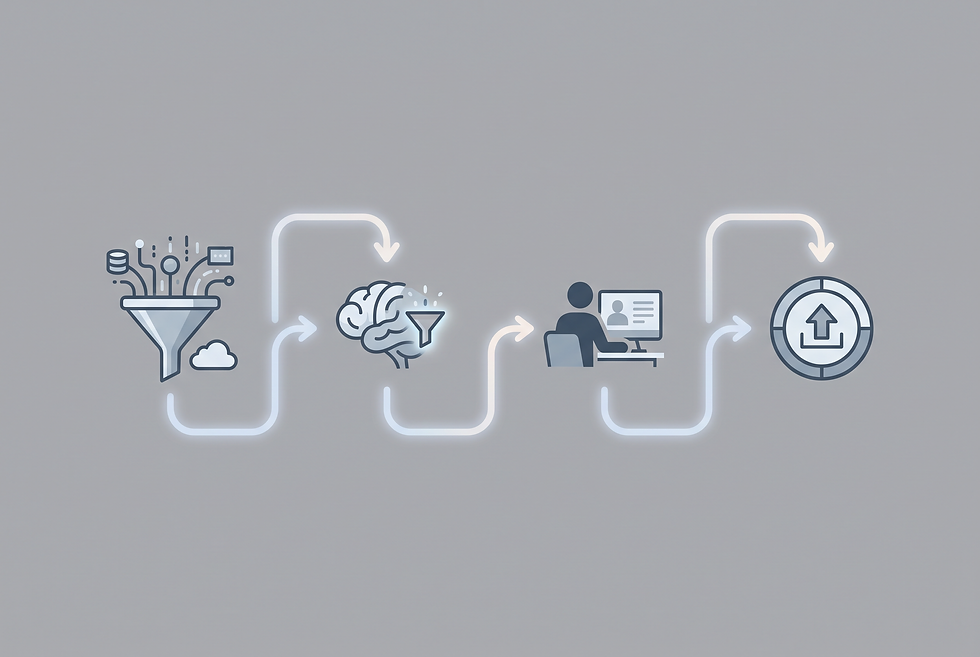
The following step-by-step workflow illustrates how a hire-ready AI worker processes technical B2B inquiries from initial ingestion to verified business outcome:

Data Ingestion: The AI worker continuously monitors designated commercial channels (e.g., enterprise email queues, website technical request forms, and messaging apps).
Contextual Retrieval: The worker extracts key parameters (application fluid, pressure rating, material tolerance, volume) and retrieves exact technical documentation and pricing logic.
Intent and Authority Check: The worker evaluates the inquiry against its governance rules. If parameters match standard guidelines, it advances to generation; if outside standard thresholds, it flags a human engineer.
Structured Generation and CRM Logging: The AI worker drafts a complete, contextual response, creates or updates the CRM deal record, and attaches the relevant technical datasheets.
Human Review (When Triggered): If the transaction value or engineering variance exceeds the worker's authority ceiling, a notification is sent to the designated sales director with a pre-drafted response ready for one-click approval.
Customer Delivery & Proactive Nurturing: Upon approval or autonomous dispatch, the response is delivered through the customer's preferred channel. The AI worker automatically schedules multi-stage, value-added follow-ups.
Shift Reporting: At the end of each operational cycle, the system compiles an executive summary of pipeline metrics, resolution times, and review queues.
Operational Comparison: Legacy Tool Stacks vs. Hire-Ready AI Workforce
The table below contrasts traditional software-driven B2B operations with a fully orchestrated AI worker deployment.
Operational Dimension | Traditional B2B Tool Stack | Generic AI Chatbot / Copilot | Enterprise AI Workforce Platform |
Operational Model | Manual human data entry into passive SaaS tools | Prompt-dependent, isolated conversational assist | Delegated, autonomous role execution with clear SOPs |
Time to First Response | 24–72 hours across distributed teams | Instant, but limited to generic pre-set scripts | Sub-5 minutes with full technical context and accuracy |
Systems Integration | Siloed databases requiring manual synchronization | Surface-level iframe or simple webhook triggers | Bidirectional read/write integration with CRM, ERP, and email |
Governance & Safety | Dependent on human compliance and manual audits | Unpredictable prompt drift; risk of hallucination | Deterministic authority guardrails with mandatory escalation |
Output & Accountability | Individual task tracking in project boards | No operational ownership or outcome tracking | Structured Daily Reports, task audits, and measurable KPIs |
Scalability | Linear headcount growth required to scale volume | Low maintenance, but zero complex workflow depth | Elastic digital workforce scaling across regions and roles |
What Enterprise Leaders Must Learn from Early Implementations
Organizations successfully scaling autonomous digital labor follow three core operational principles:
Principle 1: Hire for Roles, Not Generic Tools. Do not evaluate AI platforms as software feature checklists. Evaluate them as operational capacity. Define the job title, daily tasks, authority ceiling, and required business output exactly as you would for a full-time employee.
Principle 2: Ground Autonomy in Strict Operational Guardrails. Enterprise adoption succeeds when risk is bounded. Give AI workers high autonomy for repetitive, deterministic qualification and follow-up tasks, while enforcing strict human sign-off for custom engineering, contract terms, and pricing exceptions.
Principle 3: Prioritize First Value Over Massive System Overhauls. Avoid 12-month digital transformation projects that deliver no early utility. Implement a single, focused AI worker targeting a high-friction bottleneck—such as inbound international inquiry qualification—to establish a proven First Value Event within 14 days.
What This Looks Like Across B2B Verticals
This operational framework applies across multiple high-consideration industries:
For an Industrial Automation Manufacturer: An AI worker ingests complex machinery inquiries, validates payload and reach specifications against digital catalogs, and qualifies distributor leads before dispatching to regional technical reps.
For a Precision CNC & Contract Manufacturer: An AI worker triages incoming RFQs, verifies material requirements and manufacturing tolerances, cross-references machine availability, and drafts baseline estimates for engineering review.
For Commercial Water Treatment Systems: An AI worker handles engineering project specifications, verifies water chemistry parameters, and coordinates site survey scheduling with field engineers.
Deploying the YTT AI Worker: AI Global Sales Rep
Within the YTT AI Workforce architecture, the most effective entry point for global industrial and B2B manufacturers is the deployment of a dedicated AI Global Sales Rep.
Role Job Title: AI Global Sales Rep
Main Daily Tasks: Continuous 24/7 technical lead qualification, RFP data extraction, automated multi-channel follow-up across email and WhatsApp, catalog recommendation, and CRM record enrichment.
Primary Work Channels: Corporate Email (Outlook/Gmail), WhatsApp Business API, Website Technical Forms, and Enterprise CRM integrations.
Authority Boundary: Fully authorized to deliver standard technical datasheets, answer application FAQs, and schedule qualified discovery meetings. Automatically escalates custom price adjustments, non-standard warranties, and contract terms to senior commercial directors.
First Value Event: The first complex international inbound RFQ triaged, enriched in the CRM, technically matched to catalog specs, and scheduled for an engineering discovery call within 10 minutes of submission.
Daily Report Result: A structured morning digest delivered to the Commercial Director summarizing qualified international leads, meetings booked, pending quotation approvals, and follow-up metrics across active pipeline accounts.
FAQ
What distinguishes an enterprise AI workforce platform from generic LLM copilots?
An enterprise AI workforce platform deploys role-specific digital workers equipped with structured job definitions, institutional knowledge integrations, bidirectional system actions, and strict governance guardrails. Unlike generic copilots that require continuous human prompting, AI workers operate autonomously within defined authority boundaries and deliver auditable daily reports.
How do B2B companies maintain governance and prevent AI hallucinations?
Governance is enforced through deterministic authority boundaries, hybrid Retrieval-Augmented Generation (RAG) tied strictly to verified enterprise data, and automated human-in-the-loop escalation paths for non-standard parameters, custom pricing, or contract negotiations.
What systems does an AI worker connect to in a standard B2B enterprise stack?
Hire-ready AI workers integrate natively via secure APIs with enterprise CRMs (Salesforce, HubSpot), ERP platforms, quotation software, scheduling tools, and commercial communication channels including corporate email (Outlook, Gmail), WhatsApp Business, and web portals.
How quickly can a B2B enterprise realize the First Value Event from an AI worker?
By focusing on a single high-friction role—such as the AI Global Sales Rep handling inbound technical qualification—organizations typically achieve their First Value Event within 7 to 14 days of onboarding without requiring extensive legacy system overhauls.
Scale Your Enterprise Operations with an Autonomous AI Workforce
Transition from manual data entry to autonomous operational execution. Explore how YTT AI Workforce deploys hire-ready digital workers tailored to your technical sales and operations workflows.


Comments