%20%E6%8B%B7%E8%B4%9D.png)
B2B Marketing Agency Manufacturing Guide: 12 Questions Before Hiring

Executive Summary: Industrial manufacturers are shifting from traditional brand agencies to performance and systems-driven commercial partners. This evaluation guide provides engineering and industrial commercial leaders with twelve verifiable operational questions to audit agency technical literacy, RFQ quality controls, search visibility, data governance, and AI worker orchestration. By replacing disconnected marketing retainers with end-to-end sales routing workflows, industrial enterprises turn digital discovery into pipeline velocity.
Evaluating a B2B Marketing Agency Manufacturing Partner: The Operational Reality
Industrial manufacturing operates under fundamentally different commercial dynamics than consumer goods or generic enterprise software. When industrial machinery manufacturers, precision machining subcontractors, robotics integrators, and automation component suppliers evaluate an external growth partner, traditional consumer-centric marketing benchmarks inevitably fail.
For companies in precision engineering, hydraulic systems, packaging machinery, and contract manufacturing, customer acquisition cycles routinely span six to eighteen months. Deal sizes range from fifty thousand dollars to several million dollars per capital expenditure deployment. The buying unit rarely consists of a single point of contact; instead, purchasing decisions involve cross-functional buying committees comprising plant managers, chief technology officers, procurement directors, compliance officers, and maintenance heads.
In this environment, hiring a b2b marketing agency manufacturing specialist cannot be treated as an outsourcing exercise for creative graphics or superficial impressions. Industrial executives require commercial partners who comprehend production cycle times, tolerance specifications, DIN/ISO standards, export tariffs, and complex distributor channels. When an agency lacks deep domain knowledge, marketing spend produces vanity website sessions and irrelevant inquiries that waste valuable engineering application hours.
The Structural Breakdown: Why Traditional Agency Retainers Fail in Industry
Historically, industrial enterprises engaged digital agencies on monthly time-and-materials retainers focused on top-of-funnel volume. Agency reporting traditionally highlighted metrics such as impressions, click-through rates, raw form fills, and social media interactions. However, commercial directors and export sales leaders consistently report structural breakdowns when bridging top-of-funnel activity with actual factory floor bookings.
The core breakdown occurs at the intersection of technical qualification and commercial handoff. Generic agencies often target broad transactional keywords or produce generic blog posts generated without technical accuracy. The resulting inquiries frequently request single-unit consumer items, student research data, or low-margin requests for quotation (RFQs) that do not align with factory minimum order quantities (MOQs) or machine capabilities.
Furthermore, traditional marketing retainers create severe sales follow-up gaps. When a high-value international distributor or tier-one automotive supplier submits an engineering inquiry across time zones, standard office-hour responses introduce a forty-eight-hour latency. Industrial research shows that initial response time is directly correlated with bid shortlist inclusion. When response times lag, qualified buyers turn to competing regional suppliers.
The Twelve Questions Industrial Leaders Must Ask Before Signing an Agency Agreement
To audit whether a prospective marketing partner possesses the operational rigor necessary for industrial commercial expansion, executive buyers should evaluate the agency against twelve critical procurement questions.
1. Domain Depth: How Do You Validate Technical and Engineering Accuracy?
Industrial buyers immediately detect superficial content. Ask the agency how their editorial and strategy teams extract domain knowledge from your internal subject matter experts (SMEs). Do they utilize former mechanical and electrical engineers, or do they rephrase generalist search results? The agency must demonstrate an operational process for verifying dimensional tolerances, alloy classifications, and industry certifications before any technical collateral or spec sheet is published.
2. Content Architecture: How Do You Map Content to Multi-Stakeholder Buying Committees?
Industrial procurement requires addressing distinct personas simultaneously. The plant manager seeks throughput reliability and minimal line downtime; the safety officer demands OSHA or CE compliance; the CFO focuses on total cost of ownership (TCO) and payback periods; the procurement manager evaluates delivery lead times and payment terms. Inquire how the agency structures multi-track content assets that provide technical schematics for engineers while offering financial justification models for executive sponsors.
3. Search Infrastructure: What Is Your Strategy for Generative Engine Optimization (GEO) and Technical SEO?
Modern industrial sourcing increasingly relies on AI-powered search engines, industry vertical directories, and large language model answers alongside traditional search engines. Ask the prospective agency how they optimize technical product parameters for machine-readable schemas, structured data tables, and citation ecosystems. An advanced b2b marketing agency manufacturing strategist should explain how your product data feeds into automated engineering indexing and generative search engines.
4. Lead Qualification: How Do You Filter Out Sub-MOQ and Non-Commercial Noise?
Raw lead generation metrics are counterproductive if application engineers spend twenty hours a week reviewing non-viable RFQs. Inquire about the agency's qualification architecture. Do they implement gated multi-step CAD upload forms, dynamic MOQ parameters, and domain verification filters? The agency should take contractual responsibility for delivering marketing qualified leads (MQLs) that meet clear technical and financial thresholds.
5. Sales Handoff: How Are Inquiries Enriched and Routed to Regional Sales Reps?
Inquire about the technical integration between web inbound touchpoints and enterprise CRM systems (such as HubSpot, Salesforce, or SAP). Ask how international inquiries are enriched with corporate data, revenue estimates, and geographic territory routing. A viable industrial partner ensures that sales representatives receive full context, including downloaded technical drawings and specific application requirements, within minutes of submission.
6. Speed to Lead: How Does Your Workflow Handle 24/7 Global Time-Zone Inquiries?
For export manufacturers targeting North American, European, or Southeast Asian markets, lead capture happens outside domestic operating hours. Ask the agency if they rely on static contact forms that sit in a queue overnight or if they deploy automated, technically trained digital interaction layers that qualify requirements and schedule discovery calls in real time across international time zones.
7. Attribution and Pipeline Metrics: What Exact KPIs Govern Contract Performance?
Reject vanity dashboards that focus solely on web traffic and impressions. Demand that the agency define success through qualified pipeline value, cost per qualified RFQ, proposal conversion rates, and closed-won revenue influence. The reporting must track deal velocity through each milestone of the industrial sales cycle.
8. Data Ownership: Who Retains Legal Title to Ad Accounts, Creative Assets, and Data Lakes?
Ensure that all Google Ads accounts, LinkedIn Campaign Managers, analytical property tracking, automated qualification workflows, and proprietary customer interaction data remain the exclusive intellectual property of the manufacturer. Under no circumstances should an agency retain proprietary control over the underlying conversion architecture or audience lists.
9. 90-Day Implementation Roadmap: What Measurable Milestone Is Reached by Day 30, 60, and 90?
Avoid multi-month theoretical onboarding phases with zero commercial impact. Require the agency to outline specific deliverables for the first ninety days: technical domain auditing and positioning by Day 30; conversion architecture and automated qualification deployment by Day 60; and live campaign testing and verified pipeline attribution by Day 90.
10. Channel Orchestration: How Do You Balance Organic Search, Paid Acquisition, and Account-Based Marketing (ABM)?
Industrial marketing requires a balance of long-term organic authority and targeted outbound engagement. Inquire how the agency aligns technical search optimization with hyper-targeted ABM campaigns directed at specific engineering accounts, tier-one integrators, and OEM procurement departments.
11. Channel and Distributor Protection: How Do You Mitigate Conflict with Existing Dealer Networks?
Many equipment manufacturers rely on established distributor or representative networks. Ask the agency how their digital demand generation strategy supports regional channel partners rather than alienating them. The workflow should route regional opportunities to authorized dealers while maintaining manufacturer brand governance and buyer transparency.
12. AI Workforce Integration: How Do You Incorporate Intelligent Autonomous Systems into Marketing and Sales Workflows?
Evaluate whether the agency operates on obsolete manual processes or utilizes modern AI sales and commercial workflows. An agency proficient in next-generation B2B operations deploys autonomous workers to handle technical knowledge base retrieval, inbound qualification, CRM data sanitation, and automated multi-lingual export communications.
Comparative Operational Framework: Traditional Agency vs. Modern Industrial Growth System
The following table outlines the fundamental operational differences between a conventional outsourced marketing agency and a modern, workflow-driven industrial commercial engine.

Evaluation Vector | Traditional Marketing Agency Retainer | Modern Industrial Commercial Growth System |
Core Deliverable Metric | Website impressions, clicks, raw form submissions | Verified technical RFQs, pipeline velocity, qualified revenue |
Technical Content Development | Generalist copywriters rewriting Wikipedia & competitor blogs | Structured knowledge capture from internal engineering SMEs |
Lead Qualification Protocol | Basic single-step contact forms sent via email | Dynamic parameter filtering (MOQ, tolerances, CAD, compliance) |
Response Time Latency | 24 to 48 hours during domestic business hours | Sub-minute automated technical acknowledgment and routing |
Search Engine Strategy | Generic keyword targeting and basic metadata updates | Technical Schema, Generative Engine Optimization (GEO), CAD indexing |
System Integration | Disconnected Google Analytics dashboards | End-to-end CRM bidirectional data sync and deal attribution |
Data & Asset Ownership | Agency-managed proprietary accounts and siloed data | 100% manufacturer ownership of all assets, models, and workflows |
Technology Architecture | Manual copywriting and static marketing automations | AI Sales Workers, RAG knowledge bases, automated commercial workflows |
How the Modern Industrial Commercial Workflow Operates
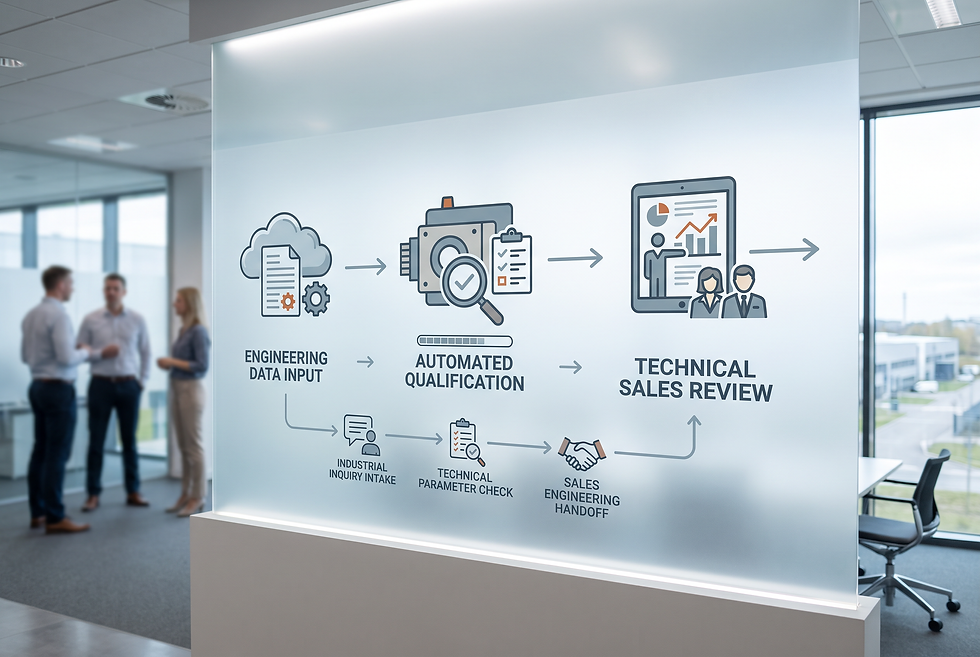
To bridge the gap between initial digital interaction and qualified commercial pipeline, progressive industrial manufacturers deploy structured, automated qualification and routing workflows. The end-to-end mechanism functions across seven distinct steps:
Data and Requirement Ingestion: A potential enterprise buyer lands on a technical solution page via organic search, GEO answer citations, or targeted ABM advertising. The buyer submits application parameters, material specifications, required certifications, and estimated annual batch sizes.
Automated AI Technical Qualification: Rather than routing raw text to an unassigned inbox, an intelligent digital qualification layer evaluates the submission against pre-configured manufacturing constraints (e.g., maximum CNC axis dimensions, minimum order tonnage, or compatible fluid viscosities).
Entity Enrichment and Intent Verification: The system cross-references the buyer's corporate email domain with global enterprise databases to verify company capitalization, credit status, industrial classification, and regional location.
Dynamic Decision Gate: If the inquiry meets high-value tier criteria, the workflow immediately triggers a calendar booking interface for the dedicated application engineering team. If the inquiry is a standard distributor or aftermarket request, it is categorized accordingly.
Human Engineering and Sales Review: The regional sales director or commercial engineer receives an enriched brief containing verified technical specifications, company profile data, and recommended next steps.
Immediate Multilingual Buyer Engagement: The prospect receives an immediate, technically accurate confirmation detailing engineering feasibility parameters and confirmed scheduling details in their native business language.
Continuous Feedback and CRM Optimization: Every interaction, qualification outcome, and pipeline progression status is logged back to the enterprise CRM, continuously refining keyword targeting, audience profiles, and qualification thresholds.
Replicable Methodologies for Industrial Commercial Leaders
When restructuring commercial operations or selecting an external growth partner, manufacturing executives should apply three foundational business principles:
Principle 1: Eliminate Technical Ambiguity from the Discovery Phase. Treat your digital properties not as branding brochures, but as digital application engineers. Publish exact tolerances, operating envelopes, material compatibility matrices, and compliance certifications. Detailed technical documentation repels unqualified retail consumers while building immediate credibility with enterprise procurement committees.
Principle 2: Align Compensation with Commercial Velocity. Transition agency and internal marketing incentives from top-of-funnel discovery to qualified pipeline generation and sales cycle compression. Require partners to demonstrate how every content asset and ad dollar directly moves opportunities through formal engineering review stages.
Principle 3: Deploy Autonomous Operational Layers for Export Expansion. Global industrial buyers do not wait for domestic time zones. Deploying intelligent, automated systems to capture, qualify, and route international technical inquiries ensures your commercial engine operates twenty-four hours a day without expanding headcount linearly.
What This Operating Model Looks Like Across Industrial Verticals
For an Industrial Robotics and Automation Manufacturer: A tier-two automotive components supplier in Germany searches for automated robotic welding cells capable of handling high-strength aluminum alloys. The automated system identifies the payload and cycle time parameters, presents pre-validated integration case studies, verifies facility power requirements, and schedules an engineering technical consultation within three minutes.
For a Precision CNC Machining & Casting Subcontractor: An aerospace contractor uploads STEP files and material tolerance requirements. The dynamic digital portal filters the request against machine bed limits and AS9100 certification requirements, calculates rough capacity availability, and routes the qualified drawing package directly to the chief estimation engineer.
For an Industrial Water Treatment and Pump Manufacturer: A municipal engineering consultancy reviews hydraulic pump curves online. An intelligent digital interface assists the consultant in calculating flow rates and head loss, verifies electrical phase compatibility, and packages a complete submittal sheet for immediate project bidding.
Operationalizing Industrial Sales with an AI Global Sales Rep
To execute this integrated approach without adding administrative complexity, industrial manufacturers deploy dedicated autonomous AI workers alongside human commercial teams.
Within industrial automation, machinery manufacturing, and engineering component exports, the most effective starting configuration is deploying an AI Global Sales Rep.
Primary Work Channels: Official company website technical portal, global RFQ intake endpoints, international email inquiries, and connected CRM platforms.
Main Daily Tasks: Ingesting complex technical inquiries; analyzing CAD/spec parameters against factory capability rules; executing 24/7 multi-lingual technical discovery conversations; verifying international buyer corporate credentials; and assigning high-margin opportunities to human export sales directors.
Authority Boundary: The AI Global Sales Rep is fully authorized to provide public technical documentation, verify dimensional and material compatibility, qualify budget thresholds, and schedule discovery meetings. It is strictly constrained from providing binding commercial pricing, modifying legal contract terms, or signing production commitments without formal human review and engineering authorization.
First Value Event: The first automated capture, technical qualification, and calendar booking of a verified international tier-one procurement buyer outside domestic operating hours, complete with enriched company background and project scope delivered to the sales director.
Daily Operational Report Result: Every morning at 08:00, the commercial leadership team receives a consolidated operational briefing: raw inquiries filtered, qualified international RFQs generated, target account engagement status, technical documentation bottlenecks identified, and pending high-value engineering consultations scheduled for the week.
FAQ
How does a B2B marketing agency for manufacturing differ from a general digital marketing agency?
A specialized manufacturing marketing agency focuses on complex B2B buying cycles, multi-stakeholder engineering committees, technical DIN/ISO compliance, and high-value RFQ qualification rather than consumer vanity metrics like raw traffic and superficial social clicks.
What metrics should industrial manufacturers use to evaluate agency performance?
Manufacturers should evaluate agency performance using verified technical RFQs, cost per qualified engineering lead, pipeline sales velocity, proposal win rates, and direct CRM-attributed revenue rather than impressions or unverified form fills.
Why is Generative Engine Optimization (GEO) critical for industrial equipment manufacturers?
GEO ensures that complex engineering parameters, machine specifications, and technical product catalogs are properly structured, cited, and indexed by AI search engines and LLMs where modern procurement engineers increasingly conduct technical research.
How do AI digital workers support industrial export sales teams?
AI digital workers provide 24/7 multilingual technical qualification, enrich corporate buyer data, verify engineering parameters against factory production capabilities, and immediately route qualified RFQs to regional sales engineers.
Diagnose Your Industrial Growth Engine
Request a comprehensive commercial growth diagnosis to audit your technical content architecture, RFQ qualification workflows, and export pipeline velocity today.


Comments