%20%E6%8B%B7%E8%B4%9D.png)
Customer Communication Management Software B2B vs AI Workers

Enterprise buyers in industrial manufacturing, heavy equipment, and specialized B2B sectors require immediate, technically accurate responses to commercial inquiries. While traditional customer communication management software b2b solutions centralize multi-channel messaging into shared queues, they still depend entirely on manual human triaging. Autonomous AI workers introduce an execution-first paradigm, actively handling inbound intake, technical parameter qualification, multi-touch follow-ups, and structured escalation within existing business systems.
Evaluating Customer Communication Management Software B2B Architecture
For more than two decades, enterprise communication platforms have focused on channel consolidation. Traditional customer communication management software b2b suites aggregate disparate communication channels—such as corporate email, website request forms, live chat widgets, and customer support portals—into a unified operator dashboard. While this consolidation reduced fragmented inboxes, it failed to solve the fundamental labor bottleneck: human commercial and technical personnel must still read, comprehend, categorize, and draft responses for every incoming interaction.
In complex industrial environments, incoming inquiries are rarely simple transactional questions. A prospective buyer typically submits customized technical specifications, computer-aided design (CAD) drawings, bill-of-materials (BOM) files, industry certification mandates, and specific delivery timelines. Traditional software tools treat these complex submissions as unstructured text tickets, leaving the burden of verification on overloaded sales engineers and customer service representatives.
According to Gartner research on B2B buying behavior (2023), business buyers spend only 5% to 6% of their total evaluation journey directly engaging with any single sales representative. The majority of their time is dedicated to independent digital research and cross-functional technical alignment. When a procurement team or engineering director finally initiates contact through an enterprise digital channel, their tolerance for generic automated acknowledgments or prolonged response latency is extremely low.
When traditional communication platforms leave inquiries unaddressed for 24 to 48 hours while waiting for human triage, commercial conversion rates decline precipitously. Furthermore, scaling human coverage across global industrial markets with varying time zones, languages, and technical disciplines requires unsustainable administrative and payroll overhead.
The Software Management Layer vs the Autonomous Execution Layer
Traditional software platforms serve as a passive management layer. They store conversation histories, assign ticket priorities, and present data to human operators. In contrast, an autonomous AI worker operates as an active execution layer. Rather than merely recording incoming messages or firing rigid rule-based routing trees, an AI worker assumes complete operational ownership of specific job functions within defined guardrails.
In high-value technical sectors, an autonomous execution layer performs distinct operational functions:
Multi-Modal Inbound Intake: Ingests unstructured technical specifications, RFQ files, operating conditions, and commercial requirements across digital touchpoints.
Domain-Specific Qualification: Validates buyer project parameters against production capabilities, minimum order quantities (MOQs), geographic service zones, and regulatory compliance rules.
Automated Specification Retrieval: Proactively communicates with buyers to obtain missing technical dimensions, material grades, or certification standards before sales engineer review.
Engineering-Ready Escalation: Compiles verified project data into structured technical briefs and assigns qualified commercial opportunities directly to account directors.
Persistent Cadence Management: Coordinates follow-up schedules, milestone check-ins, and meeting bookings across buying committees without manual intervention.
Automated Operational Reporting: Delivers concise daily operational summaries detailing qualified pipeline additions, active technical verifications, and pending human approvals.
Evaluation Dimension | Traditional B2B Communication Software | Autonomous AI Worker Architecture |
Core Architectural Focus | Centralized inbox aggregation & message routing | Autonomous job role execution & workflow completion |
Labor Requirement | Requires full-time human operators for drafting and triage | Operates autonomously with targeted human exception review |
Response Speed | Hours or days depending on queue backlogs | Instant, context-aware technical acknowledgment 24/7 |
Technical Comprehension | Manual inspection against internal catalogs & ERPs | Autonomous parsing of technical tolerances, BOMs, and RFQs |
Human Approval Boundary | Human manually executes 100% of communication steps | Human reviews commercial pricing, legal terms, and engineering guarantees |
Procurement & Rollout | Multi-seat enterprise software licenses with lengthy setups | Outcome-based workforce deployment (Hire to Start Work in minutes) |
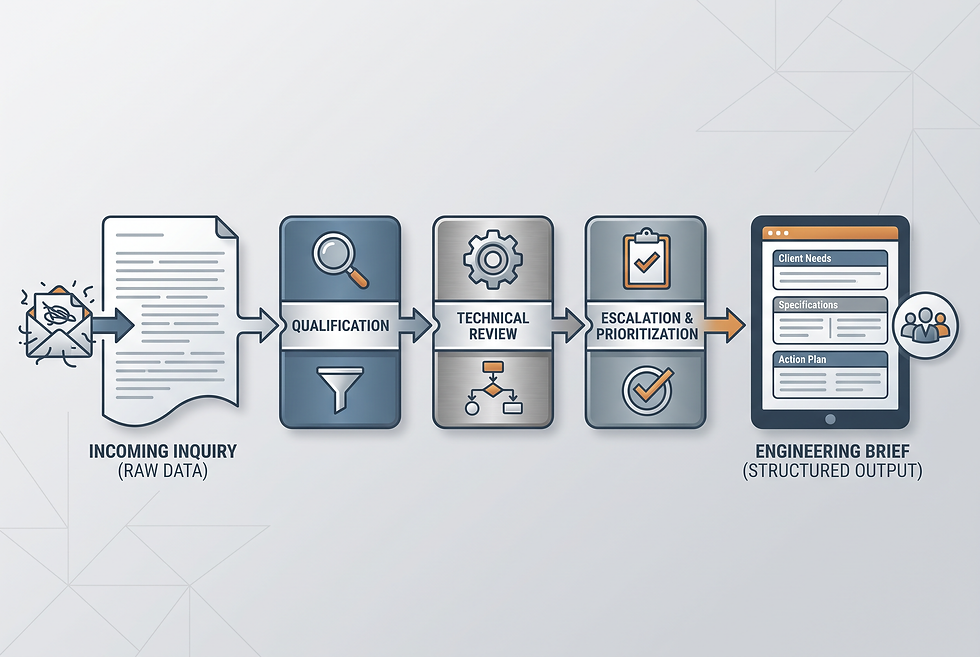
Operational Workflows: How AI Workers Execute Complex Inbound Sequences
To understand how an AI worker transforms industrial customer operations, examine the end-to-end workflow of a technical manufacturing inquiry. When an original equipment manufacturer (OEM) submits a request for precision components, the AI worker initiates an autonomous intake sequence.
First, the AI worker ingests the inbound message, extracts critical data points—such as tensile strength requirements, operating temperature thresholds, annual production volumes, and required ISO standards—and cross-references them against verified engineering catalogs. If critical parameters are omitted from the initial submission, the AI worker immediately generates a contextual, professional follow-up request to collect the missing data.
Second, once the project specifications are complete, the AI worker cross-checks the buyer's corporate entity against account-tier criteria and regional export compliance databases. If the inquiry meets commercial thresholds, the worker organizes the data into an engineering-ready dossier, logs the complete qualification record in the enterprise CRM, and alerts the designated application sales engineer.
Third, the AI worker manages subsequent scheduling, confirming meeting availability between the buyer's procurement team and internal engineering directors. Throughout this interaction cycle, human specialists are relieved of administrative intake, allowing them to focus entirely on high-level solution architecture and commercial negotiations.
According to research from McKinsey & Company (2023) on generative AI in commercial operations, automating complex lead qualification and administrative communication tasks can increase sales team productive capacity by up to 30% to 50%, while dramatically accelerating deal velocity in technical B2B cycles.
Governing Autonomous Communication with Human Approval Boundaries
Deploying autonomous AI systems within industrial manufacturing and mission-critical enterprise environments requires rigorous governance structures. Autonomous execution must never compromise brand reputation, pricing discipline, or legal compliance.
A robust operational framework establishes clear separation between autonomous tasks and human approval boundaries. The AI worker independently manages routine intake, data extraction, standard documentation delivery, meeting coordination, and qualification checks. However, sensitive commercial and technical milestones must require explicit human confirmation.
Key mandatory human approval boundaries include:

Commercial Pricing and Contract Quotations: Any binding price quote, customized volume discount, payment term deviation, or rebate structure must be verified and approved by an authorized sales director.
Master Services Agreements and Legal Terms: Contractual liability clauses, warranty agreements, intellectual property ownership, and formal tender terms require designated legal counsel or executive sign-off.
Custom Engineering Guarantees: Deviations from standard product specifications, custom tooling commitments, or specialized quality certifications must be validated by licensed application engineers.
High-Risk Commercial Escalations: Critical complaints from key accounts, regulatory compliance inquiries, or geopolitical trade restrictions must immediately route to executive leadership with comprehensive interaction logs.
Deploying Specialized AI Workers with YTTAI Workforce
Adopting advanced AI capabilities does not require protracted IT infrastructure overhauls, expensive bespoke development, or complex prompt-engineering efforts. Modern industrial enterprises are shifting away from sprawling software toolsets in favor of modular, role-based workforce adoption.
YTTAI structures AI workforce adoption around clear, accountable business units: one specific vertical industry, combined with one specialized AI worker, delivering one unambiguous operational outcome. Rather than selling abstract AI agent toolkits or complex multi-tiered software modules, the YTTAI Product-Led Growth (PLG) framework follows a streamlined operational path: Hire, 5-Minute Onboarding, Start Work, Daily Report, First Value, and 30-Day Paid validation.
Under this model, commercial leaders in global manufacturing introduce dedicated inbound qualification and customer-facing AI workers that integrate seamlessly with existing communication channels and enterprise systems. Within minutes of onboarding, the AI worker assumes responsibility for continuous technical intake, catalog verification, and pipeline updates, sending daily executive summaries that highlight key account activities and escalated commercial opportunities.
To discover how specialized AI workers streamline technical qualification and inbound management, explore AI customer-facing workers built for modern manufacturing enterprises. Revenue leaders can also review scalable implementation blueprints for digital commercial teams by examining sales and inbound automation workflows.
A Decision Framework for B2B Commercial Leadership
When determining whether to retain legacy communication platforms or deploy autonomous AI workers, commercial leaders should evaluate three diagnostic criteria:
Inbound Complexity and Volume: If inbound inquiries contain dense technical parameters, custom drawings, or multi-step qualification requirements that currently consume more than 20% of sales engineers' time, an autonomous execution layer is essential.
International Response Latency: If commercial inquiries originating from international markets experience response delays exceeding four hours due to time zone disparities, an AI worker eliminates latency without adding overseas shift staffing.
Data Completeness at Handoff: If commercial sales teams frequently receive poorly qualified leads with missing specifications, deploying an AI worker ensures every escalated inquiry includes verified project parameters.
Conclusion
Legacy customer communication software organized enterprise messaging, but it left the heavy cognitive burden of execution entirely on human personnel. By transitioning from passive customer communication management software b2b stacks to autonomous AI workers, industrial manufacturers ensure continuous technical intake, enforce strict governance boundaries, and empower commercial teams to focus on high-margin strategic growth.
FAQ
What is the primary difference between B2B customer communication software and an AI worker?
B2B customer communication software functions as a passive inbox that organizes incoming messages for human agents to triage and answer. An AI worker operates as an autonomous team member that directly reads, technically qualifies, gathers missing specifications, and escalates sales-ready inquiries into existing workflows without manual intervention.
How does an AI customer-facing worker handle complex technical specifications and RFQs?
The AI worker parses unstructured technical data—such as tolerances, BOMs, material grades, and compliance certifications—from incoming messages. It compares these details against catalog parameters, asks clarifying follow-up questions to fill technical gaps, and compiles structured dossiers for sales engineers.
What human approval boundaries are required when implementing autonomous AI communication?
Autonomous AI workers operate within strict guardrails where binding price quotes, volume discounts, custom warranty terms, legal agreements, and engineering deviations require explicit human approval before being finalized with customers.
How does the Hire to Start Work model differ from traditional enterprise software deployment?
Instead of multi-month software configurations and user-seat licensing, the outcome-based model deploys a specialized AI worker for a specific vertical role with a 5-minute onboarding process, immediate daily reporting, and clear operational milestones.
Deploy an Autonomous AI Worker for Your B2B Inbound Inquiries
Transition from passive message routing to autonomous technical qualification. Hire and onboard a dedicated AI customer-facing worker tailored to your manufacturing industry in minutes.


Comments