%20%E6%8B%B7%E8%B4%9D.png)
Digital Worker Platform: How to Hire, Onboard and Manage AI Workers

Executive Summary: Complex B2B enterprises are transitioning from fragmented software tools to an integrated digital worker platform to scale repetitive technical sales and operational workflows. By deploying autonomous digital workers with bounded decision authority and structured daily reporting, industrial organizations compress response cycles from days to minutes. This analysis outlines the architecture, onboarding mechanics, operational governance, and phased deployment framework required to generate measurable revenue impact without technical debt.
The Structural Bottleneck in Industrial and Complex B2B Operations
Industrial equipment manufacturers, precision engineering suppliers, and technical distributors operate within commercial environments characterized by long sales cycles, high-touch engineering reviews, and multi-stakeholder buyer journeys. In these markets, revenue growth has historically scaled linearly with operational headcount. Expanding into new geographic regions or capturing secondary buyer demand has required hiring additional sales development reps, technical estimators, and customer support engineers.
This operating model faces severe friction in modern procurement cycles. Modern buyers expect rapid answers to technical inquiries, immediate validation of production capabilities, and structured pricing estimates across disparate time zones. When a prospective buyer submits an inquiry regarding machinery specifications, material tolerance limits, or custom system integration, standard human workflows often introduce multi-day latency. Inquiries sit in shared inboxes, require manual CRM data entry, pass through engineering validation queues, and wait for commercial approvals before an initial response is generated.
According to industry research on industrial buyer behavior, over 70% of enterprise buyers choose the vendor that delivers a complete, technically accurate response first. The primary constraint is rarely lead volume; it is processing latency. Human sales teams spend between 40% and 60% of their working hours on administrative triage, data enrichment, repetitive follow-ups, and baseline specification checks rather than high-leverage commercial negotiations and engineering consultations.
What Industrial Enterprises Sell and Why the Process Stalls
To understand why standard automation tools fail in technical B2B environments, one must examine how high-value industrial solutions are bought and sold. A standard transaction for specialized machinery, fluid handling systems, or precision contract manufacturing involves complex variables: dimensional tolerances, compliance standards, operating volume constraints, material certifications, and delivery timelines.
When inquiries enter the commercial funnel, they rarely follow a clean, standardized format. Prospective buyers submit fragmented technical descriptions, engineering drawings, or open-ended requests for quotation (RFQs). Standard customer relationship management (CRM) workflows and basic rules-based chatbots cannot autonomously evaluate whether a prospective client's operational environment matches the manufacturer's technical thresholds.
Consequently, organizations face three acute operational challenges:
Inquiry Triage Delays: High-value enterprise opportunities sit in identical queues alongside low-intent inquiries or out-of-scope requests, leading to slow response times for critical accounts.
Information Asymmetry in Technical Qualification: Account managers lack the immediate engineering context to answer deep technical questions, while engineering teams lack the time to participate in early-stage commercial discovery.
Follow-Up Inconsistency: Multi-month evaluation processes require structured, value-added follow-ups that human reps frequently drop when prioritizing immediate quarterly closures.
Deploying point software solutions often increases administrative overhead. Sales teams must update multiple disconnected dashboards, leading to fragmented customer data, manual reporting overhead, and lost commercial opportunities.
The Shift Toward an Enterprise Digital Worker Platform
The fundamental shift occurring across advanced manufacturing and enterprise supply chains is the transition from passive software tools to an active digital worker platform. Unlike traditional robotic process automation (RPA) that follows rigid, fragile scripts, or generic generative AI chatbots that produce unverified open-domain text, a purpose-built digital worker platform deploys autonomous, role-specific agents designed to execute end-to-end business jobs.
An enterprise digital worker functions as an autonomous digital employee. It possesses a clearly defined role title, specific operational channels (such as enterprise email, WhatsApp, website chat, or CRM messaging), dynamic access to verified company knowledge, and strict authority boundaries governing what actions it may execute autonomously versus what requires human authorization.
Instead of asking human staff to learn complex prompt engineering or manually trigger individual AI utilities, the digital worker platform embeds these autonomous agents directly into existing communication channels and enterprise systems. The digital worker assumes responsibility for the repetitive, time-critical stages of the revenue and service pipeline, executing technical qualification, answering domain-specific inquiries, routing verified records to internal systems, and presenting structured summaries to human managers.
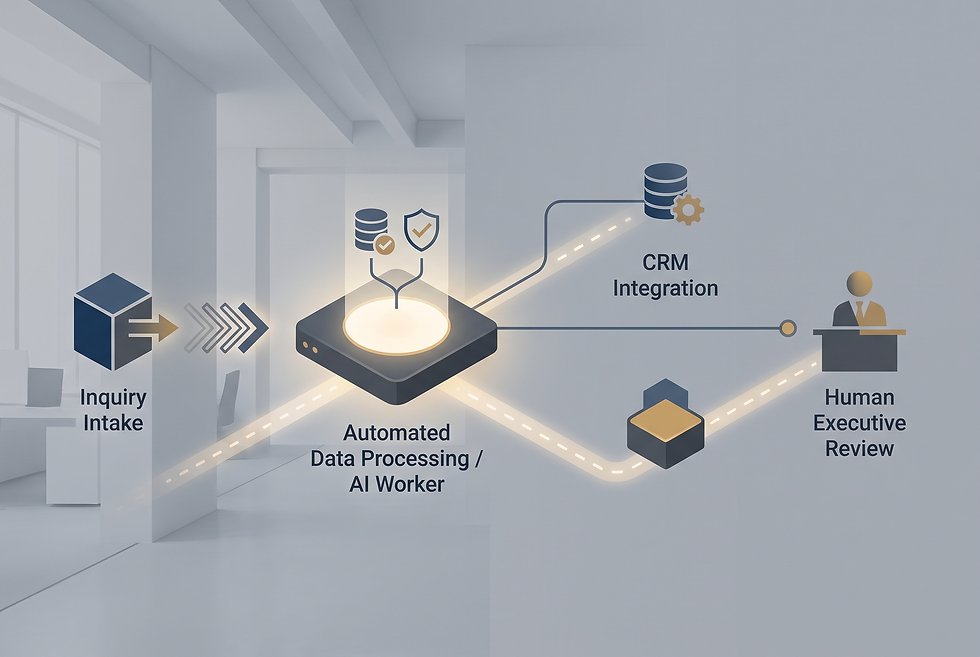
The 7-Stage Digital Worker Lifecycle: From Hiring to Expansion
Deploying autonomous digital workers into a high-stakes B2B environment requires an enterprise-grade operational lifecycle. Leading organizations treat the integration of digital workers with the same operational rigor as hiring, onboarding, and managing human employees.
Stage 1: Role Definition and Selection (Hire)
Rather than attempting to automate an entire department at once, the deployment begins with a discrete, high-impact job-to-be-done. Organizations select a pre-configured digital worker tailored to a specific commercial function—such as an AI Global Sales Rep, AI Export Coordinator, or AI Technical Account Specialist. The role is defined by explicit KPIs: inquiry response latency, lead qualification accuracy, meeting booking rates, and CRM hygiene.
Stage 2: 5-Minute Knowledge Ingestion (Onboarding)
Onboarding does not require months of custom code or model training. The platform ingests authoritative enterprise knowledge assets: product catalogs, engineering manuals, case studies, compliance certifications, pricing rules, and qualification frameworks. The platform constructs a vector and relational knowledge base, establishing deterministic retrieval boundaries that prevent hallucinations and ensure responses strictly reflect verified engineering capabilities.
Stage 3: Setting Operational Authority and Guardrails
A critical governance layer in any enterprise digital worker platform is the explicit calibration of decision boundaries. Management configures what the digital worker is authorized to do independently and where human approval is mandatory:
Autonomous Actions: Answering technical specification inquiries based on verified documentation, qualifying buyer requirements against capacity matrices, capturing contact and project data, logging interactions in the CRM, and sending structured follow-up sequences.
Human Approval Triggers: Issuing customized commercial pricing discounts, approving non-standard warranty clauses, signing off on complex engineering exceptions, or scheduling final contract reviews.
Stage 4: Autonomous Execution Across Channels
Once deployed, the digital worker monitors incoming commercial channels 24/7. When a global prospect submits an inquiry in any language, the worker identifies the intent, retrieves verified engineering specifications, structures a tailored technical response, and engages in multi-turn qualification dialogues. It maintains contextual awareness across weeks of communication, updating the central pipeline record in real time.
Stage 5: The Daily Operational Report
Transparency is essential for enterprise trust. At the end of every operating cycle (typically 24 hours), the digital worker compiles an automated Daily Operational Report delivered directly to department leaders. This report details total conversations handled, qualified opportunities generated, identified high-intent buying signals, edge-case inquiries flagged for human review, and knowledge gaps encountered during execution.
Stage 6: First Value Realization
Within the initial 7 to 14 days of live deployment, the organization reaches the "First Value Event." This is the precise moment the digital worker independently captures, qualifies, and schedules an enterprise-grade sales meeting or prevents a high-value prospect from abandoning an inquiry due to off-hours response latency. This tangible operational milestone validates the knowledge baseline and governance model.
Stage 7: 30-Day Validation and Portfolio Expansion
By day 30, operational metrics are reviewed: conversion uplift, hours of manual triage eliminated, and pipeline acceleration. With the foundational governance model validated, leadership expands the digital workforce, deploying adjacent workers such as an AI Customer Success Representative or an AI Business Development Specialist to scale other operational workflows.
Structural Comparison: Manual Operations vs. Integrated Digital Worker Platform
The following table outlines the operational shift experienced by B2B enterprises moving from fragmented manual processes to an autonomous digital worker platform.

Operating Dimension | Traditional Manual Operations | Disconnected Point SaaS Tools | Enterprise Digital Worker Platform |
Inquiry Response Time | 12 to 48 hours (dependent on business hours and team queues) | Instant automated autoreply (generic, non-conversational) | Under 2 minutes (multi-lingual, technically contextual, 24/7) |
Technical Qualification | Manual back-and-forth emails between buyer, sales, and engineering | Static multi-step web forms with high drop-off rates | Autonomous multi-turn dialogue grounded in engineering manuals |
Governance & Safety | Relies entirely on individual employee adherence to manuals | Rigid binary logic (if/then) unable to handle nuanced queries | Explicit authority guardrails with automated escalation for edge cases |
CRM & System Hygiene | Inconsistent manual data entry; missing contact fields | Periodic batch synchronization requiring custom API maintenance | Continuous, automated bidirectional CRM logging and data enrichment |
Management Visibility | Weekly/monthly self-reported sales pipeline meetings | Static dashboard graphs requiring manual interpretation | Automated daily executive briefings with actionable opportunity summaries |
Scaling Cost | Linear: requires additional salaries, training, and management overhead | Step-function: expensive seat licenses with low user adoption | Elastic: instantaneous deployment across new markets and product lines |
Operational Principles for Scaling an Autonomous Digital Workforce
Organizations that achieve sustained competitive advantage through digital workers follow three structural principles:
1. Anchor Digital Workers to Business Jobs, Not Generic Prompts
Generic chatbot deployments fail because they lack business context and clear ownership. Digital workers succeed when they are treated as specialized functional operators assigned to a specific business process. Defining a clear scope of work—such as "International Inbound Technical Lead Qualification"—ensures the AI operates with explicit success criteria and deterministic knowledge boundaries.
2. Prioritize Authority Calibration Over Full Autonomy
Total autonomy in enterprise B2B sales is neither practical nor desirable. The key to successful adoption is defining the handoff boundary between autonomous execution and human relationship management. When a digital worker handles 80% of technical fact-finding and administrative triage, human sales executives can dedicate 100% of their bandwidth to strategic negotiations, relationship-building, and solution design.
3. Establish a Continuous Knowledge Feedback Loop
A digital worker platform should continuously improve through operational interactions. When the digital worker flags an inquiry it cannot answer with high confidence, that inquiry is highlighted in the Daily Report. Technical managers update the central knowledge repository with the correct engineering parameters, immediately elevating the operational intelligence of the entire digital workforce.
Vertical Applications in Complex B2B Industries
The operational architecture of an enterprise digital worker platform applies directly across several industrial and commercial sectors:
Industrial Automation & Machinery: Deploying an autonomous worker to field global RFQs, clarify machine cycle times, verify voltage and factory floor constraints, and deliver qualified technical briefs directly to regional sales engineers.
Precision CNC & Contract Manufacturing: Ingesting material specs, surface finish requirements, and volume batch data to pre-screen supplier fit, qualify quoting readiness, and eliminate non-viable inquiries prior to human estimator review.
Commercial Water & Fluid Handling Equipment: Engaging municipal and commercial contractors to assess flow rates, chemical compatibility, and environmental certifications, automatically scheduling technical consultations for high-tier projects.
Specialized Packaging Machinery: Handling inbound distributor inquiries across multiple regions, verifying container dimensions, speed requirements, and integration specifications while keeping regional account managers informed.
Implementing the First Digital Worker: YTT AI Global Sales Rep
For enterprise organizations seeking to modernize their international commercial operations, the most effective entry point is deploying an AI Global Sales Rep via the YTT AI Workforce platform. This autonomous worker is designed to resolve the international response latency and technical qualification bottleneck.
Operational Profile: AI Global Sales Rep
Primary Role: Autonomous qualification, technical inquiry resolution, and lead pipeline progression for global B2B accounts.
Operating Channels: Enterprise email, web-based interaction portals, WhatsApp Business, and direct CRM webhooks.
Authority Boundaries:
Autonomous Execution: Instant multi-lingual technical Q&A based on enterprise documentation, buyer qualification against ideal customer profile (ICP) criteria, gathering application constraints, logging complete interaction histories to Salesforce/HubSpot, and booking discovery calls.
Escalation Required: Commercial discounts exceeding standard tier thresholds, custom engineering feasibility requests, formal contract signing, and binding tender submissions.
First Value Milestone: Autonomously handling a multi-turn international RFQ during off-market hours, verifying engineering compatibility, and booking a qualified technical discovery call with complete project notes for the regional sales director.
Daily Operational Report Output: A concise morning executive briefing summarizing all international inbound interactions, qualified pipeline value added, specific accounts requesting human intervention, and newly identified competitive mentions from buyer conversations.
By establishing a bounded, role-based digital workforce, modern B2B enterprises eliminate operational latency, elevate sales capacity, and scale global revenue without proportional headcount expansion.
FAQ
What is an enterprise digital worker platform?
A digital worker platform is an enterprise software system that deploys, manages, and governs autonomous AI workers. Unlike basic chatbots or rigid automation scripts, digital workers execute end-to-end commercial and operational roles, maintain domain-specific knowledge, adhere to strict authority boundaries, and integrate directly with core systems like CRMs and ERPs.
How do digital workers prevent inaccurate information or hallucinations?
Enterprise digital workers operate under deterministic retrieval-augmented generation (RAG) guardrails restricted to verified company documentation, engineering specs, and commercial guidelines. If a buyer inquiry falls outside the verified knowledge base or exceeds predefined authority boundaries, the digital worker automatically routes the inquiry to a human specialist.
How long does it take to deploy and onboard an AI worker?
Role-specific digital workers can ingest standardized product catalogs, technical manuals, and qualification rules in minutes. Full operational calibration, including CRM integration and authority boundary setting, typically takes a few hours, allowing organizations to achieve their first verified value event within the first week of deployment.
Does deploying a digital worker platform require replacing existing CRM systems?
No. A digital worker platform is designed to sit on top of your existing enterprise stack. It acts as an active execution layer that interacts bi-directionally with existing CRMs (such as Salesforce, HubSpot, or Microsoft Dynamics), communication channels (Email, WhatsApp, Web), and enterprise databases without requiring infrastructure replacement.
Scale Your Global B2B Sales Capacity with Autonomous Digital Workers
Eliminate technical qualification latency and capture international enterprise demand 24/7. Explore how the YTT AI Workforce platform deploys specialized digital workers to scale your commercial pipeline with complete operational governance.


Comments