%20%E6%8B%B7%E8%B4%9D.png)
How to Preserve Customer Context Across Long B2B Sales Cycles

Executive Summary: When complex B2B enterprise procurement cycles stretch between six and eighteen months, critical customer nuances, verbal concessions, and technical revisions frequently vanish into disconnected communication silos. Leading industrial equipment and engineering suppliers are resolving this institutional vulnerability by replacing manual CRM updates with ambient contextual memory systems. By unifying multi-channel customer data across inboxes, messaging apps, and meeting transcripts into structured intelligence, organizations eliminate deal blind spots, ensure seamless account handoffs, and protect commercial profit margins.
Company Snapshot: High-Mix Industrial Machinery Manufacturing
To examine the operational mechanics of multi-quarter deal preservation, this case study examines a mid-market industrial packaging automation manufacturer operating across North America and Western Europe.
Industry Sector: Engineered-to-order industrial packaging machinery and secondary robotics automation.
Core Products: High-speed continuous-motion cartoners, robotic palletizing cells, integrated inspection systems, and multi-year lifecycle service agreements.
Primary Customers: Global Tier-1 and Tier-2 consumer packaged goods (CPG) brands, contract packaging enterprises, and specialty industrial chemical manufacturers.
Commercial Model: Consultative direct sales combined with specialized regional value-added distributors, with average contract values (ACV) ranging from $250,000 to $1.8 million per line.
Analytical Significance: The organization presents the classic operational profile of high-friction, multi-stakeholder B2B commerce: 6 to 14 committee stakeholders, rigorous multi-phase engineering reviews, deep customizations, and sales cycles averaging 11 months.
What the Enterprise Sells and How Long-Cycle Procurement Operates
Capital packaging machinery is never purchased through self-service digital transactions or standard commercial catalogs. Every capital expenditure requires extensive upfront engineering validation, plant footprint analysis, utility consumption checks, power and pneumatic compliance, factory acceptance testing (FAT) agreements, and stringent multi-year service level agreements (SLAs).
In this environment, buyer-supplier interactions do not follow a tidy linear path inside a centralized CRM record. Instead, communication scatters across multiple stakeholders and mediums:
The client's VP of Operations discusses overall production capacity constraints over formal scheduled video calls.
The plant maintenance supervisor texts exact sensor specifications and conveyor height measurements via WhatsApp directly from the active factory floor.
Corporate procurement officers negotiate milestone payment schedules, penalty clauses, and freight terms over high-volume email threads with various attachments.
Independent regional distributors exchange informal relationship updates and local competitive intel over LinkedIn messaging.
Because procurement runs across three to four fiscal quarters, buying committees experience frequent personnel turnover. Plant managers retire, procurement directors rotate categories, and supplier sales engineers switch territories. When key personnel depart, the commercial relationship faces catastrophic context leakage: historical objections, agreed-upon engineering compromises, and verbal pricing concessions are buried in inaccessible personal inboxes and handwritten field notes.
The Business Problem: Context Fragmentation and Commercial Friction
Before overhauling its contextual intelligence strategy, the machinery manufacturer faced severe revenue friction caused by four systemic operational bottlenecks:
The CRM Logging Deficit: Field sales engineers and technical account executives spent under three hours per week manually updating CRM records. Critical technical nuances—such as a customer's specific legacy PLC compatibility requirements or strict plant sanitation standards—remained locked in private Outlook folders or unindexed local notebooks.
The Account Handoff Black Hole: When territory accounts were reassigned or when business development reps handed qualified opportunities over to senior application engineers, up to 70% of historical deal nuance disappeared. Buyers were routinely forced to repeat their technical constraints, creating immediate frustration and signaling internal disorganization.
Uncoordinated Multi-Channel Inquiries: While formal RFQ documents arrived via corporate email, emergency line-layout revision requests often arrived via WhatsApp or SMS. Because these channels were disconnected from the central quoting desk, estimating teams frequently built cost models on superseded layout revisions.
Margin Erosion via Concession Amnesia: During final executive pricing reviews, buyers frequently cited verbal pricing concessions or free spare-parts guarantees made months earlier during early plant walk-throughs. Lacking a verified chronological audit trail, sales leaders routinely conceded unbudgeted discounts to keep high-stakes deals on schedule.
What Changed: Deploying an Ambient Context Ingestion and Memory Layer
To resolve this structural vulnerability, commercial leadership transitioned from manual record-keeping to an automated contextual architecture. Rather than treating the CRM as a burdensome post-call administrative database, the enterprise deployed an ambient contextual ingestion layer designed to synthesize asynchronous business development touchpoints into a persistent, accessible, and queryable asset.
The commercial transformation focused on three core operational pillars:
Omnichannel Ingestion: Automatically capturing and standardizing customer signals across Outlook, Gmail, WhatsApp Business, LinkedIn InMail, recorded Microsoft Teams meetings, and inbound engineering RFQ PDFs.
Contextual Synthesis & Entity Extraction: Utilizing deterministic retrieval and semantic analysis to extract discrete procurement entities, including requested technical specifications, commercial objections, timeline milestones, competitor mentions, and stakeholder authority mapping.
Role-Based Permission Governance: Structuring access controls to ensure sensitive commercial margins and proprietary engineering tolerances remain visible only to authorized internal personnel while maintaining operational context for front-line reps.
How Modern Enterprises Preserve Customer Context Across Long B2B Sales Cycles
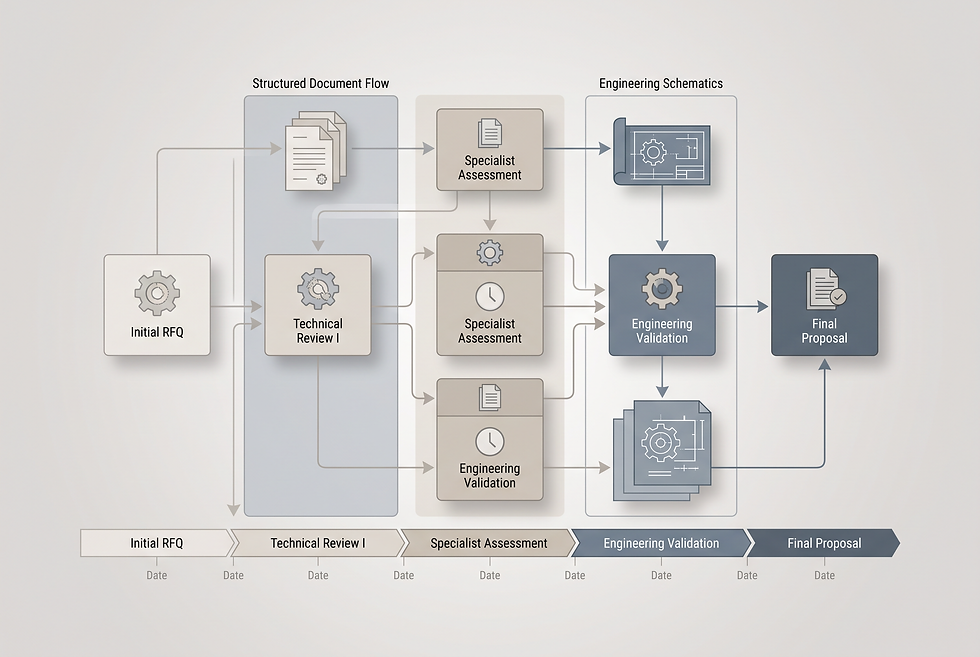
To preserve customer context across long B2B sales cycles without violating internal data governance or overwhelming staff with administrative tasks, the enterprise structured its workflow around five continuous phases that link front-line conversations directly to engineering and commercial execution.
Phase 1: Multi-Channel Data Ingestion
Inbound and outbound communications across corporate email accounts, connected messaging channels, and transcribed video meetings are automatically ingested in real time. Boundary filters exclude personal communications, filtering strictly for domain-verified commercial accounts and authorized RFQ project IDs.
Phase 2: Semantic Entity & Objection Extraction
The contextual pipeline parses raw text and speech transcripts to isolate critical deal dimensions:
Explicit Technical Constraints: Voltage requirements, line speeds, footprint constraints, and third-party robotic integration specs.
Commercial Objections: Concerns regarding lead times, warranty lengths, maintenance costs, and competitor pricing references.
Stakeholder Sentiment & Dynamics: Shifts in stakeholder engagement, champion verification, and procurement timeline changes.
Action Item Mapping: Clear commitment tracking specifying deliverables, internal owners, and promised turnaround windows.
Phase 3: Synthesis into a Persistent Account Timeline
Extracted entities are unified into a centralized Sales Memory Graph linked to the customer account record. If a plant engineer mentions a specific floor slope during a casual messaging exchange, that technical detail is automatically attached to the active RFQ engineering specification sheet rather than remaining isolated in a chat thread.
Phase 4: Human-in-the-Loop Review and Territory Handoff
When an opportunity advances from discovery to formal solution engineering, the system automatically prepares a comprehensive Account Genesis Dossier. The incoming Application Engineer receives an executive timeline containing verified stakeholder priorities, historical objections, and confirmed technical parameters. The engineer reviews, validates, and accepts the dossier with one click before initiating CAD drawings.
Phase 5: Context-Aware Downstream Action & Governance
When pricing specialists or contract managers generate revised proposals, the quoting interface surfaces all historical concessions, previous bid versions, and unresolved objections. Fine-grained permission rules ensure external distributors only see relevant technical specifications and end-user delivery milestones, while internal gross margin calculations remain strictly gated.
Operational Comparison: Fragmented Logging vs. Unified Sales Memory
Workflow Dimension | Legacy Ad-Hoc Process | Unified Contextual Memory Layer |
Data Capture Method | Manual CRM text entry dependent on rep discipline. | Ambient, multi-channel capture across email, chat, and calls. |
Technical Nuance Retention | Buried in individual email threads, PDFs, and rep notes. | Extracted as structured parameters in an account memory timeline. |
Account Handoff Speed | 3–5 business days of manual briefings and redundant discovery. | Instant synthesis via verified Account Genesis Dossiers. |
RFQ Revision Tracking | High risk of quoting against outdated engineering revisions. | Real-time version reconciliation linked directly to technical RFQ logs. |
Margin & Concession Control | Reliance on rep recollection; frequent unverified discounts. | Complete chronological audit trail of all verbal and written terms. |
Data Governance | Uncontrolled WhatsApp/email chains outside enterprise oversight. | Centralized role-based access control and auditable permissions. |
Verifiable Evidence and Operational Benchmarks
According to documented internal project reviews and RevOps performance benchmarks recorded by the manufacturer over an 18-month deployment period:

Account Transition Efficiency: Internal onboarding time for new sales engineers taking over active territory pipelines decreased from an average of 14 business days to under 48 hours.
RFQ Iteration Cycle Time: The cycle time required to generate complex technical proposals decreased by 34%, primarily due to the elimination of redundant discovery cycles and specification clarification loops.
Engineering Revision Errors: Factory acceptance testing rework attributable to outdated technical specifications dropped by 27% year-over-year.
Rep Turnover Resilience: In territories experiencing sales rep transitions mid-cycle, deal slippage rates fell from 41% to under 12%, preserving deal velocity across multi-quarter procurement initiatives.
Strategic Takeaways: What Enterprise Revenue Leaders Can Learn
Industrial and technology leaders seeking to eliminate context fragmentation across multi-quarter sales cycles can extract three fundamental operating principles from this deployment:
1. Decouple Context Retention from Rep Memory
Enterprise sales processes that rely on individual human memory or voluntary CRM administrative hygiene will inevitably experience data degradation. Context retention must be architected as an ambient infrastructure service that captures, cleanses, and structures data automatically without requiring reps to act as manual data-entry clerks.
2. Structure Knowledge Around Decisions, Not Just Transcripts
Storing hundreds of pages of raw call transcripts and thousands of unindexed email threads creates noise, not clarity. Effective systems extract structured decision nodes: what was rejected, why it was rejected, what technical compromise was accepted, and who authorized the deviation.
3. Enforce Strict Governance and Channel Separation
Preserving context does not mean granting unrestricted data access to every commercial participant. Rigorous role-based permissions must delineate internal strategic discussions, engineering calculations, and distributor-facing execution instructions to safeguard commercial margins and intellectual property.
Cross-Industry Application: Context Preservation in Specialized Sectors
The necessity to capture and maintain granular deal history applies directly across multiple complex vertical markets:
For Precision CNC Machining & Contract Manufacturing: Preserves tight CAD tolerance modifications, tooling constraints, and raw material certification requirements across multiple revision bids.
For Commercial Water Treatment Systems: Tracks municipal regulatory approvals, chemical load requirements, and site inspection histories across 24-month public-private tender cycles.
For Enterprise Healthcare Equipment: Maintains compliance certifications, facility layout approvals, and physician preference records across multi-hospital purchasing networks.
For Commercial Property Portfolio Leasing: Unifies tenant tenant-improvement (TI) allowance negotiations, lease term counter-offers, and multi-broker communications across multi-year asset lifecycles.
Operationalizing Institutional Memory with Dedicated AI Workers
For enterprise equipment and technical suppliers seeking to implement this operating logic without overburdening their engineering or IT teams, modern commercial architectures utilize dedicated AI Workers embedded directly within the revenue workflow.
Primary Deployment: AI Technical Sales Rep
Core Role & Job Title: AI Technical Sales Rep
Main Daily Responsibilities: Ingests complex multi-channel inquiries, parses technical RFQs and engineering constraints, updates the central Account Memory Graph, drafts context-aware technical proposal responses, and prepares automated briefings for human sales engineers.
Primary Work Channels: Corporate Email (Exchange/Google Workspace), RFQ Submission Portals, WhatsApp Business API, and CRM Context Integrations.
Authority Boundaries & Governance: Strictly gated against issuing final commercial pricing or approving engineering waivers without explicit human review. Operates with read-and-draft permissions; human technical sales directors retain sole sign-off authority on formal quotes.
First Value Event: The first automated compilation of a comprehensive Account Genesis Dossier for an active, multi-month RFQ, identifying three previously unrecorded technical constraints and consolidating all prior communication threads into a 2-page actionable brief within 15 minutes of territory reassignment.
Daily Operational Briefing Output: Delivers a concise Daily Intelligence Digest to sales directors, highlighting newly surfaced objections, flagged concession requests, timeline delays across active deals, and unassigned technical action items.
FAQ
Why is customer context lost so frequently during long B2B sales cycles?
Context loss in enterprise sales occurs because communications are fragmented across unlinked channels such as personal inboxes, messaging apps, and meeting rooms. When sales reps turn over or accounts are reassigned, unrecorded technical nuances, verbal concessions, and stakeholder dynamics fail to transfer into static CRM databases.
How does automated sales memory differ from traditional CRM data entry?
Traditional CRMs rely on manual, retrospective data entry by busy sales reps, resulting in sparse, outdated records. Automated sales memory operates ambiently, capturing interactions across all communication channels, extracting structured technical and commercial entities, and organizing them chronologically without manual logging.
How are customer data privacy and permission controls maintained across channels?
A modern contextual intelligence layer uses domain filtering and role-based access control (RBAC). Sensitive data such as proprietary engineering schematics or gross profit margins are partitioned, ensuring external partners and distributors only access authorized execution details while internal leadership maintains full audit oversight.
What is the fastest way to achieve ROI when implementing contextual sales memory?
The fastest ROI event occurs during account handoffs and RFQ technical quoting. By eliminating redundant discovery cycles and instantly surfacing historical customer constraints, companies reduce quote generation time by over 30% and prevent margin-eroding concession disputes.
Eliminate Context Leakage in Your Long-Cycle Deals
Request a Sales Memory Assessment to discover how persistent contextual intelligence can safeguard technical requirements, accelerate RFQs, and protect your margins across complex enterprise pipelines.



Comments