%20%E6%8B%B7%E8%B4%9D.png)
AI Outbound Sales Compliance Checklist for International B2B Teams

An ai outbound sales compliance checklist is an operational governance framework that enables international B2B revenue teams to automate cross-border prospecting while maintaining strict adherence to privacy laws like GDPR, CAN-SPAM, and CASL. It enforces lawful data sourcing, verified sender identity, frictionless opt-outs, audit-ready recordkeeping, and mandatory human oversight before binding commercial actions occur.
Disclaimer: This guide provides operational governance best practices for enterprise systems and does not constitute formal legal counsel. Organizations should consult certified legal experts regarding jurisdiction-specific requirements.
The Multi-Jurisdiction Regulatory Landscape for Global B2B Outreach
Global enterprise expansion exposes sales organizations to divergent and increasingly stringent regulatory frameworks. Managing outbound prospecting across international borders requires commercial teams to balance strict opt-in mandates with documented legitimate interest assessments depending on recipient residency and local statutes.
According to Gartner research from 2023 on privacy-enhancing computation, over 75% of the world's population had its personal data covered under modern privacy regulations by the end of 2024. For cross-border commercial teams, this regulatory reality eliminates generic mass-prospecting in favor of auditable, context-aware, and legally defensible communication.
In North America, the United States operates primarily under the CAN-SPAM Act, which permits unsolicited commercial email provided the sender includes accurate header data, transparent sender identification, a valid physical postal address, and an immediate opt-out mechanism. In contrast, Canada’s CASL establishes a strict opt-in regime requiring documented express or implied consent prior to sending, accompanied by severe statutory financial liabilities for non-compliance.
Across the European Union and the United Kingdom, the General Data Protection Regulation (GDPR) alongside regional ePrivacy directives requires either documented consent or a defensible Legitimate Interest Assessment (LIA). In B2B contexts, legitimate interest applies only when processing directly relates to the recipient's specific professional role, maintains strict relevance, and upholds the data subject's fundamental rights and privacy expectations.
Core AI Outbound Sales Compliance Checklist
To standardize international outreach without compromising pipeline velocity, revenue operations leaders must embed systematic verification checkpoints directly into outbound platforms. Below is the operational checklist covering governance fundamentals across major global jurisdictions.
Compliance Pillar | Key Operational Requirement | Applicable Jurisdictions | Enforcement & Verification Method |
Consent & Legal Basis | Documented Legitimate Interest Assessment (LIA) or explicit opt-in proof | EU, UK, Canada, Australia | Pre-send verification check via automated CRM audit logs |
Sender Identity | Accurate email headers, registered domain, and physical postal address | US, EU, UK, Global | SPF/DKIM/DMARC protocol validation and footer template locks |
Frictionless Opt-Out | One-click unsubscribe link or direct keyword reply handling within 10 days | US (CAN-SPAM), EU (GDPR), Global | Centralized suppression synchronization across all sending channels |
Data Provenance | Publicly accessible B2B sources, lawful business directories, zero data brokers | Global (GDPR Art. 14, CCPA/CPRA) | Data pipeline provenance tags and audit trail recording |
Recordkeeping & Audit | Time-stamped consent logs, email archives, and suppression lists stored for 3+ years | Global | Immutable logging databases with search and export capabilities |
Human Escalation | Mandatory manual approval on pricing, contract terms, and technical commitments | Enterprise standard | Hard workflow gates preventing autonomous execution on deal commitments |
Jurisdiction Filtering | Dynamic routing based on prospect country rules and regional do-not-contact lists | Cross-border markets | Real-time IP and country-code pipeline routing rules |
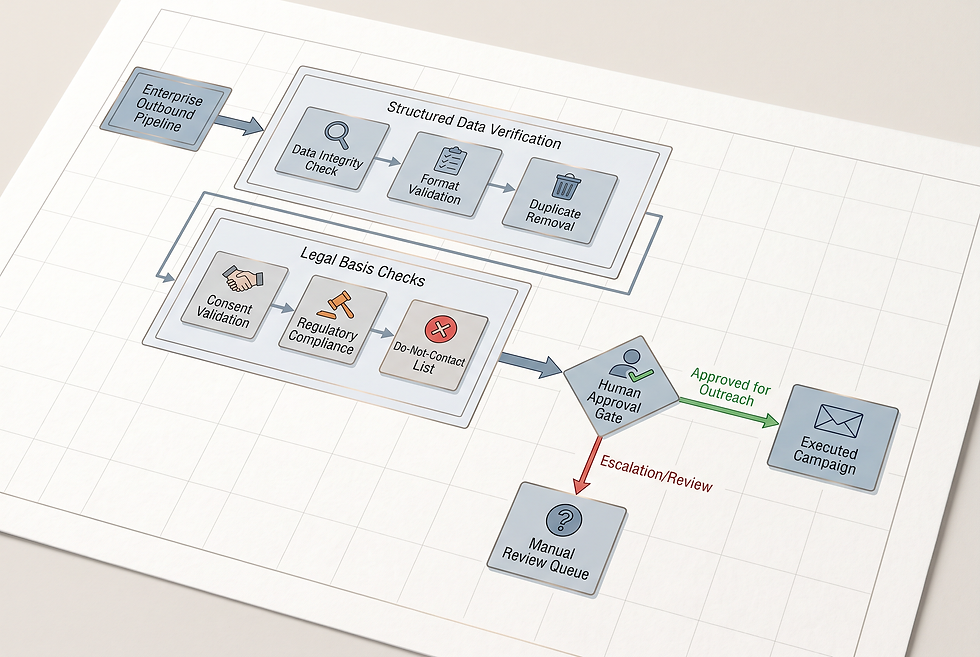
Data Sourcing, Verification, and Recordkeeping Architecture
Auditable outreach begins long before an automated email enters the delivery queue. Data provenance dictates whether commercial communication remains legally defensible when subjected to scrutiny by data protection authorities.
Under GDPR Article 14, when personal data is obtained from third-party sources rather than directly from the individual, data controllers are obligated to inform the individual within one month regarding the specific categories of data processed and the precise source origin. Autonomous prospecting engines must therefore track and log the exact source of every corporate contact record.
B2B organizations should systematically eliminate unverified web scraping and opaque bulk contact lists purchased from unregulated brokers. Sourcing must rely on verified enterprise channels, public corporate directories, business social networks, and direct industry exchanges that clearly record collection timestamps.
Robust recordkeeping infrastructure requires synchronized suppression management. When a prospect requests to be removed from communication in one territory, that suppression signal must propagate immediately across all corporate domains, SDR accounts, and campaign queues. Maintaining an immutable log of suppression events protects enterprises during regulatory audits.
For teams scaling international pipelines, pairing regulatory controls with disciplined account discovery—such as the structured workflows detailed in the B2B Sales Master Playbook—ensures messaging remains relevant, compliant, and focused on high-fit accounts.
Enforcing the Human-in-the-Loop Governance Boundary
While artificial intelligence accelerates account research, lead qualification, and contextual message drafting, critical business commitments must remain under direct human supervision. Autonomous outreach systems must feature explicit architectural boundaries that prevent automated engines from committing to commercial terms without executive sign-off.
According to a 2024 Salesforce State of Sales report, 81% of high-performing sales teams enforce explicit human-in-the-loop policies when deploying AI across customer-facing communications. Automated triggers must immediately pause sequences and escalate tasks to authorized sales personnel under predefined conditions.

Mandatory escalation gates include:
Pricing and Quotations: Custom discounting, standard rate deviations, and formal quotation generation require verified sales operations approval.
Contractual and Legal Commitments: Service-level agreements, warranty statements, payment terms, and indemnification clauses must route through legal or sales leadership.
Custom Engineering Specifications: Manufacturing tolerance commitments, specialized engineering modifications, and tailored delivery schedules require direct review by technical engineering teams.
Dispute and Sensitive Handling: Any prospect communication expressing regulatory concern, GDPR access requests, or formal complaints must halt outreach immediately and notify governance managers.
Teams integrating AI across cross-border go-to-market motions can explore proven multi-channel orchestration frameworks in the Global Manufacturing B2B Marketing Guide to align compliance with conversion efficiency.
Step-by-Step Implementation Workflow for Sales Operations
Operationalizing outbound compliance requires revenue operations and IT leadership to implement a clear, five-stage rollout workflow across the tech stack:
Jurisdiction Mapping and Rule Engine Configuration: Configure routing engines to classify prospective accounts by country of incorporation and individual recipient location, automatically applying local compliance rules (e.g., CASL vs. CAN-SPAM vs. GDPR).
Sender Authentication Hardening: Implement and verify technical DNS authentication standards, including SPF, DKIM, and DMARC with strict alignment policies across all secondary sending domains.
Template Governance and Legal Footers: Lock standard footer components across all automated sequence templates to ensure physical company addresses and clear opt-out mechanisms cannot be modified by individual reps.
Suppression List Centralization: Establish bi-directional CRM and marketing automation synchronization so unsubscribe events update instantly across all active outbound mailboxes.
Quarterly Governance Audits: Conduct scheduled sampling audits of outgoing messages, data provenance logs, and human escalation response times to verify continuous adherence to global standards.
How Enterprise Platforms Operationalize Governed Outreach
Enterprise platforms such as YTTAI embed these regulatory constraints directly into go-to-market workflows. Rather than treating compliance as an afterthought or post-campaign manual check, the platform integrates automated jurisdiction checking, verified sender authentication, and immutable activity auditing directly into daily sales execution.
By establishing automated boundaries for data ingestion, dynamic compliance footers, and mandatory human review checkpoints for commercial terms, international sales organizations scale outreach confidently while maintaining complete governance integrity.
FAQ
Is cold outbound sales email legal under GDPR in the European Union?
Yes, B2B cold emailing is permissible under GDPR when conducted on the legal basis of Legitimate Interest. The communication must be strictly relevant to the recipient's professional role, provide a simple opt-out mechanism, and include a clear explanation of how their data was obtained.
What is the difference between CAN-SPAM and CASL compliance for B2B sales?
CAN-SPAM (United States) allows unsolicited commercial emails without prior opt-in, provided sender details are accurate, postal addresses are included, and opt-outs are honored within 10 business days. CASL (Canada) requires verified express or implied consent prior to sending, alongside strict identification and recordkeeping standards.
Why is a Human-in-the-Loop system mandatory for AI outbound sales?
Human approval prevents autonomous systems from making unauthorized commercial, pricing, contractual, or engineering commitments. Requiring manual authorization on sensitive parameters mitigates commercial liability and ensures regulatory adherence across international jurisdictions.
How long must international B2B teams retain opt-out and consent records?
Global best practices recommend retaining consent logs, suppression requests, and Legitimate Interest Assessments for at least three to five years. This documentation provides defensible audit trails in the event of regulatory inquiries under GDPR, CASL, or regional data protection authorities.
Build a Governed Global Sales Workflow
Equip your international sales team with built-in compliance controls, dynamic jurisdiction routing, and robust human-in-the-loop governance. Explore how YTTAI powers secure cross-border B2B growth.


Comments