%20%E6%8B%B7%E8%B4%9D.png)
Lead Generation for CNC Machining Companies: A Practical B2B Growth Guide

Executive Summary: Precision CNC contract manufacturers face lengthening sales cycles, idle machine spindle capacity, and intense price competition from overseas suppliers. To capture high-margin production contracts, industrial machine shops are modernizing their commercial operations. This practical guide analyzes how structured CAD intake, automated technical triage, and engineering-led outbound pipelines revolutionize lead generation for CNC machining companies, transforming slow manual estimating into a scalable B2B revenue engine.
Company and Industry Snapshot: The Precision Subcontracting Sector
Custom CNC machining suppliers operate in a specialized contract manufacturing environment defined by substantial capital equipment investments, tight tolerance demands, and complex procurement requirements. Precision machine shops serve high-value industries including aerospace, medical technology, robotics, automotive, industrial automation, defense, and energy.
In this sector, the commercial model relies heavily on custom engineered-to-order (ETO) and make-to-print production. Unlike standardized catalog distributors, machine shops sell physical production capacity, specialized tooling expertise, 3-axis to 5-axis milling precision, Swiss turning tolerances, and quality certifications such as ISO 9001, AS9100, and ISO 13485. Commercial viability depends entirely on matching shop floor capacity with stable, high-margin production runs rather than sporadic prototyping jobs that tie up valuable spindle time without repeat revenue.
For commercial executives and shop owners, establishing predictable lead generation for CNC machining companies is essential to smooth out demand volatility, maintain steady machine utilization rates, and secure recurring production runs from OEM procurement teams.
What the Precision Machining Sector Sells and How Buyers Procure
The procurement journey in custom manufacturing is highly technical, multi-stakeholder, and risk-averse. Buyers are typically mechanical design engineers, sourcing managers, procurement directors, and commodity buyers who evaluate suppliers based on three primary criteria: technical feasibility, quality assurance compliance, and on-time delivery reliability.
The purchasing process begins when an engineering team finalizes CAD models and technical 2D drawings with explicit Geometric Dimensioning and Tolerancing (GD&T) specifications. Procurement teams then initiate a Request for Quote (RFQ) process, sending drawing packages to a shortlist of approved or newly vetted suppliers. Because switching suppliers introduces significant operational risk and potential assembly line stoppages, buyers require detailed proof of capability, surface finish compliance, material traceability, and machine park availability before issuing a formal Purchase Order (PO).
Consequently, lead generation for CNC machining companies cannot rely on generic marketing slogans. Buyers require concrete technical proof: machine park lists, spindle envelope dimensions, CMM inspection reports, alloy handling experience (such as titanium, PEEK, Inconel, and aerospace-grade aluminum), and demonstrated adherence to strict quality management systems.
The Core Business Problems in Traditional Machine Shop Sales
Most mid-sized CNC machining facilities operate with legacy commercial models that fail to capture modern digital-first engineering buyers. Machine shops encounter four structural friction points in their commercial pipeline:
Severe RFQ Quoting Bottlenecks: Estimators and senior application engineers spend hours manually calculating cycle times, tooling costs, and raw stock pricing for low-probability leads. This creates quoting delays of 5 to 10 business days, during which responsive competitors secure the business.
Low Technical Qualification of Inbound Inquiries: General website contact forms generate unstructured inquiries lacking 3D CAD files (STEP/IGES), material specs, annual batch volumes, or delivery timelines, forcing sales reps to spend days chasing missing data.
Neglected Existing Account and Dormant RFQ Follow-Up: Sales teams lack systematic follow-up cadences for submitted quotes, allowing millions of dollars in unclosed RFQs to expire without structured follow-up.
Geographic and Language Barriers in Export Markets: Domestic machine shops struggling with regional demand fluctuations often lack dedicated international business development capacity to target overseas procurement teams across North America and Western Europe.
When evaluating why traditional sales methods fail, it becomes clear that lead generation for CNC machining companies requires bridging the gap between initial prospect curiosity and rigorous engineering validation.
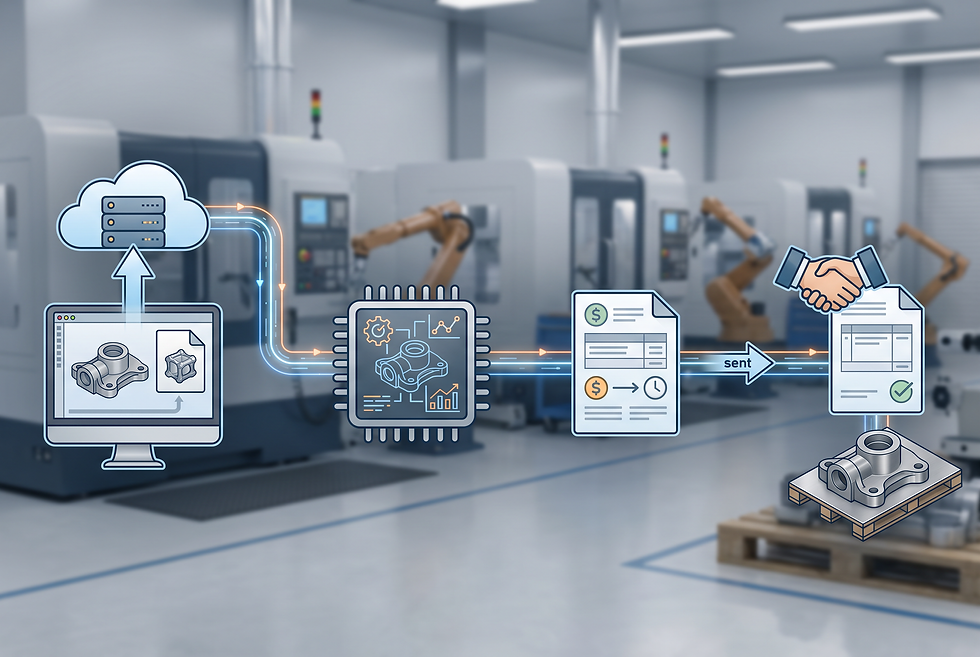
Modern Framework: Lead Generation for CNC Machining Companies
To overcome these hurdles, forward-thinking precision manufacturers are standardizing their digital commercial architecture. Rather than relying solely on relationship-driven field sales or static trade shows, industrial suppliers now deploy automated front-end qualification, structured CAD intake portals, and proactive account-based outreach.
Leading machine shops build systematic acquisition engines that combine technical content marketing (such as machining tolerance guides, material selection whitepapers, and Design for Manufacturability (DFM) best practices) with outbound business development pipelines targeting specific hardware verticals. This ensures sales engineering teams focus only on fully qualified, production-ready RFQs that match their machine capabilities.
Operational Dimension | Traditional Machine Shop Process | Modern Systematic Growth Model |
Inbound Lead Capture | Generic text contact form with no file upload validation | Structured CAD intake portal requiring STEP/PDF, volume, alloy, and target date |
Technical Qualification | Manual engineering review taking 3–7 business days | Automated rule-based DFM and capacity check within 24 hours |
RFQ Follow-Up Cadence | Ad-hoc single email or no follow-up after quote submission | Automated 5-touch engineering sales cadence tracking quote status and revisions |
Outbound Prospecting | Cold calls to regional directories with no intent data | Account-based outreach to hardware engineers based on hiring, funding, and CAD signals |
Sales Engineering Role | Administrative data entry and repetitive price estimation | High-value technical consulting, design reviews, and commercial contract closing |
Export Expansion | Reactive handling of occasional international inbound inquiries | Systematic multilingual outbound campaigns targeting verified overseas procurement managers |
How the Precision Machining Acquisition Workflow Actually Works
A robust commercial pipeline in precision manufacturing operates across a seven-stage workflow that bridges marketing, technical estimation, and account closing.
Step 1: Ingestion of High-Intent Signals
Inbound prospects enter the funnel through technical organic search, targeted Google search campaigns, or CAD-focused DFM landing pages. Simultaneously, outbound workflows track key buying triggers—such as high-growth robotics startups securing Series A funding, aerospace OEMs posting openings for mechanical sourcing specialists, or consumer hardware brands expanding new product introduction (NPI) teams. This multi-pronged intake powers reliable lead generation for CNC machining companies across domestic and export markets.
Step 2: Intelligent Data Enrichment and Compliance Verification
Incoming leads are enriched with business firmographics, company size, revenue, and ITAR/export control compliance requirements. The system cross-references the prospect's industry against the shop's specific certifications (e.g., verifying ISO 13485 alignment for medical device RFQs or AS9100 for aerospace assemblies).
Step 3: Automated Technical Intake and Triage
The system prompts the prospective client to upload native 3D files alongside 2D PDF drawings containing critical tolerance callouts. Basic parameters such as envelope size, material class (e.g., 6061 Aluminum, 316L Stainless Steel, PEEK, Inconel), batch volume, and secondary finishing (e.g., anodizing, heat treating, passivating) are extracted and checked for completeness.
Step 4: Engineering Decision Gate and Capacity Matching
Senior estimators review pre-triaged RFQs that have already cleared capability thresholds. Jobs that exceed internal machine envelope dimensions or require unavailable 5-axis capabilities are immediately routed to approved subcontracting partners or politely declined with alternative engineering suggestions.
Step 5: Rapid Quote Generation and Multi-Channel Presentation
Estimators generate a detailed cost breakdown. The commercial proposal is delivered via a digital customer portal with integrated interactive pricing tiers (e.g., prototype run of 10 units vs. production run of 500 units) and firm lead-time commitments.
Step 6: Structured Follow-Up and Technical Consultation
If the buyer does not approve the quote within 48 hours, an automated follow-up cadence initiates. This sequence provides additional value—such as suggestions for reducing part cost by modifying corner radii or relaxing non-critical surface roughness tolerances—positioning the shop as an engineering partner rather than a transactional vendor.

Step 7: Feedback Loop and Closed-Loop Analytics
Win/loss reasons (e.g., price, lead time, tooling limitation, material unavailability) are logged directly into the CRM. This data trains commercial quoting thresholds and highlights which machine centers have unallocated capacity for upcoming quarters.
Evidence and Industry Results
Data across the industrial manufacturing sector underscores the direct correlation between rapid response times, technical qualification, and win rates:
Response Speed and Win Probability: According to benchmark data published in the Harvard Business Review, B2B vendors that respond to technical inquiries within an hour are nearly seven times more likely to qualify the lead compared to those that respond after two hours, and over 60 times more likely than companies that wait 24 hours.
CAD-Driven Digital Quoting Impact: In published industry case studies from digital manufacturing platforms, automating early-stage drawing intake and DFM validation reduced quote generation turnaround from an average of 4.8 days down to under 6 hours, resulting in a reported 28% to 35% increase in RFQ conversion rates.
Account-Based Technical Outbound: According to industrial marketing reports by ThomasNet, precision machining facilities utilizing technical content assets (such as CNC tolerance optimization whitepapers) in multi-touch outreach experienced a 42% higher response rate from mechanical design engineers compared to generic capabilities brochures.
What Other Precision Manufacturers Can Learn: Core Operating Principles
Machine shop owners, Managing Directors, and commercial directors seeking to scale lead generation for CNC machining companies should adopt three foundational operating principles:
Treat the RFQ Process as a Product: The speed and clarity of your quote is the buyer's first preview of your shop's quality and reliability. Eliminating friction during quotation directly drives conversion.
Lead with Engineering Authority, Not Low Pricing: Competing on price alone triggers a race to the bottom against low-cost overseas suppliers. Win high-margin contracts by demonstrating superior DFM insight, material optimization, and verifiable quality control.
De-silo Estimating and Business Development: Keep skilled CNC programmers and estimators focused on high-probability quotes by automating initial data collection, prospect enrichment, and quote follow-up.
What This Operating Model Looks Like for Contract Machining
For precision machining enterprises, implementing this framework means aligning commercial outreach with shop floor capacity:
Targeting High-Value Niches: Focus lead generation campaigns on specific material and machine competencies (e.g., micro-machining for medical instruments or large-format 5-axis machining for aerospace tooling) where buyer price sensitivity is lower.
Localizing International Pipelines: For shops targeting export contracts in North America or Western Europe, establish dedicated digital outreach channels that address regional compliance standards, Incoterms, and logistics pathways upfront.
Systematizing Re-engagement: Re-engage past customers with automated alerts when seasonal production cycles or typical part replacement intervals approach.
YTT AI Worker Mapping: AI Business Development Rep
For precision CNC suppliers looking to operationalize this acquisition model without expanding internal headcount, deploying an industry-specific digital sales agent creates immediate commercial leverage.
Worker Job Title: AI Business Development Rep (Precision Manufacturing)
Main Daily Tasks: Systematically scans targeted manufacturing databases and hiring signals; enriches prospective accounts with engineering contact information; executes personalized, technical cold-email and LinkedIn outreach campaigns; extracts CAD files and RFQ specifications from incoming inquiries; and populates the CRM with structured project requirements.
Primary Work Channels: Corporate Email, LinkedIn InMail, Website Inbound Portals, and CRM APIs (HubSpot, Salesforce, Pipedrive).
Authority Boundary: Operates autonomously on lead prospecting, initial technical qualification, drawing collection, and follow-up reminders. Transfers quotes to human Estimators and Sales Directors once complete 3D CAD/PDF drawing packages and project volumes are validated.
First Value Event: Successfully captures, enriches, and delivers a fully qualified, production-ready RFQ package (complete with 3D model, material specs, batch volume, and target delivery date) directly to the estimating team within 7 days of deployment.
Daily Report Result: Delivers an end-of-day summary detailing total outbound accounts contacted, open rates, technical responses received, RFQs qualified, and dormant quotes requiring immediate sales engineer intervention.
FAQ
Why is lead generation for cnc machining companies different from standard B2B sales?
Lead generation for CNC machining companies requires rigorous technical feasibility verification, 3D CAD drawing analysis, material specification checks, and quality certification reviews (such as ISO 9001 or AS9100). Standard B2B sales techniques fail because machine shop buyers are mechanical engineers and procurement specialists evaluating precision tolerances, machine park capacity, and delivery reliability rather than generic business services.
How quickly should a CNC machine shop respond to an RFQ?
Machine shops should ideally acknowledge and qualify an incoming RFQ within 2 to 4 hours, and deliver a comprehensive engineering quote within 24 to 48 hours. B2B procurement benchmarks indicate that suppliers who respond first have a significantly higher conversion rate, as engineering buyers frequently proceed with the first qualified shop meeting their technical tolerances and delivery schedule.
What technical files are required for effective CNC lead qualification?
An effective qualification process requires a 3D CAD file (such as STEP, IGES, or Parasolid) for volumetric and toolpath calculations, alongside a 2D PDF drawing containing explicit GD&T tolerances, thread callouts, surface roughness requirements, material specifications, and batch volumes.
How can machine shops generate export leads in overseas markets?
Machine shops generate international leads by establishing targeted digital acquisition pipelines, highlighting international quality certifications, offering clear DDP shipping terms, and deploying automated account-based outreach to hardware engineers and sourcing managers in target export countries.
Scale Your Precision Machining Pipeline Today
Discover how our AI Business Development Rep automates technical lead qualification, captures high-margin RFQ packages, and keeps your CNC spindles running at full capacity.


Comments