%20%E6%8B%B7%E8%B4%9D.png)
Lead Generation for Industrial Machinery Manufacturers: Global B2B Guide

Executive Summary: Capital equipment producers face severe sales friction when expanding across international territories. Traditional trade shows and passive distributor channels yield unpredictable pipeline velocity, while complex technical requirements stall incoming inquiries. Modern operating models address this bottleneck by combining structured engineering intake, continuous qualification, and workflow automation to convert international demand into verified project specifications.
Company Snapshot: High-Value Equipment in Global Commerce
Industrial machinery manufacturers operate in high-stakes capital goods environments. Companies in this sector engineer, build, and deploy high-value equipment ranging from automated packaging lines, plastic injection molding cells, and CNC machining centers to specialized water treatment infrastructure and heavy material handling systems.
Core commercial profiles across this category include:
Industry Sector: Industrial machinery, capital equipment, and precision mechanical engineering.
Primary Offerings: Custom-engineered machinery, modular production systems, turnkey assembly equipment, and lifecycle aftermarket services.
Core Buyers: Plant managers, procurement directors, chief operating officers, and vice presidents of engineering within manufacturing plants, tier-1 industrial suppliers, and international operating groups.
Business Model: High-mix capital equipment sales characterized by average deal sizes ranging from $80,000 to well over $2,000,000, complemented by long-term preventative maintenance contracts and spare parts revenue.
Understanding how these enterprises generate sustainable revenue requires analyzing the distinct buying motions behind capital acquisitions rather than applying generic transactional marketing templates.
What the Company Sells: Anatomy of the Industrial Purchasing Journey
Unlike off-the-shelf commercial goods, industrial machinery is rarely purchased through rapid digital self-service. The capital buying process follows a rigorous, multi-stakeholder evaluation path determined by technical feasibility, footprint constraints, production throughput targets, and payback cycles.
When a factory plans to expand production capacity or replace obsolete machinery, the commercial journey begins months before an official Request for Quote (RFQ) is issued. Engineering leads first evaluate mechanical specifications, power draw, cycle time tolerances, software compatibility (such as PLC architectures), and safety compliance across regional regulatory standards (such as CE, UL, or ISO benchmarks).
Procurement departments simultaneously assess supplier balance sheets, export compliance, total landed cost, warranty coverage, and regional service availability. Because capital equipment purchases represent significant balance-sheet investments, buying committees demand extensive validation, including application testing, factory acceptance test (FAT) protocols, and customer reference visits. Consequently, lead generation for industrial machinery manufacturers cannot simply capture email addresses; it must capture, validate, and structure complex operational parameters.
The Business Problem: Structural Inefficiencies in Capital Equipment Sales
Industrial equipment exporters and original equipment manufacturers (OEMs) face substantial commercial bottlenecks in their pipeline development.
First, lead response latency creates immediate friction. When an international plant engineer submits a request across different time zones, inquiries frequently sit in generic email queues for three to five business days before technical sales engineers can review them. By the time a commercial representative responds, the buyer has already engaged alternative domestic or regional suppliers.
Second, inbound inquiries arrive with incomplete technical specifications. Overseas buyers routinely submit vague RFQs lacking vital parameters such as raw material viscosity, daily production volume, electrical voltage standards, or dimensional floor plans. This forces expensive application engineers to spend hours playing email ping-pong merely to gather foundational project variables.
Third, language barriers and regional channel fragmentation dilute pipeline quality. Export sales directors often rely on third-party regional distributors who prioritize established lines over new machinery introductions. When direct export teams attempt to manage overseas territories from domestic headquarters, international inquiries slip through the cracks due to language nuances, regional compliance misunderstandings, and inconsistent follow-up cadences.
What Changed: Modernizing Industrial Machinery Lead Generation
Forward-thinking machinery producers have fundamentally restructured their commercial infrastructure. Instead of treating sales as an isolated manual effort dependent on periodic industrial expos, leading enterprises implement connected digital intake engines and automated technical qualification protocols.
Key architectural shifts include:
Application-Centric Digital Touchpoints: Replacing static brochure downloads with interactive sizing calculators, technical parameter selectors, and ROI estimation models.
Intelligent Inquiry Triage: Deploying rule-based and retrieval-augmented processing engines that parse complex technical inquiries, extract critical parameters, and cross-reference them against engineering capabilities.
Instant Specification Gathering: Utilizing structured automated workflows that promptly assist international prospects in completing engineering data sheets before human sales engineering assignment.
Unified Commercial Visibility: Integrating website engagement data, technical document interactions, and email conversations directly into centralized CRM architectures to eliminate territory blind spots.
How the Workflow Actually Works: Step-by-Step Technical Qualification
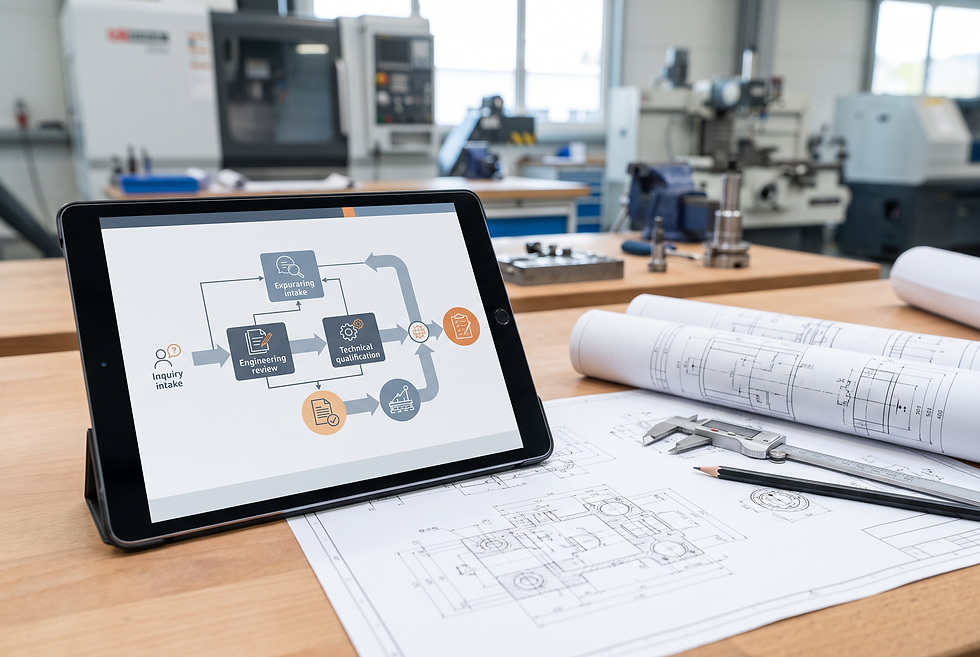
Effective lead generation for industrial machinery manufacturers operates as an orchestrated six-stage process that aligns engineering validation with commercial rigor.
Step 1: Multi-Channel Inbound Data Ingestion
Inquiries enter the system across global digital channels, including website application pages, direct RFQ forms, industry technical directories, and regional microsites. The intake engine captures raw inputs, uploaded project drawings, and localized buyer metadata.
Step 2: Automated Technical Information Extraction
The intake system parses the inquiry to identify foundational parameters: target production output (parts per hour), raw material grade, facility voltage (e.g., 480V 60Hz vs. 400V 50Hz), installation timeline, and geographic destination.
Step 3: Specification Completeness Verification
If critical variables are missing, the workflow automatically initiates a tailored, technical follow-up inquiry in the buyer's language, guiding the engineer to provide exact tolerance requirements and factory floor constraints.
Step 4: Commercial Qualification and Lead Scoring
The system assesses the commercial viability of the project based on factory fit, budget alignment, target geography, and import compliance rules. High-fit projects with complete technical scopes are prioritized for expedited handling.
Step 5: Human Engineering Assignment and Proposal Drafting
A qualified Application Engineer or Territory Sales Director receives a complete, structured dossier containing the validated technical scope, CAD considerations, and preliminary cost envelope. The commercial engineer reviews the dossier, confirms technical feasibility, and issues a customized preliminary proposal.
Step 6: Systematic Technical Follow-Up and Continuous Optimization
After proposal delivery, the system tracks buyer document interactions, automated reminders ensure timely follow-up regarding commercial review milestones, and system analytics continuously refine qualification parameters based on historical win-loss patterns.
Comparative Operational Performance
Operational Dimension | Traditional Industrial Sales Process | Modern Structured Lead Generation Workflow |
Inquiry Initial Response Time | 48 to 120 hours across global time zones | Under 15 minutes with complete localized acknowledgment |
Technical Data Collection | 4 to 6 back-and-forth manual email exchanges | Single-session structured parameter capture and verification |
Engineering Time Allocation | 60% spent gathering basic operating parameters | 85% focused on high-value solution design and sizing |
Global Territory Coverage | Limited by local distributor focus and office hours | 24/7 multilingual qualification across all target export markets |
Lead-to-Preliminary-Quote Cycle | 14 to 21 business days | 2 to 4 business days for standard and semi-custom configurations |
Evidence and Results: Realized Operational Impact
Industrial organizations that adopt structured digital intake and technical qualification architectures consistently document observable operational improvements across their commercial units.
According to an official manufacturing technology case study published by the Association for Manufacturing Technology (AMT, 2023), capital equipment builders adopting automated RFQ intake workflows reduced their initial technical review latency by more than 65% while increasing quote delivery accuracy.
Similarly, industrial market research from McKinsey & Company (2022) on B2B industrial commercial excellence highlights that capital machinery enterprises standardizing their technical lead qualification processes experience a 20% to 30% increase in sales engineering capacity without requiring additional technical headcount. These operational gains stem directly from eliminating manual administrative ping-pong and allowing senior engineers to concentrate exclusively on validated, high-margin machinery configurations.
What Other Companies Can Learn: Core Methodological Principles
Machinery and equipment manufacturers seeking to modernize their commercial operations can extract four critical principles from these industry transformations:
Treat Technical Parameters as Commercial Currency: Do not pass raw, unverified contact forms to sales teams. High-performing organizations mandate structured parameter intake before commercial assignment.
Eliminate Time Zone Penalties: Global buyers operate in distinct production shifts. Implementing asynchronous, automated qualification ensures overseas projects receive instant momentum.
Protect Engineering Bandwidth: Application engineers represent a scarce operational asset. Automate baseline data gathering so engineers spend their time solving production bottlenecks rather than collecting voltage data.
Unify Commercial and Technical Data Streams: Ensure that specifications captured during the initial inquiry flow seamlessly into quoting systems, ERP software, and field service records.
What This Looks Like Across Industrial Verticals
This operational blueprint translates across diverse manufacturing sectors:
For an Industrial Automation & Robotics Integrator: The workflow automatically gathers payload requirements, cycle times, reach envelopes, and end-of-arm tooling specifications before routing the opportunity to regional integration specialists.
For a Packaging Machinery OEM: The system verifies product dimensions, packaging materials (e.g., film gauge or corrugated grade), sealing speeds, and washdown compliance standards immediately upon inquiry submission.
For a Water Treatment Equipment Fabricator: The intake engine captures influent water chemistry, required daily flow rates, discharge regulatory limits, and skid footprint constraints to deliver preliminary system schematics.
YTT AI Worker Mapping: AI Export Sales Rep
For industrial machinery manufacturers pursuing international market expansion, operationalizing these principles requires dedicated execution capability.
Worker Job Title: AI Export Sales Rep
Main Daily Tasks: Ingests overseas technical inquiries across web portals and RFQ mailboxes, validates technical specifications against standard engineering boundaries, engages international buyers in their native languages to gather missing operational parameters, and packages complete project dossiers for application engineering teams.
Primary Work Channels: Global website intake forms, incoming RFQ email channels, WhatsApp Business API, and synchronized CRM records.
Authority Boundary: Autonomously qualifies inquiries, requests technical parameter clarifications, calculates preliminary sizing estimates based on predefined machinery catalogs, and schedules technical review meetings; strictly leaves final custom pricing approvals, mechanical engineering sign-offs, and commercial contract execution to human sales leadership.
First Value Event: Successfully capturing complete technical specifications from an overseas manufacturing prospect within 30 minutes of inquiry submission and delivering a structured engineering dossier directly to the territory sales manager.
Daily Report Result: A structured summary detailing the number of international inquiries processed, technical completeness rates across active RFQs, identified machine model matches, and prioritized sales engineering action items scheduled for the day.
FAQ
What is the biggest challenge in lead generation for industrial machinery manufacturers?
The primary challenge is the technical complexity of the sales process. Capital equipment inquiries typically lack critical operating parameters upon initial submission, creating prolonged email exchanges and delaying sales engineering reviews across global time zones.
How do technical specifications impact industrial machinery lead qualification?
Complete technical specifications—such as production throughput, power requirements, material properties, and space constraints—allow application engineers to quickly verify manufacturing feasibility, calculate accurate cost estimates, and prioritize high-value opportunities.
How can industrial equipment exporters capture high-intent international RFQs?
Manufacturers can capture serious international buyers by providing interactive technical sizing tools, offering instant multilingual inquiry responses, and using automated workflows to verify project scope before human engineering assignment.
Modernize Your Global Machinery Sales Pipeline
Deploy an AI Export Sales Rep to qualify international machinery inquiries 24/7, capture complete engineering specifications, and accelerate proposal delivery across overseas markets.


Comments