%20%E6%8B%B7%E8%B4%9D.png)
Lead Generation for Packaging Machinery Companies: A Practical B2B Growth Guide

Executive Summary: Industrial packaging machinery manufacturers face elongated sales cycles, cross-border time-zone friction, and resource-heavy pre-sales engineering demands. This study outlines how modern original equipment manufacturers (OEMs) transform capital equipment commercial operations by integrating technical qualification into front-end intake, automating specification gathering, and deploying structured multi-stakeholder follow-ups. By aligning commercial discovery with engineering validation, packaging equipment builders convert technical inquiries into high-value contracts while protecting senior engineering capacity.
Company Snapshot: Navigating the Packaging Automation Sector
The packaging machinery sector builds critical production infrastructure for food and beverage processors, pharmaceutical companies, chemical manufacturers, and consumer packaged goods (CPG) enterprises. Operating under hybrid distribution models that blend direct key-account sales with regional dealer networks, machinery builders produce specialized equipment including primary flow wrappers, vertical form-fill-seal (VFFS) systems, multi-head weighers, automated cartoners, and end-of-line robotic palletizing cells.
Unlike off-the-shelf industrial supplies, packaging machinery requires extensive customization, application-specific integration, factory acceptance testing (FAT), and compliance with sanitary standards such as 3-A or IP69K washdown ratings. Capital expenditures for standalone machines frequently start at $80,000, while complete turnkey packaging lines readily exceed $2,500,000. Because purchasing decisions require consensus across plant managers, reliability engineers, procurement directors, and executive leadership, traditional commercial funnels often fail to qualify high-intent opportunities efficiently.
What Packaging Machinery Companies Actually Sell: The Procurement Reality
Industrial packaging equipment is rarely purchased on impulse. Purchases are triggered by concrete operational shifts: a brand owner introduces a new sustainable packaging format, a contract packer scales factory throughput to fulfill retailer volume, or a plant automates secondary packaging to combat persistent labor shortages.
The machinery procurement journey requires stringent technical validation:
Material Compatibility: Validating whether mechanical forming shoes, sealing jaws, and feed rolls accommodate specific film gauges, barrier laminates, bio-resins, or recycled corrugated boards.
Throughput Requirements: Ensuring rated parts-per-minute (PPM) capabilities sync seamlessly with upstream processing and downstream case-packing units.
Facility Constraints: Checking electrical voltage, pneumatic air pressure, ceiling clearance, and floor space against existing plant layouts.
Total Cost of Ownership (TCO): Evaluating changeover duration, preventive maintenance intervals, wear-part availability, and overall equipment effectiveness (OEE).
When commercial teams lack the means to gather these parameters early, sales pipelines become clogged with ambiguous quote requests that consume valuable engineering hours.
The Business Problem: Technical Friction in Equipment Inquiries
For established equipment manufacturers, generating raw inquiries is rarely the core challenge. The primary operational breakdown occurs in lead triage, technical parameter collection, and timely global responsiveness. Inbound inquiries typically originate from international trade expos, global directory listings, and organic web searches.
Machinery builders routinely face three operational bottlenecks:
Application Engineering Diversion: Sales representatives cannot quote custom packaging machinery without mechanical validation. Consequently, senior application engineers spend hours reviewing unvetted inquiries rather than delivering billable customer projects.
Cross-Border Response Latency: Over 45% of machinery inquiries originate from overseas manufacturing hubs. International buyers across different time zones often wait 48 to 72 hours for an initial response, during which competing European or Asian OEMs initiate discovery.
Incomplete Scope in Inbound RFQs: Inbound messages frequently consist of vague statements such as "Please quote high-speed pouch machine." Without container dimensions, product viscosity, operating temperatures, or target output, sales engineers cannot produce an accurate budgetary estimate.
This dynamic creates friction: prospective buyers experience sluggish communication, while machinery sales teams burn bandwidth chasing unqualified or unviable opportunities.
What Changed: Engineering-First Lead Qualification Workflows
Forward-thinking packaging machinery enterprises no longer treat technical qualification as an internal manual task. Instead, they embed engineering logic directly into initial commercial interactions.
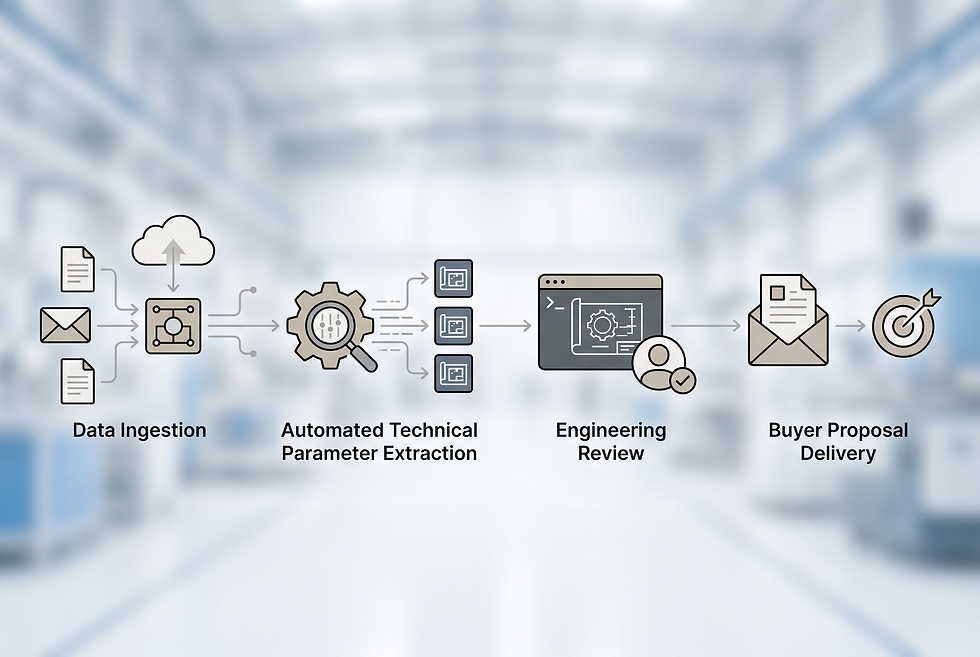
Rather than directing prospects to generic contact forms or unstructured email addresses, leading OEMs deploy structured digital workflows that capture critical packaging parameters at the first touchpoint. By systematically requesting container samples, film specifications, speed requirements, and factory layout constraints upfront, the manufacturer immediately isolates high-value capital investment projects from exploratory price checks.
This shift allows sales engineering departments to focus exclusively on vetted, high-probability proposals while automated workflows organize technical parameters, verify corporate identity, and maintain rigorous follow-up schedules.
Lead Generation for Packaging Machinery Companies: Step-by-Step Architecture
Executing high-performing lead generation for packaging machinery companies requires an operational framework spanning technical ingestion to final proposal delivery across six stages:
Step 1: Multi-Channel Ingestion and Entity Extraction
Inbound project requests arrive via website RFQ portals, regional distributor networks, or direct commercial inboxes. The system parses unstructured customer inquiries to extract essential parameters: package type, target speed (PPM), container dimensions, product characteristics, and desired delivery schedule.
Step 2: Automated Catalog Matching and Feasibility Screening
The extracted project parameters are evaluated against the manufacturer's standard machine catalog and engineering design rules. If a food processor requests a flow wrapper operating at 220 packs per minute with nitrogen flushing, the system matches the requirement to standard platform options and identifies required custom change-parts.
Step 3: Dynamic Parameter Gap Resolution
If an inbound request omits key technical data—such as pouch seal geometry, film thickness, or power supply specifications—the workflow automatically initiates a structured technical clarification. The prospective plant engineer receives an intuitive specification prompt to submit missing mechanical drawings or material samples before human engineers touch the file.
Step 4: Commercial Scoring and Buyer Verification
The opportunity is scored using three criteria: project timeline, technical catalog fit, and corporate verification (plant location, manufacturing capacity, and business domain validity). High-scoring capital projects are flagged for immediate sales engineering review.
Step 5: Rapid Engineering Briefing and Budgetary Proposal
With clean operational parameters synthesized into an executive engineering brief, the application engineer completes feasibility checks in minutes. The system compiles a modular preliminary quote containing equipment footprint drawings, utility consumption tables, and standard acceptance criteria.
Step 6: Account-Based Stakeholder Nurturing
Capital equipment deals require multi-stakeholder approval. Automated follow-up sequences deliver technical schematics and cleanability certifications to plant engineers, while sharing total cost of ownership models and maintenance ROI data with executive decision-makers.
Operational Comparison: Legacy vs. Modern Machinery Sales Workflows
The table below contrasts traditional machinery sales practices with modern engineering-led commercial workflows:
Workflow Dimension | Legacy Packaging Machinery Sales | Modernized Engineering Lead Workflow |
Inquiry Ingestion | Generic web contact forms and unstructured emails | Structured technical parameter capture with automatic parsing |
Technical Triage | Application engineers spend 3–6 hours manually verifying unvetted RFQs | Automated catalog baseline matching and mechanical compatibility screening |
Information Gathering | Multiple slow back-and-forth email rounds to clarify container specs | Dynamic technical prompts that request missing drawings and speed data |
Response Speed | 3 to 7 business days for initial budgetary quotations | Under 24 hours for verified preliminary engineering estimates |
Lead Tracking | Static CRM notes with inconsistent regional sales follow-up | Automated multi-stakeholder follow-up cadence based on buyer engagement |
Engineering Utilization | Senior engineers diverted to low-probability qualification tasks | Engineers focus exclusively on high-value custom proposals and FAT execution |
Evidence and Results: Quantifiable Gains in Global Machinery B2B Sales
Industrial equipment manufacturers adopting structured technical intake and commercial workflow automation demonstrate measurable operational gains across verified industry benchmarks:
Response Acceleration: According to research published by Harvard Business Review on industrial lead management, B2B vendors that contact prospective buyers within one hour of inquiry submission are nearly seven times more likely to qualify the lead compared to those waiting even two hours. In cross-border machinery exports, closing the time-zone gap directly prevents deal leakage to regional competitors.
Engineering Overhead Reduction: Data reported by the Packaging Machinery Manufacturers Institute (PMMI) indicates that incomplete project scopes account for over 30% of engineering pre-sales overhead. Establishing structured digital intake protocols recovers up to 15 hours of technical engineering time per department each week.
Pipeline Conversion Improvements: Industrial manufacturing benchmarks compiled by HubSpot Research show that technical sales automation and systematic follow-up cadences increase lead-to-opportunity conversion rates by 18% to 27% across extended B2B capital sales cycles.
What Other Machinery Companies Can Learn: Transferable Principles
Machinery builders looking to optimize their commercial operations should implement three core organizational principles:
1. Shift Technical Scoping to the Initial Touchpoint
Never allow sales representatives to chase an RFQ without preliminary technical validation. Collecting structured container dimensions, materials, and line speed parameters upfront filters out non-serious inquiries and elevates enterprise projects.
2. Neutralize the Cross-Border Time Zone Barrier
Over 40% of packaging machinery inquiries originate in international markets across Latin America, Southeast Asia, and Europe. Automated parameter collection ensures international prospects receive immediate technical engagement regardless of headquarters working hours.
3. Support Multiple Stakeholders with Tailored Assets
A plant engineer requires pneumatic schematics and sanitation ratings, while a procurement director needs spare-parts pricing and warranty terms. Automated workflows should segment technical collateral by stakeholder persona automatically.
Vertical Applications Across Packaging Machinery Segments
This commercial workflow adapts across diverse packaging machinery sub-sectors:
Food & Beverage Packaging OEMs: Processing plants require strict washdown compliance (3-A, USDA) and fast recipe changeovers. Automated workflows instantly capture container dimensions, seal types, and clean-in-place (CIP) requirements.
Pharmaceutical & Medical Packaging: Equipment purchases hinge on cleanroom compatibility and validation packages (IQ/OQ/PQ). Automated scoping collects sterilization constraints and serialization requirements upfront.
Secondary & End-of-Line Packaging: Case packing and palletizing cells depend heavily on pallet patterns, payload weights, and conveyor infeed elevations. Structured intake secures facility drawings before custom drafting begins.
Operationalizing the Model: Deploying an AI Equipment Sales Rep
To execute this rigorous commercial workflow without expanding administrative headcount or burdening technical teams, packaging machinery manufacturers are deploying specialized digital workers.
Job-to-be-Done: Technical Lead Qualification & Global Inbound Execution
Within an industrial machinery builder, an AI Equipment Sales Rep serves as the primary commercial interface between inbound global buyers and internal application engineering teams.
Primary Work Channels: Website RFQ forms, commercial email inboxes, regional distributor portals, and WhatsApp for international trade inquiries.
Main Daily Tasks:
Reviewing incoming project requests and extracting mechanical data (PPM, package styles, container substrates, facility parameters).
Cross-referencing customer requirements against machinery catalog baselines and standard engineering limits.
Requesting missing technical parameters directly from prospective plant managers and purchasing teams.
Compiling structured Opportunity Dossiers for sales directors and engineering teams.
Running persistent, multi-week follow-up cadences on active capital equipment proposals.
Authority Boundaries: The AI Equipment Sales Rep gathers operational parameters, provides verified catalog specifications, and schedules technical consultations. It is strictly constrained from issuing binding price discounts, altering custom engineering terms, or signing commercial contracts without human executive sign-off.
First Value Event: Capturing an inbound international machinery inquiry after local business hours, extracting complete line parameters, and delivering a verified project qualification brief directly to the sales engineer's inbox prior to 08:00 AM.
Daily Operational Report: The sales director receives a daily summary highlighting total RFQs received, verified high-intent engineering briefs, flagged specification gaps, and follow-up milestones achieved across open pipeline deals.
FAQ
Why do traditional B2B marketing tactics fail for packaging machinery lead generation?
Traditional marketing tactics often focus on superficial vanity metrics like generic eBook downloads and basic contact forms. Packaging machinery decisions depend on custom container geometries, line speeds (PPM), and strict sanitary certifications, which require engineering-led qualification from the initial commercial touchpoint.
How quickly should an industrial machinery manufacturer respond to an international RFQ?
Industrial buyer research shows that responding within one hour yields the highest qualification rates. Because international buyers operate in disparate time zones, automated specification intake systems ensure cross-border inquiries receive immediate technical engagement rather than waiting days for manual review.
What technical parameters are most critical to capture during initial packaging lead qualification?
Machinery OEMs must capture target throughput in parts per minute (PPM), package dimensions and style, packaging material specifications, product physical properties (such as temperature, viscosity, or bulk density), utility constraints, and anticipated installation timelines.
Does commercial workflow automation replace application engineers in machinery sales?
No. Automation does not replace application engineers; it removes repetitive administrative triage. By pre-screening incoming inquiries and extracting missing container specifications, engineers can focus exclusively on complex layout designs, custom tooling, and high-margin proposal reviews.
Modernize Your Equipment Sales Pipeline
Deploy an AI Equipment Sales Rep to qualify complex technical inquiries 24/7, eliminate engineering bottlenecks, and accelerate international machinery sales across your entire catalog. Explore our guided commercial workflows today.


Comments