%20%E6%8B%B7%E8%B4%9D.png)
Lead Generation for Robotics Companies: Strategic B2B Framework

Executive Summary
Industrial automation manufacturers face a persistent commercial bottleneck: high-intent engineering leads frequently stall during initial qualification, draining valuable pre-sales engineering resources. This analysis examines how leading robotics original equipment manufacturers (OEMs) and system integrators modernize their pipeline generation. By converting unstructured buyer inquiries into structured technical parameters before sales handoff, industrial automation suppliers accelerate proposal velocity, eliminate lead leakage across global time zones, and achieve predictable pipeline growth.
Industry Snapshot: The Robotics and Industrial Automation Landscape
The global robotics industry operates within a demanding commercial ecosystem defined by high capital expenditure, multi-stakeholder buying committees, and substantial integration risk. Industrial robotics manufacturers produce articulated arms, autonomous mobile robots (AMRs), Cartesian gantry systems, collaborative robots (cobots), delta robots, and specialized end-of-arm tooling (EOAT). Target buyers span tier-1 automotive suppliers, electronics contract manufacturers, warehousing and logistics operators, pharmaceutical packaging plants, and precision metal fabrication facilities.
Unlike standardized machinery components, industrial robotics deployments are rarely off-the-shelf catalog purchases. Every deployment requires rigorous validation of payload capacity, reach envelopes, cycle times, end-effector mechanics, integration software, factory communications protocols, and safety compliance. Consequently, commercial business models vary from direct OEM equipment sales and value-added distributor networks to turnkey system integration partnerships and Robotics-as-a-Service (RaaS) subscription structures. Building an effective system for lead generation for robotics companies requires engaging plant managers, continuous improvement directors, robotics software engineers, and corporate procurement executives across every stage of evaluation.
What Robotics Companies Sell: The Complexities of the Commercial Cycle
Selling robotics hardware and turnkey automation systems differs fundamentally from transactional B2B sales. Industrial automation purchases are evaluated through strict operational metrics: return on investment (ROI) payback period, throughput improvement, labor reallocation, scrap rate reduction, and overall equipment effectiveness (OEE).
The customer procurement journey typically involves three distinct phases:
Operational Identification and Application Scoping: A manufacturing or logistics facility identifies an operational bottleneck, labor shortage, ergonomics hazard, or quality consistency issue on the production floor.
Technical Feasibility and Project Sizing: Plant engineers evaluate payload thresholds, cycle rates, environmental conditions (such as cleanroom ratings, washdown requirements, or weld splatter exposure), and system integration complexity.
Commercial Validation and Procurement: Plant leadership, finance directors, and corporate procurement executives review the total cost of ownership (TCO), ongoing maintenance contracts, spare parts availability, warranty terms, and financing options.
Because technical requirements govern every stage of the procurement cycle, generic commercial follow-up fails. If an inbound inquiry does not receive immediate technical clarification regarding application scope and payload specifications, prospective buyers quickly redirect their Requests for Quotation (RFQs) to competing automation providers.
The Business Problem: Structural Friction in Industrial Pipeline Generation
Industrial robotics manufacturers and automation suppliers experience recurring points of commercial failure during inbound and outbound prospecting. Despite substantial investments in industrial trade exhibitions, technical application white papers, digital webinars, and specialized directory listings, pipeline velocity consistently falters due to four operational hurdles:
Slow Technical Qualification: Prospective buyers frequently submit inquiries containing vague specifications (for example, "Need an articulated robot for machine tending"). Pre-sales applications engineers often spend days exchanging emails simply to capture payload weight, cycle time, reach requirements, and CAD dimensions before quoting is even feasible.
Pre-Sales Engineering Resource Depletion: Applications engineers are expensive, scarce technical assets. Forcing engineering teams to spend 30% to 40% of their working hours sifting through unqualified inquiries severely limits their capacity to design high-value custom solutions for enterprise accounts.
Global Time-Zone Latency: Global robotics buyers operate across multiple regions, including North America, Europe, East Asia, and Latin America. Inquiries arriving outside standard operating hours often wait 24 to 72 hours for an initial response, by which point the prospect has already engaged a regional competitor.
Channel and System Integrator Friction: Robotics OEMs relying on independent systems integrators (SIs) often lose visibility into end-user project progress. Incomplete project scoping leads to misaligned expectations, prolonged quotation rounds, and abandoned opportunities.
Transforming Lead Generation for Robotics Companies: The Modern Operating Model
Leading automation companies have shifted away from passive inquiry collection toward structured, automated pre-qualification. Rather than treating inbound web traffic or event contacts as raw leads to be routed blindly to sales representatives, advanced manufacturers deploy an architectural layer that captures, classifies, and structures technical requirements instantaneously.
Executing successful lead generation for robotics companies requires an operational shift characterized by three core pillars:
Application-Specific Data Ingestion: Replacing generic "Contact Us" forms with dynamic qualification paths that capture critical application variables, including payload, reach, cycle time, target material, environmental factors, and existing PLC interfaces.
Contextual Retrieval and Sizing Assistance: Leveraging integrated technical knowledge bases to provide immediate directional feasibility estimates, CAD file submission guidelines, and relevant deployment case studies based on the buyer's industry.
Synchronized Opportunity Routing: Delivering pre-scoped, engineering-ready dossiers to regional sales managers and authorized systems integrators within minutes of initial buyer contact.
How the Workflow Actually Works: Step-by-Step Technical Qualification
A modern lead generation framework for industrial robotics companies executes through six structured operational stages, balancing automated precision with necessary human engineering judgment:
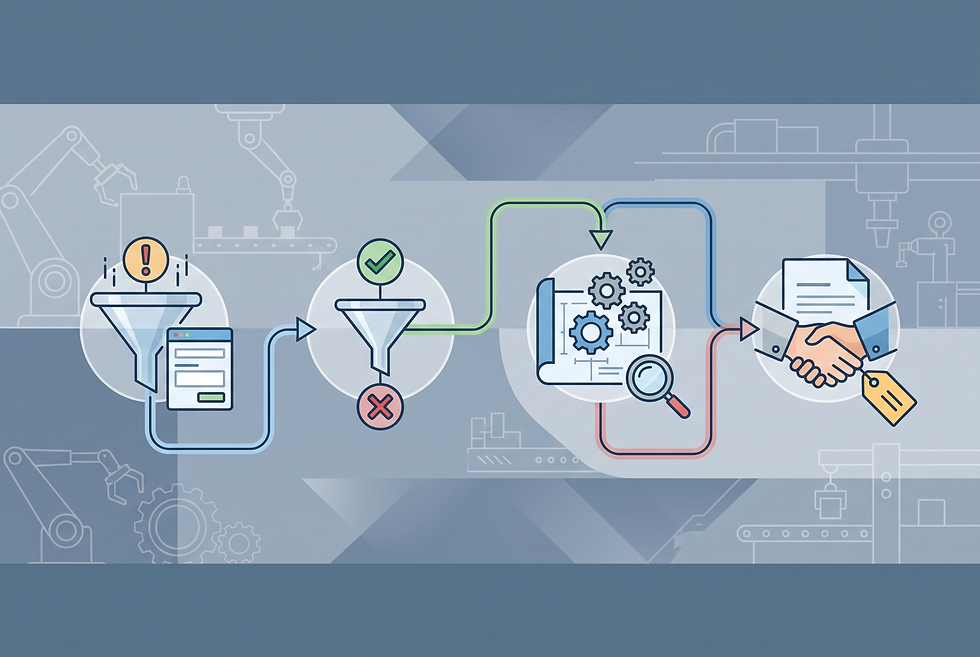
Data Ingestion and Context Extraction: The prospective buyer enters through a technical landing page, digital configurator, or trade show scan. The system captures preliminary application context alongside corporate email verification and operational facility location.
Automated Application Scoping: An automated technical qualification layer engages the prospect via real-time digital interface or immediate email dialogue, systematically requesting missing operational parameters, such as payload capacity, required axis degrees, cleanroom level, target cycle time, and project timeline.
Deterministic Feasibility and Parameter Check: The qualification workflow cross-references captured parameters against the OEM product catalog, identifying the suitable robot payload family, compatible controller models, and necessary integration accessories.
Human Review and Engineering Validation: Once the technical data achieves minimum engineering completeness, an applications engineer or technical sales manager reviews the auto-compiled project dossier. The human expert approves or adjusts the suggested equipment baseline.
Commercial Handoff and Solution Scoping: The vetted opportunity is assigned to the appropriate territory director or certified system integrator, accompanied by a structured technical brief, eliminating repetitive discovery questions.
Continuous Workflow Optimization: System logs record buyer drop-off points, missing application questions, and integration objections, allowing product and commercial teams to refine qualification prompts and pre-sales documentation.
Comparative Process Analysis: Legacy vs. Structured Robotics Qualification
Process Dimension | Legacy Industrial Sales Process | Structured Qualification Operating Model |
Initial Inbound Response | 24 to 72 business hours via generic sales email | Real-time structured response (under 5 minutes) |
Technical Data Collection | 3 to 5 manual back-and-forth email exchanges | Automated multi-parameter intake and validation |
Pre-Sales Engineering Role | Manually reviews unqualified contacts and raw leads | Focuses exclusively on pre-vetted, high-feasibility projects |
Data Structure at Handoff | Unstructured notes, partial project specifications | Comprehensive technical dossier with payload and timeline |
Integrator Collaboration | Fragmented communications with delayed updates | Direct handoff of verified project specs to regional SIs |
Buyer Experience | Prolonged waiting cycles for basic feasibility checks | Instant technical clarity and guided documentation access |
Evidence and Performance Benchmarks
According to findings published in the McKinsey & Company Global Industrial Robotics Survey (2022), over 80% of automated manufacturing decision-makers cite vendor responsiveness and technical competence during early scoping as decisive factors in final vendor selection. Furthermore, industry data compiled by the Association for Advancing Automation (A3) highlights that project cycle times in industrial equipment sales frequently exceed 6 to 9 months when technical scoping is handled without standardized qualification frameworks.
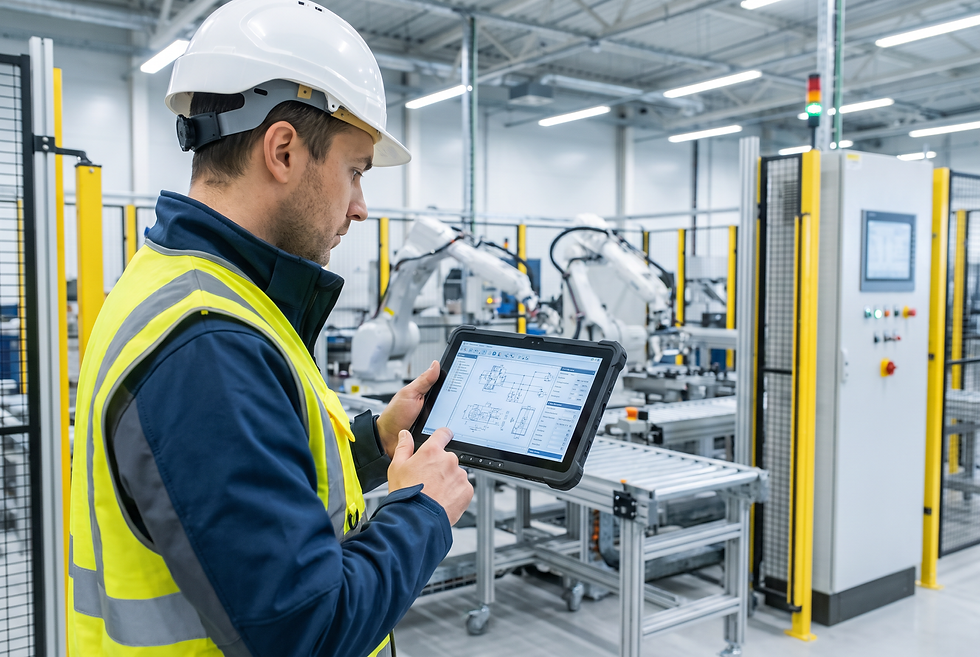
Empirical operational data from industrial equipment manufacturers implementing structured technical lead workflows demonstrates significant efficiency gains. Automation manufacturers transitioning to structured digital pre-sales intake report up to a 60% reduction in pre-sales engineering hours spent on unqualified projects, alongside a 40% compression in overall RFQ preparation time. By eliminating administrative friction and accelerating early-stage engineering validation, industrial equipment companies maintain higher conversion rates across competitive bidding environments.
What Other Companies Can Learn: Core Methodological Principles
Industrial machinery manufacturers and automation suppliers can adopt several transferable operating principles from modern robotics sales workflows:
Front-Load Technical Rigor: Never route raw inquiries directly to field sales without basic operational qualification. Capturing payload, throughput requirements, and budget authority early preserves commercial bandwidth.
Decouple Data Gathering from Engineering Design: Routine parameter collection does not require a senior engineer. Automating the intake process frees pre-sales talent to focus on architectural system design and high-stakes customer presentations.
Treat the Buying Committee as Multi-Disciplinary: Provide distinct informational tracks. Offer engineering leads downloadable CAD assets and API documentation while providing plant executives clear ROI modeling tools and maintenance schedules.
Standardize Integrator Data Handoffs: If third-party integrators deploy your hardware, establish standardized project briefs. Uniform documentation reduces miscommunication and strengthens distribution relationships.
What This Looks Like for Robotics and Automation OEMs
For a mid-sized industrial robotics OEM manufacturing articulated pick-and-place systems, adopting this framework transforms day-to-day pipeline management. Rather than receiving generic "Request a Quote" submissions that languish in sales inboxes, global inquiries from manufacturing hubs across North America, Europe, and Asia are immediately engaged.
When a prospective plant manager in Frankfurt or Chicago submits a project inquiry, the system instantly identifies the target application (e.g., palletizing, machine tending, optical inspection), gathers operational specifications, and confirms facility integration constraints. By the time the regional commercial director opens the CRM the following morning, the opportunity is already fully categorized, complete with a structured payload breakdown, estimated budget range, and suggested robot series.
AI Worker Mapping: The AI Global Sales Rep
To operationalize this model without expanding administrative overhead, industrial robotics and automation manufacturers implement specialized digital workforce roles designed specifically for global technical commerce.
Role Profile: AI Global Sales Rep
Primary Responsibilities: 24/7 technical lead qualification, interactive RFQ parameter collection, multi-lingual inquiry triage, and structured CRM opportunity creation.
Work Channels: Enterprise digital portals, technical landing pages, inbound email channels, and integrated messaging applications.
Authority Boundaries: Operates strictly within verified product specification manuals, engineering guidelines, and approved commercial parameters. Does not issue binding pricing or final engineering warranties without direct human authorization.
First Value Event: Successfully engaging an inbound global prospect within 5 minutes, capturing complete operational specifications (payload, reach, cycle time, integration timeline), and generating a validated technical briefing dossier for regional sales engineering review.
Daily Operational Report: Summarizes total international inquiries engaged, breakdown of qualified vs. non-feasible applications, verified RFQ dossiers ready for engineering sign-off, and identified product parameter trends across target industrial verticals.
FAQ
How does lead generation for robotics companies differ from standard B2B software lead generation?
Lead generation for robotics companies requires upfront technical validation of physical and operational parameters—such as payload, reach, cycle times, safety standards, and factory floor integration constraints—making simple demographic qualification insufficient for industrial sales.
How can robotics manufacturers prevent pre-sales engineers from wasting time on unqualified inquiries?
By implementing structured pre-qualification workflows that collect and validate essential engineering parameters before an applications engineer spends time reviewing or designing a custom automation layout.
What role do system integrators play in the robotics lead generation workflow?
System integrators convert OEM hardware into functional factory-floor deployments; providing them with standardized, pre-qualified project dossiers ensures faster quotation times, fewer scoping errors, and higher closing rates.
Why is multi-lingual, 24/7 inquiry response critical for industrial automation exporters?
Global automation buyers source equipment across different time zones. Immediate response to technical RFQs prevents prospective buyers from taking their project specifications to regional competitors.
Scale Your Global Robotics Pipeline with Precision
Deploy an AI Global Sales Rep to handle 24/7 technical lead qualification, automate structured RFQ intake, and deliver engineering-ready project dossiers directly to your sales team.



Comments