%20%E6%8B%B7%E8%B4%9D.png)

Why Manufacturers Should Use AI for Sales Conversion

Manufacturers should use AI for sales conversion to automate complex B2B quotation workflows, respond to global inquiries instantly, and gain predictive insights that turn raw leads into closed deals faster than manual sales pipelines. By eliminating manual delays in processing customized technical specifications, AI ensures that high-value opportunities are quoted accurately and secured before competitors can react.
Why Traditional B2B Manufacturing Sales Fall Short
Traditional manufacturing sales pipelines are hindered by long response times, highly custom product specifications, and manual handoffs between sales and engineering teams. In B2B manufacturing, a typical RFQ (Request for Quote) requires cross-referencing raw material costs, production capacity, and shipping logistics.
When human sales representatives spend days compiling these variables, buyers often move to more responsive competitors. Manual data entry in legacy systems also increases error rates, leading to lost revenue and friction in the buyer journey.

What is an AI Sales Agent for Manufacturing?
An AI Sales Agent for manufacturing is an autonomous, intelligent software solution designed to handle the complex, multi-step customer inquiries typical of industrial procurement. Unlike basic chatbots, these agents understand technical schematics, pricing models, and production timelines.
They integrate directly with your B2B manufacturing CRM to read historic sales records, analyze current inventory, and generate precise technical proposals. This allows industrial enterprises to scale their customer acquisition without proportionally increasing their sales headcount.
Why Should Manufacturers Use AI for Sales Conversion?
Using AI-powered sales conversion software provides deep operational advantages that directly impact the bottom line. Key benefits include:
Instantaneous Response Times: AI agents analyze and reply to complex RFQs in minutes, securing the "first responder" advantage in B2B buying.
24/7 Global Coverage: International buyers in different time zones receive instant, localized support and multi-lingual technical engagement.
Higher Quote Accuracy: AI cross-references real-time raw material indexes and factory capacity to eliminate pricing underestimation.
Streamlined Pipeline Tracking: Automation handles follow-ups, contract updates, and credit checks, freeing human experts to focus on relationship-building.
Sales Metric | Traditional Manual Process | AI-Powered Sales Automation |
|---|---|---|
:--- | :--- | :--- |
RFQ Response Time | 2 to 5 Business Days | Under 15 Minutes |
Data Entry Error Rate | High (Manual spreadsheets) | Negligible (Direct CRM Sync) |
Lead Qualification | Subjective / Inconsistent | Predictive / Data-driven |
Lead-to-Quote Conversion | ~15% to 25% | Up to 45%+ |

How Can Industrial Sales Automation Improve Lead Qualification?
Not all leads are created equal. Industrial sales automation software uses predictive analytics to score incoming leads based on their conversion likelihood, order volume potential, and technical feasibility.
By analyzing historical database interactions, the AI identifies high-intent procurement managers and prioritizes them for your senior engineers. This ensures your human sales team expends energy only on high-value, high-margin opportunities.
How YTT Sales Master and GoSell Transform Manufacturing CRM
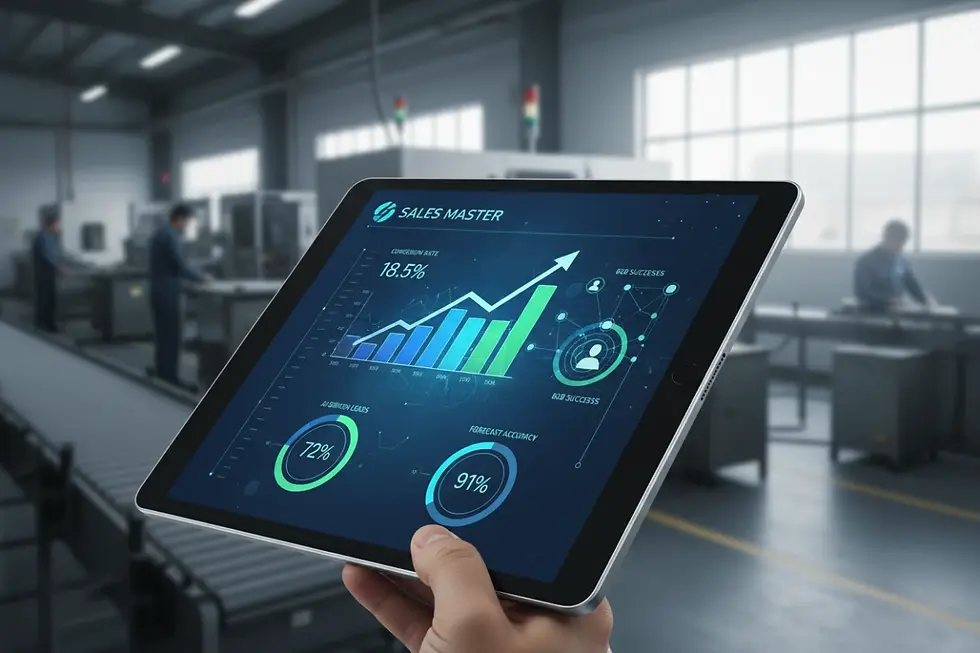
To bridge the gap between complex industrial specifications and fast sales cycles, manufacturers are adopting specialized software packages like the YTT Sales Master and GoSell.
These platforms enhance the standard B2B manufacturing CRM by embedding native AI sales agents directly into the pipeline. By automatically pulling CAD metadata, bill of materials (BOM), and production schedules, YTT Sales Master generates dynamic quotes, tracks customer interactions across multiple channels, and recommends optimal pricing tiers automatically.
What Are the Best Practices for Implementing AI in Factory Sales?
To maximize the ROI of your AI sales conversion software, follow these core steps:
Clean Your CRM Data: Ensure your historical pricing sheets, product catalogs, and customer transaction logs are accurate before training the AI.
Define Clear Hand-Off Rules: Set specific thresholds for when an AI Sales Agent should transfer a highly complex or high-value quote to a human representative.
Integrate ERP and CRM: Ensure your Enterprise Resource Planning (ERP) database communicates flawlessly with your AI-powered CRM to prevent quoting products with unavailable materials.
If you want to revolutionize your sales operations, reduce quotation times from days to minutes, and systematically close more high-value contracts, Contact YTTAI for YTT Sales Master / GoSell / AI CRM support today to schedule a custom demonstration.
FAQ
Will an AI Sales Agent replace my human engineering and sales teams?
No. The AI Sales Agent is designed to handle repetitive inquiries, routine RFQs, and initial lead qualifications. This allows your human engineers and sales executives to focus on complex custom designs, strategic negotiations, and long-term client relationships.
How does AI handle highly customized engineering orders and RFQs?
Advanced AI-powered sales conversion software integrated with a B2B manufacturing CRM can analyze uploaded technical drawings, PDFs, and CAD files. By matching these files against past production data and predefined material rules, the AI generates accurate estimates or flags the file for manual engineering review if it exceeds automated limits.
How long does it take to integrate platforms like YTT Sales Master and GoSell?
Integration timelines vary based on your existing IT infrastructure, but standard configurations with popular B2B CRMs and ERP databases can typically be deployed and trained on your historic data within a few weeks, yielding immediate improvements in response speed.


Comments