%20%E6%8B%B7%E8%B4%9D.png)
AI GTM Strategy for Manufacturers: Fix Execution Before Adding Tools

Executive Summary:
Industrial manufacturers often struggle with stalled pipeline growth despite investing heavily in tech stacks. GTM initiatives rarely collapse from poor positioning; they fail at the operational execution layer. By moving from disconnected prospecting tools to an end-to-end AI GTM strategy, industrial revenue teams can operationalize buyer signals, automate technical account qualification, and maintain consistent outbound cadences without inflating sales headcount or diluting engineering time.
Company Snapshot: The Reality of Modern Industrial Equipment Go-to-Market
In complex industrial sectors—ranging from custom precision tooling and packaging machinery to industrial automation systems—companies typically operate on multi-million dollar annual contract values with lengthy procurement cycles. Their primary buyers are VP-level engineering directors, plant managers, supply chain heads, and Chief Technology Officers who demand technical depth, regulatory compliance, and rapid proof of capability before agreeing to an initial technical discovery call.
Historically, these manufacturers relied on field sales representatives, industry trade exhibitions, word-of-mouth referrals, and distributor networks. In modern international commerce, however, enterprise buyers conduct over 70% of their technical evaluation digitally before ever speaking with a sales representative. Consequently, industrial revenue leaders must capture demand across global territories, track subtle buying signals, and respond instantly with high-context technical collateral. This requires an operational rhythm that manual prospecting models simply cannot sustain.
What Complex Manufacturers Sell: High-Stakes Procurement and Sales Friction
Manufacturers do not sell off-the-shelf software; they sell engineered physical assets, bespoke fabrication lines, and operational uptime. A typical purchase cycle involves multiple stakeholders across procurement, health and safety, electrical engineering, and executive leadership. The transaction journey entails submitting detailed Requests for Quotations (RFQs), verifying compatibility with existing factory infrastructure (such as PLC architectures, pneumatic lines, or ERP integrations), and undergoing rigorous factory acceptance testing (FAT).
Because the cost of purchasing the wrong industrial system carries catastrophic operational downtime risks, buyers ignore generic outbound sales messaging. They require precise engineering data sheets, regional compliance documentation, and clear cycle-time calculations during their initial touchpoints. When a traditional business development representative (BDR) attempts outreach using generic SaaS sales templates, industrial buyers disengage immediately. The fundamental sales mechanism requires deep technical fluency paired with relentless execution consistency.
The Core Business Problem: Why Industrial GTM Fails at the Execution Layer
Industry analysis and modern go-to-market benchmarks reveal a consistent structural flaw: commercial strategy is rarely the bottleneck. Organizations generally know their ideal customer profile (ICP), understand their competitive differentiators, and possess strong customer references. The breakdown occurs in the daily execution layer.
Industrial revenue teams face three pervasive execution gaps:
Signal Disconnect: Buying signals—such as plant expansion permits, regulatory mandate deadlines, machinery auction bids, or executive leadership hires—occur constantly across disparate databases, yet sales teams lack the bandwidth to monitor and synthesize these indicators in real time.
Superficial Account Research: Evaluating an industrial prospect requires reading quarterly manufacturing reports, analyzing supply chain bottlenecks, and identifying installed legacy hardware. Human reps often spend 45 minutes researching a single enterprise account, resulting in low outbound volume and severe operational fatigue.
Follow-Up Decay and Pipeline Slippage: Complex sales cycles require 8 to 14 contextual touches spread across 60 days. Manual reps routinely abandon outreach sequences after two attempts when an immediate reply is not received, letting high-value target accounts go cold.
When companies encounter these friction points, executive leadership often reacts by purchasing additional disconnected point solutions—intent data feeds, email warmers, data scrapers, and sequencing tools. This tool proliferation exacerbates the problem by creating fragmented data silos, increasing administrative burden, and failing to address the core breakdown: continuous, autonomous execution.
What Changed: Moving from Point-Solution Tool Sprawl to an AI GTM Strategy
Rather than adding another dashboard for human reps to manage, forward-thinking B2B manufacturers are adopting a unified ai gtm strategy. Under this paradigm, artificial intelligence is not merely a drafting assistant for cold emails; it operates as an autonomous execution engine that unifies account selection, research, signal interpretation, multi-channel outreach, and pipeline reporting.
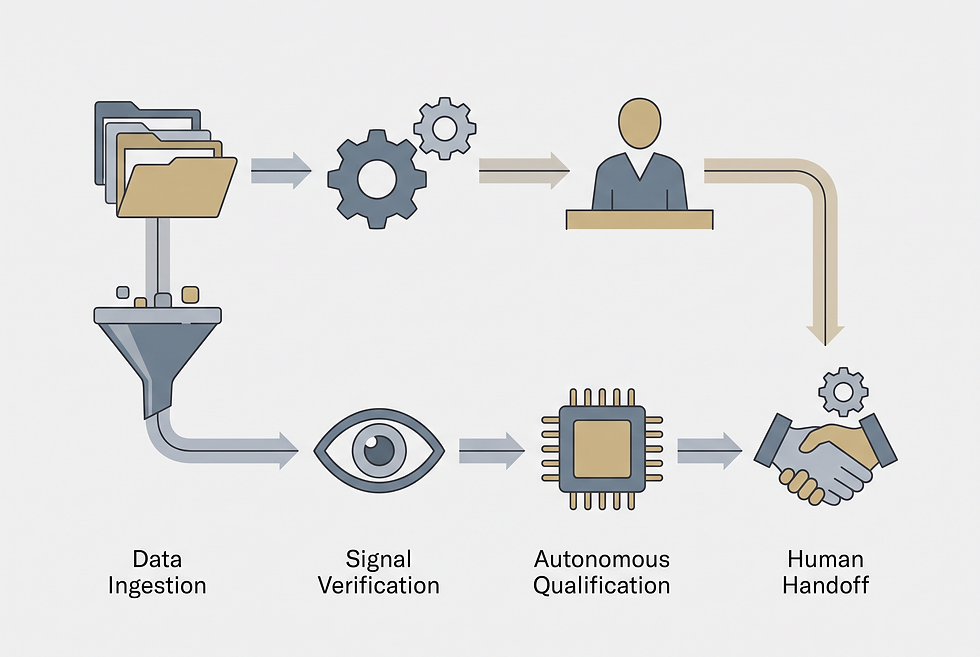
Instead of treating each stage of the funnel as an isolated manual task, the AI-driven architecture creates a continuous feedback loop. Account intelligence feeds directly into personalized technical value propositions; inbound technical inquiries trigger automated capability matching; and pipeline telemetry automatically refines targeting criteria without requiring manual CRM updates from sales managers.
How the Workflow Actually Works: The Six-Stage AI GTM Execution Engine
To build an autonomous GTM execution engine that maintains enterprise-grade reliability, organizations must structure their operations into distinct, observable stages. The following six-step workflow illustrates how data flows from initial market signals to closed-loop commercial attribution:
Step 1: Dynamic ICP Ingestion and Account Scoring
The engine continuously connects to global corporate registries, trade data feeds, and firmographic databases. Instead of relying on static spreadsheets, it filters accounts using dynamic parameters: factory square footage, export licensing, installed equipment types, and recent capital expenditure announcements. Accounts are programmatically tiered based on readiness and strategic fit.
Step 2: Intent Signal Detection and Trigger Verification
The system monitors multi-channel trigger events, including new environmental compliance mandates, executive appointments in plant operations, published job postings for specialized automation technicians, and visits to high-intent technical documentation pages. When a threshold score is crossed, the account moves automatically to the active research queue.
Step 3: Deep Technical Account Research and Persona Mapping
Rather than performing superficial web scrapes, the AI agent parses annual sustainability reports, facility expansion filings, and existing technology footprints. It maps specific stakeholder personas within the target enterprise—such as the Operations Director and the Reliability Engineering Lead—matching each with relevant operational case studies, regional compliance certifications, and equipment payback metrics.
Step 4: Autonomous Tier-1 Outreach and Technical Inquiry Response
The system crafts hyper-personalized, engineering-grade outreach tailored to each persona's operational challenges. When an account replies with technical questions regarding voltage specifications, footprint constraints, or software protocol compatibility (e.g., Modbus, OPC-UA), the AI drafts precise answers drawn strictly from verified internal engineering manuals and product catalogs.
Step 5: Human Engineering and Commercial Review Gateway
Autonomous action operates within strictly governed guardrails. When an enterprise prospect requests a formal pricing quote, a customized engineering feasibility assessment, or an on-site pilot demonstration, the workflow generates a structured briefing dossier and seamlessly hands off the interaction to the assigned Regional Sales Director or Solutions Architect.
Step 6: Closed-Loop Pipeline Telemetry and Continuous Optimization
Every interaction, conversion, objection, and pipeline progression event is structured and logged into the central CRM without manual sales rep entry. If accounts in a specific industrial sub-sector disengage at a particular technical objection, the system flags the pattern in the weekly pipeline intelligence review and automatically adjusts messaging parameters for incoming pipeline cohorts.
Operational Benchmarks and Process Comparison
The table below highlights the operational differences between traditional, manual B2B manufacturing outreach and an integrated AI GTM execution model:

Operational Dimension | Traditional Manual / Point-Tool Model | Integrated AI GTM Execution Model |
Account Research Depth | 30–60 minutes per account; generic surface-level data | Under 60 seconds; parses regulatory filings, supply chain footprints, and technical specs |
Signal Responsiveness | Batch-processed weekly or monthly; high decay rate | Real-time trigger detection within minutes of signal publication |
Technical Personalization | Rep uses static templates with minor variable replacement | Dynamic value propositions referencing specific machine compatibility and plant metrics |
Follow-Up Consistency | 2–3 touches before lead is dropped due to rep fatigue | 8–12 contextual, multi-channel touchpoints executed with strict protocol discipline |
Inquiry Qualification | 24–48 hour delay; often requires engineering escalation | Sub-5 minute initial technical response based on verified technical knowledge base |
Pipeline Telemetry | Fragmented notes; manual CRM updates subject to human bias | Automated structured logging with real-time feedback loops to ICP targeting |
Strategic Takeaways: What Enterprise Leaders Can Replicate
For enterprise industrial executives looking to overhaul their commercial operations, several foundational principles emerge from this execution-centric model:
Separate Strategy from Execution Overhead: Strategy defines where to play and how to win. Execution is the operational process of delivering that message at scale. Avoid forcing expensive sales engineers to spend half their workweek conducting data entry and manual prospect searching.
Enforce Strict Guardrails on Autonomous Messaging: Industrial buyers value technical precision over aggressive sales copy. Autonomous systems must be restricted to verified product documentation, explicit engineering specifications, and established commercial terms, eliminating hallucination risks.
Design for First-Touch Speed and High-Value Handoffs: Speed to lead in B2B manufacturing dramatically impacts conversion rates. The objective of AI GTM is not to replace the complex closing conversation, but to compress the cycle time between initial buyer intent and technical discovery meetings.
Treat Pipeline Data as a Closed-Loop Asset: Disconnected outbound tools produce dark data. Ensure every message, reply sentiment, and objection category is structured back into your core pipeline architecture to inform ongoing product and market strategy.
Cross-Industry Application: Tailoring the Engine Across Manufacturing Sectors
This execution framework applies across diverse industrial environments:
For Precision Machining and CNC Contract Manufacturers: The engine tracks supply chain reshoring tenders, defense contract awards, and aerospace vendor requirements, automatically initiating outreach detailing machine tolerances, ISO/AS certifications, and available spindle capacity.
For Packaging Machinery Manufacturers: The system monitors consumer packaged goods (CPG) brand acquisitions, SKU expansion announcements, and sustainable packaging mandates, delivering tailored technical dossiers on line speeds and changeover efficiencies.
For Water Treatment and Fluid Handling Equipment Providers: The workflow detects municipal project bids, environmental agency infraction notices, and regional infrastructure grants, engaging municipal engineers with specific hydraulic flow schematics and compliance history.
YTT AI Worker Mapping: Deploying the AI Business Development Rep
To translate these systemic principles into an active operational environment without custom internal software development, industrial organizations deploy specialized AI digital workers.
Within the industrial manufacturing sector, the primary starting point is the AI Business Development Rep (AI BDR).
Job Title: AI Business Development Rep (Industrial Machinery & Equipment)
Main Daily Tasks: Autonomously scans global trade databases and intent triggers, maps engineering and procurement buying committees, drafts verified technical capability introductions, and maintains disciplined multi-touch outbound cadences across target enterprise accounts.
Primary Work Channels: Automated corporate email dispatch, CRM bidirectional synchronization, and internal communication alerts (e.g., Slack or Microsoft Teams) to notify human account executives.
Authority Boundaries: Operates autonomously within pre-approved messaging boundaries and verified engineering documentation; automatically pauses and routes conversations to Senior Solutions Architects upon receipt of customized RFQs, non-disclosure agreement (NDA) requests, or commercial discount inquiries.
First Value Event: Successful delivery of an engineering-qualified sales meeting with an active target enterprise account possessing verified project timeline, technical requirements, and capex budget.
Daily Report Output: A concise operational summary detailing new accounts ingested, trigger signals verified, technical inquiries resolved, and qualified discovery briefings scheduled for the human sales engineering team.
FAQ
What is an AI GTM strategy in a B2B manufacturing context?
An AI GTM strategy is an integrated operational framework that uses autonomous AI workers and workflow automation to execute ideal customer profile research, intent signal tracking, hyper-personalized technical outreach, and pipeline orchestration across complex enterprise sales cycles.
How does an AI GTM strategy differ from traditional sales automation tools?
Traditional sales automation tools merely send linear, pre-written email sequences and require extensive manual data entry. An AI GTM strategy continuously analyzes unstructured account data, adapts messaging based on technical product specifications, responds to buyer inquiries in real time, and logs structured intelligence directly to your CRM.
Will an AI GTM system risk sending inaccurate technical data to industrial buyers?
No, because enterprise-grade AI GTM systems operate under strict boundary controls. They retrieve information solely from verified engineering manuals, compliance sheets, and approved company collateral using Retrieval-Augmented Generation (RAG), and escalate complex requests to human engineers.
How quickly can an industrial enterprise see results from deploying an AI sales worker?
Most manufacturing teams achieve their First Value Event—such as booking their first verified, technical discovery call with a high-tier account—within 14 to 30 days of ingesting their product documentation, ideal customer profile criteria, and intent data streams.
Build an AI GTM Execution Plan
Transform your industrial pipeline with autonomous AI workers built for complex B2B sales cycles. Visit https://www.ytt-ai.com/ to design your custom go-to-market execution architecture today.


Comments