%20%E6%8B%B7%E8%B4%9D.png)
AI Sales Platform for Manufacturers: Enterprise Architecture and Buyer Guide

Executive Summary
Industrial manufacturing leaders are overhauling complex commercial operations to resolve technical lead friction, slow response times, and protracted quote cycles. By deploying an ai sales platform for manufacturers, engineering-driven organizations bridge the gap between technical catalog complexity and customer procurement needs. This guide examines the operating mechanisms, validation checkpoints, and architecture required to deploy autonomous qualification and human-in-the-loop quoting workflows without operational disruption.
Company Snapshot: The Modern Complex Manufacturer
High-mix industrial manufacturers operate in a demanding commercial environment. Whether producing precision CNC subassemblies, industrial robotics, custom fluid handling systems, or automated packaging equipment, these companies sell high-value engineered assets to sophisticated commercial buyers.
Industry Focus: Precision discrete manufacturing, engineered-to-order (ETO) machinery, and industrial automation equipment.
Core Products: Capital equipment, specialized components, process systems, and lifecycle replacement parts.
Target Customers: Plant managers, procurement directors, system integrators, and OEM engineering leads.
Business Model: Direct enterprise sales, value-added distributor channels, and high-specification Request for Proposal (RFP) bidding.
Analysis Imperative: B2B buyers now conduct extensive digital research before engaging sales representatives. Manufacturers that fail to provide immediate, technically accurate feasibility feedback risk losing deal momentum to competitors capable of rapid qualification.
What Industrial Manufacturers Sell: High-Friction Commercial Realities
Selling industrial machinery is fundamentally different from selling standard commodities or software subscriptions. Industrial sales require deep domain expertise, adherence to strict regulatory standards, and complex integration planning.
When a buyer approaches a manufacturer, the inquiry rarely arrives as a simple checkout order. Inquiries encompass detailed technical specifications: CAD drawings, pressure tolerances, cycle times, power constraints, environmental resistance requirements, and legacy system interoperability. The sales cycle spans between three and twelve months, involving multiple stakeholders across finance, operations, and technical design.
Historically, this process forced front-line sales representatives to act as intermediaries between commercial buyers and internal application engineers. If an inquiry lacked critical operating parameters—such as peak load requirements or material compatibility—the commercial team faced multi-week email exchanges simply to establish technical feasibility. This dynamic inflated cost-of-sale while leaving front-line engineering teams overwhelmed by low-probability opportunities.
The Business Problem: Technical Lead Latency and RFQ Friction
Traditional commercial operations in manufacturing face systemic friction points that degrade pipeline velocity and revenue conversion:
Slow Lead Response Times: Inbound RFQs submitted via web forms, trade portal listings, or email inboxes often wait 48 to 72 hours for initial human review, giving competitors an opening to capture the buyer's attention.
Engineering Resource Depletion: Application engineers spend up to 40% of their billable or design time reviewing incomplete RFQs that never convert into viable commercial orders.
Knowledge Silos: Decades of institutional product knowledge remain locked in unindexed technical PDFs, legacy ERP databases, and internal engineering calculation spreadsheets.
Inconsistent Qualification: Sales development teams often lack the technical depth needed to ask rigorous technical discovery questions, resulting in unqualified leads advancing to the formal quoting stage.
Follow-Up Gaps in Extended Cycles: During multi-month evaluation cycles, standard sales teams struggle to maintain consistent, personalized technical check-ins across hundreds of active prospects.
What Changed: Deploying an AI Sales Platform for Manufacturers
To overcome these operational challenges, forward-thinking manufacturers are moving beyond static web forms and generic CRM plug-ins. Instead, they are implementing a specialized ai sales platform for manufacturers designed to interpret engineering context, automate initial technical discovery, and orchestrate the pre-sales workflow.
This architecture does not replace domain engineers or seasoned enterprise account executives. Instead, it introduces an intelligent orchestration layer between incoming demand channels and internal commercial systems. By leveraging Retrieval-Augmented Generation (RAG) connected to proprietary engineering documentation, parameter extraction models, and deterministic workflow engines, the platform acts as an automated technical assistant that operates 24/7 across global time zones.
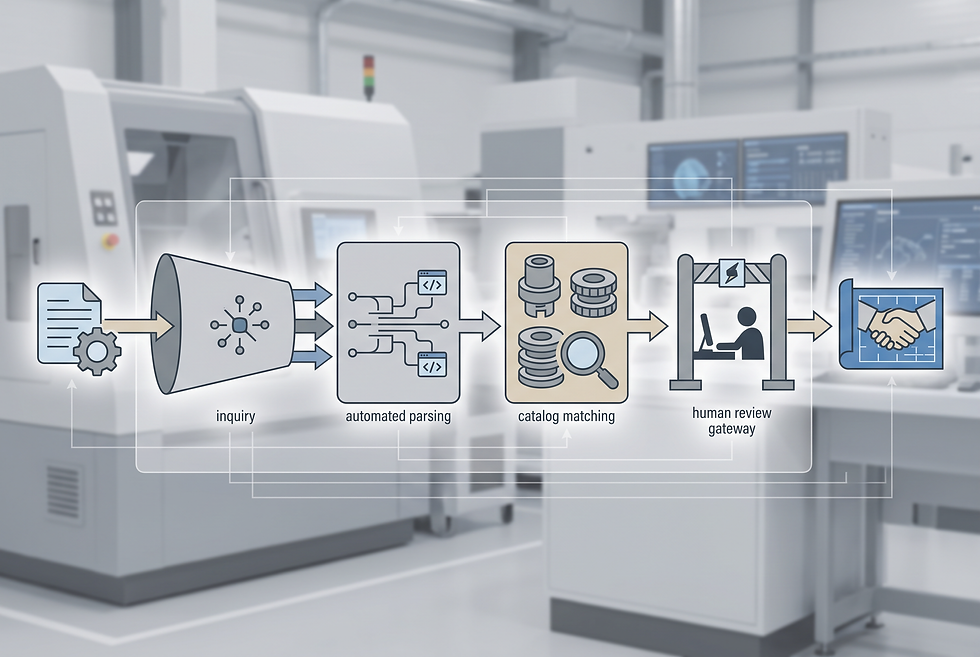
How the Workflow Actually Works: Step-by-Step Architecture
The implementation of an industrial AI sales workflow relies on explicit data boundaries, structured decision trees, and strict human-in-the-loop governance. A robust workflow follows six distinct stages:
Stage 1: Multi-Channel Data Ingestion and Parsing
Input: Raw inquiries arrive via website portals, direct technical email boxes, supplier network forms, or CAD/spec upload links.
System Action: The platform ingests text, extracts parameters from attached data sheets (e.g., voltages, dimensions, throughput targets), and identifies the prospect's organizational profile.
Output: A structured JSON object containing verified requirements, missing parameters, and buyer metadata.
Stage 2: Technical Feasibility Mapping
Input: The structured parameter object from Stage 1.
System Action: The system queries internal technical vector stores, standard product catalogs, and operating limitation rules to assess whether the customer's request fits standard or configurable product lines.
Decision Threshold: If operating parameters violate core safety or operational limits (e.g., exceeding maximum payload or incompatible chemical exposure), the system flags the incompatibility instantly.
Stage 3: Autonomous Technical Clarification
System Action: If essential engineering parameters are missing (such as duty cycle, ambient temperature, or compliance standard), the AI system initiates an immediate, professional clarification email to the prospect.
Customer Action: The buyer provides the missing engineering constraints via return email or interactive portal.
Result: The system aggregates a complete, actionable technical dossier before any human engineer spends time on the file.
Stage 4: Triage and Human Approval Gateway
Deterministic Check: High-value or highly customized ETO opportunities (e.g., deals exceeding $100,000 or requiring bespoke tooling) trigger a human approval workflow.
Human Review: The designated Application Engineer or Sales Director receives a prioritized notification in Slack, Microsoft Teams, or CRM with the drafted response, matched catalog items, and calculated feasibility notes.
Human Action: The expert approves, edits, or overrides the recommendation with a single click.
Stage 5: CRM Sync and Preliminary Quotation
System Action: Upon human approval, the system updates the CRM (e.g., Salesforce, HubSpot), creates or updates the deal record, logs the engineering spec sheet, and sends a formal initial feasibility summary or budgetary estimate to the customer.
Stage 6: Continuous Nurturing and Intelligence Aggregation
System Action: For opportunities with long procurement windows, the system monitors buyer engagement, delivers relevant application case studies, and compiles daily executive summaries of pipeline health and emerging technical requirements.
Comparative Evaluation: Legacy Operations vs. AI Sales Architecture
The following structural comparison illustrates how operational responsibilities and cycle metrics transform when shifting from traditional manual workflows to an industrial AI platform:

Operating Metric / Workflow Step | Legacy Industrial Sales Process | Modern AI Sales Platform Architecture | Operational Impact |
Initial Inbound Lead Response | 24 to 72 hours via manual inbox triage | Under 5 minutes via automated technical parsing | Eliminates initial drop-off and secures first-mover advantage |
Technical Requirement Gathering | 3 to 5 back-and-forth manual emails over 2 weeks | Automated parameter extraction and structured follow-up | Reduces discovery cycle from weeks to hours |
Engineering Triage Overhead | Application engineers manually review unqualified RFQs | Filtered triage: engineers only review complete, verified dossiers | Saves up to 40% of engineering pre-sales time |
Product Catalog Grounding | Reps rely on memory or search static PDF directories | RAG-grounded retrieval across full engineering documentation | Prevents inaccurate specifications and quote errors |
Multi-Time-Zone Coverage | Limited to regional office business hours | 24/7/365 continuous technical qualification globally | Captures international demand without adding night-shift headcount |
CRM & Deal Record Hygiene | Manual, inconsistent data entry by busy sales reps | Real-time automated data logging and structured spec mapping | Provides leadership with 100% visible, auditable pipeline data |
Evidence and Results from Industrial Implementations
Industrial organizations adopting structured automation and RAG-driven commercial workflows report significant operational improvements across core commercial metrics:
Shortened Quotation Turnaround: According to published manufacturing operations benchmarks, moving from unstructured manual quoting to automated requirement assembly reduces overall RFP response cycles by up to 60%.
Increased Engineering Efficiency: Third-party field studies in industrial automation indicate that filtering non-viable leads before engineering review allows application engineers to focus on high-margin customization, boosting proposal output without increasing head count.
Global Conversion Lift: Industry reports show that responding with actionable technical specifications within the first hour of an enterprise inquiry increases final win rates substantially compared to multi-day delays.
Key Lessons for Industrial Equipment Manufacturers
Enterprise leaders evaluating this technology should structure their deployments around four core operating principles:
Grounding Over Creativity: Sales in manufacturing require zero hallucination. An AI system must be strictly bounded to verified CAD data, engineering manuals, and operational limits. If a solution cannot be built, the platform must state so clearly.
Human Governance for High Stakes: Fully autonomous quoting is suitable for standard replacement parts, but complex machinery requires a human-in-the-loop gateway for commercial terms, pricing discounts, and custom engineering exceptions.
Structured Parameter Extraction First: Never treat an industrial inquiry as simple unstructured text. The platform must transform free-form messages into standardized engineering schemas (dimensions, duty cycles, power inputs) before taking downstream actions.
Seamless System Integration: The platform must read from and write to existing corporate infrastructure—such as ERP systems, PLM databases, and CRMs—to ensure organizational alignment without creating new data silos.
What This Looks Like Across Specific Industrial Sectors
Industrial Robotics Manufacturers: Inbound inquiries often demand specific payload, reach, and cycle-time capabilities. The platform evaluates the prospect's floor constraints against standard robot arm specifications, requesting simulation inputs before routing qualified projects to regional system integrators.
Packaging Machinery Suppliers: Inquiries typically hinge on throughput rates (units per minute), packaging material types, and sanitization standards (such as 3-A or IP69K). The system extracts these variables, identifies the right modular chassis, and prepares a baseline configuration for the engineering team.
Precision CNC & Contract Machinists: Customers upload STEP or DXF files with tight tolerance requirements. The platform checks machine envelope compatibility, material availability, and standard lead times, notifying production estimators only when specifications match plant capabilities.
Pumping & Fluid Handling Equipment: Applications depend on fluid viscosity, operating temperature, and head pressure. The system maps these inputs against pump performance curves, ensuring only technically valid configurations advance to final price quotation.
Deploying the First AI Worker: The AI Global Sales Rep
For enterprise manufacturers seeking immediate business value without a disruptive multi-year IT overhaul, the most strategic starting point is deploying a dedicated AI Global Sales Rep.
Role and Responsibilities
Worker Job Title: AI Global Sales Rep
Main Daily Tasks: Monitor all inbound digital channels (web forms, technical inboxes, partner portals), parse incoming customer requirements, execute real-time technical discovery, verify operational compatibility against product docs, and draft complete opportunity dossiers.
Primary Work Channels: Corporate Email, Website Inbound Endpoints, CRM Interface, and Internal Chat (Slack/Teams) for escalation.
Authority Boundaries: Authorized to answer technical capability questions, request missing specifications, and map catalog items. Strictly unauthorized to execute final commercial discounts, sign binding contracts, or alter engineered tolerances without human sign-off.
First Value Event: Successfully ingesting an incomplete international RFQ outside standard business hours, retrieving the required engineering parameters via automated clarification, and delivering a fully qualified, CRM-synced deal dossier to the sales director before the start of the next business day.
Daily Intelligence Reporting: Generates an end-of-day digest detailing total incoming inquiries, identified product demand trends, unresolved engineering parameter questions, and high-priority deals awaiting executive approval.
FAQ
How does an AI sales platform for manufacturers handle proprietary engineering data securely?
An enterprise-grade platform operates within isolated cloud environments using strict data boundaries and encryption. Proprietary technical manuals, CAD metadata, and internal pricing matrices are accessed via secure vector databases (RAG) and are never used to train public foundational models.
Can the AI sales platform integrate with legacy ERP and CRM systems?
Yes. Modern platforms use robust REST APIs, webhook listeners, and enterprise middleware connectors to synchronize data with established systems such as Salesforce, HubSpot, SAP, Microsoft Dynamics 365, and proprietary SQL-based product databases.
What happens when an inbound RFQ falls outside standard manufacturing tolerances?
The platform utilizes deterministic rule checks. When an inquiry requests specifications beyond certified limits (such as extreme temperature or load thresholds), the system flags the exception, explains the limitation clearly, and routes the inquiry to a senior application engineer for custom evaluation.
How much engineering time does an AI sales platform typically save?
By automating initial parameter extraction, filtering non-viable leads, and gathering missing operating data before human review, manufacturers typically save between 30% and 40% of front-line engineering time previously lost to administrative qualification.
Book an AI Platform Fit Assessment
Discover how an AI sales platform tailored for industrial manufacturers can streamline your technical qualification, protect engineering capacity, and accelerate complex RFQ cycles. Schedule your technical discovery session with our solutions architecture team today at https://www.ytt-ai.com/.



Comments