%20%E6%8B%B7%E8%B4%9D.png)
When Is a Company Ready to Use an AI SDR? A 7-Point Audit

A B2B enterprise is ready to use an AI SDR only when it operates with proven product-market fit, a strictly verified Ideal Customer Profile (ICP), predictable manual response benchmarks, and institutionalized human approval guardrails. Autonomous sales agents amplify pre-existing revenue velocity; they cannot fix broken positioning, deliverability failures, or disorganized discovery handoffs.
Outbound sales development is experiencing an operational inflection point. Revenue leaders facing rising customer acquisition costs and lengthening sales cycles are evaluating autonomous prospecting systems to expand pipeline capacity. However, treating autonomous software as a cure for broken outbound mechanics creates significant commercial risk. According to Gartner (2024), generative AI deployments in B2B sales yield positive commercial returns only when layered across standardized buyer data and disciplined go-to-market execution.
Before deploying algorithmic prospecting infrastructure, commercial leaders must conduct a thorough operational audit. Below is the comprehensive 7-point readiness framework designed for enterprise sales, marketing, and revenue operations executives.
When Is Your Organization Ready to Use an AI SDR?
Determining whether an organization is ready to use an AI SDR begins with an honest evaluation of go-to-market maturity. Autonomous prospecting systems do not discover positioning through guesswork; they ingest structured inputs, analyze market signals, and execute programmatic multi-channel touchpoints at scale. If the underlying data, value proposition, or buyer criteria are unproven, the system will only scale market rejection.
Revenue leaders must recognize that an autonomous prospecting agent functions as an execution multiplier rather than an exploratory strategy consultant. Successful adoption requires clarity across seven distinct pillars: product-market alignment, account segmentation, messaging resonance, inbox infrastructure, sales development workflow design, operational handoffs, and human governance.
1. Validated Product-Market Fit and Referenceable Retention
Autonomous prospecting agents rely on consistent, demonstrable customer success signals to generate compelling outbound narratives. If your enterprise is still pivoting between target markets, adjusting core pricing structures, or managing elevated early-stage customer churn, scaling outbound volume will merely burn through your addressable market.
To establish baseline readiness, your revenue organization must possess documented closed-won case studies, referenceable commercial accounts, and clear economic return-on-investment (ROI) data points. When your product team and account executives understand precisely why current enterprise customers buy, renew, and expand, an autonomous engine can synthesize those tangible proof points into targeted outbound sequences that resonate with executive buyers.
2. Multi-Dimensional ICP and Account Segmentation
Broad demographic filters such as targeting enterprise technology companies or mid-market manufacturers fail in automated environments. Algorithmic prospecting requires nuanced, multi-layered qualification parameters that reflect operational reality.
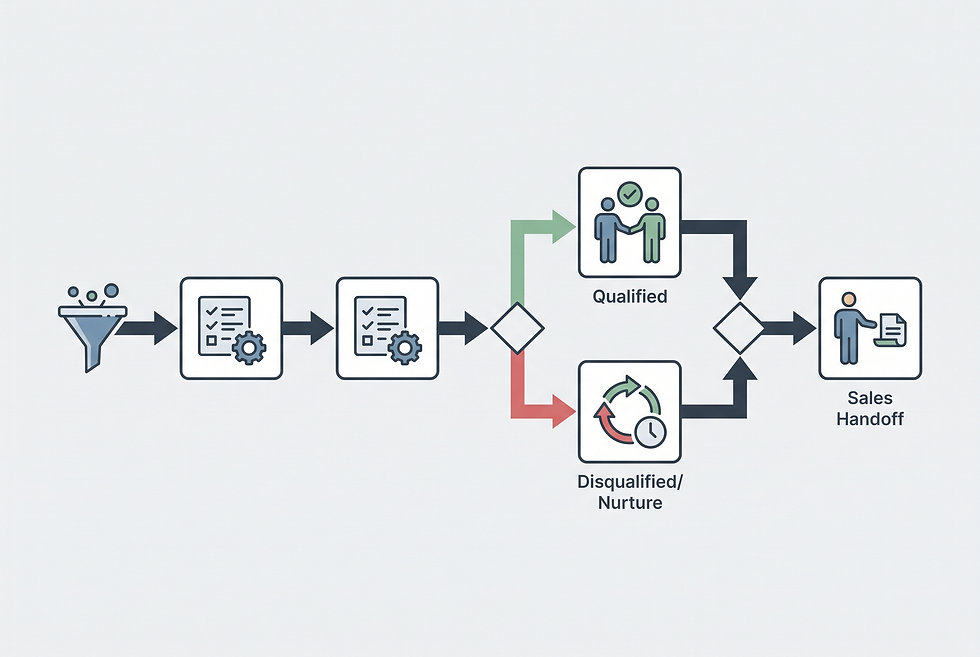
Your Ideal Customer Profile must combine firmographic boundaries with technographic footprints, hiring trends, and active organizational triggers. For instance, instead of targeting generic IT departments, top-performing teams specify accounts using legacy enterprise ERP systems that recently posted procurement engineering roles. This level of granularity gives autonomous systems the contextual boundaries required to generate relevant, high-conversion account intelligence.
3. Proven Value Proposition and Baseline Reply Rates
Algorithmic tools cannot invent buyer resonance. You must establish empirical evidence that target economic decision-makers actively engage with your current messaging before attempting to automate outreach.
Sales operations should validate benchmark performance across manual or semi-automated outbound sequences before implementing autonomy. According to research from Salesforce (2024), high-performing B2B sales teams maintain structured messaging playbooks that achieve consistent engagement baselines. In enterprise outbound campaigns, teams should achieve verified open rates above 40% and qualified positive reply rates above 2% to 3% across targeted accounts before introducing autonomous generation.
4. Technical Deliverability and Domain Infrastructure
Autonomous pipeline generation requires isolated, resilient technical infrastructure. Deploying automated email cadences from primary corporate domains creates existential risk for enterprise communication channels.
Revenue operations teams must configure dedicated secondary domains, enforce SPF, DKIM, and DMARC authentication protocols, and configure automated inbox warm-up routines. Deliverability policies enacted by Google and Yahoo in 2024 mandate strict spam threshold governance. Without isolated domain architecture and regular mailbox health monitoring, automated outreach volume will trigger immediate spam filtering and permanently damage domain reputation.
5. The 7-Point AI SDR Readiness Matrix
The following evaluation matrix details the operational standards required across each readiness pillar alongside the commercial risks of premature implementation.
Operational Pillar | Readiness Benchmark Standard | Premature Deployment Risk |
Product-Market Fit | Documented client ROI and consistent annual contract renewals | Accelerated brand burnout across key target accounts |
ICP Definition | Multi-attribute criteria combining tech stack, triggers, and pain points | Incoherent messaging distributed to unqualified non-buyers |
Offer Resonance | Validated messaging delivering >2% positive reply rate manually | High-volume scaling of unproven, low-converting offers |
Domain Architecture | Isolated secondary domains with active SPF, DKIM, and DMARC | Blacklisting and reputational damage to core business domains |
Pipeline Capacity | Dedicated AE availability with SLA to handle discovery meetings | Pipeline leakage and abandoned opportunities from slow follow-up |
Handoff SLAs | Documented SQL criteria, routing workflows, and CRM tracking | Internal misalignment and disputed pipeline attribution |
Human Governance | Strict human-in-the-loop review for pricing and contractual terms | AI hallucinations regarding pricing, scope, or commercial SLAs |

6. Account Executive Capacity and Discovery Handoff SLAs
Generating positive prospect responses is only the initial phase of pipeline generation. If incoming sales inquiries and booked discovery meetings are not managed quickly by skilled Account Executives, pipeline conversion rates drop precipitously.
Revenue leaders must establish formal Service Level Agreements (SLAs) between sales development workflows and closing teams. Organizations need to define explicit qualification criteria covering budget authorization windows, existing technical architectures, and active project timelines. Furthermore, Account Executives must maintain calendar capacity to accept and advance qualified opportunities within 24 hours of prospect engagement.
7. Pipeline Governance and Mandatory Human Approval Boundaries
Complete autonomy without operational boundaries introduces severe enterprise risk. Robust B2B execution requires clear demarcations between automated tasks and mandatory human intervention.
Autonomous systems excel at research, account monitoring, personalized icebreakers, and initial scheduling logistics. However, strict human approval boundaries must be enforced whenever prospect conversations involve customized pricing models, commercial contract terms, master service agreements, or bespoke technical implementation commitments. Sales management must retain final sign-off on commercial promises to prevent pricing discrepancies or legal complications.
Scaling Predictable Revenue Architecture with YTTAI
When an enterprise fulfills these operational prerequisites, intelligent revenue infrastructure creates sustainable pipeline advantages. Modern platforms like YTTAI help B2B organizations operationalize their outbound readiness by combining deep contextual market intelligence, automated account signal detection, and rigorous human-in-the-loop governance directly into existing sales workflows.
By uniting advanced account qualification with clear operational guardrails, commercial teams eliminate manual administrative burden while maintaining institutional control over brand representation and commercial negotiations. Explore the Sales Master architecture to benchmark your current sales readiness and design a scalable, governed outbound engine.
FAQ
Can an AI SDR fix a declining outbound sales pipeline?
No. An AI SDR scales the speed and efficiency of outbound outreach, but it cannot fix underlying issues such as unvalidated product-market fit, poorly defined target personas, or ineffective value propositions. Organizations must establish consistent manual or semi-automated baseline engagement before introducing autonomous execution.
What technical prerequisites are mandatory before deploying an AI SDR?
Organizations must establish secondary outbound domains, configure complete DNS authentication records (SPF, DKIM, and DMARC), implement automated mailbox warm-up schedules, and integrate CRM synchronization rules to ensure high deliverability and avoid database duplication.
Which sales activities require mandatory human approval in an automated workflow?
Human approval must remain mandatory whenever prospect communications touch custom pricing, discounted quotes, binding contractual commitments, non-standard enterprise SLAs, or complex technical feasibility scopes. Autonomous agents should focus on qualification, research, and initial discovery scheduling.
How do B2B revenue teams measure if an AI SDR implementation is successful?
Success is measured by pipeline velocity, cost per qualified opportunity, meeting show-up rates, and sales qualified lead (SQL) progression rates, rather than raw volume of sent emails or overall response vanity metrics.
Evaluate Your Outbound Readiness
Benchmark your team's ICP precision, technical deliverability infrastructure, and sales handoff workflows with a structured YTTAI outbound readiness assessment.


Comments